
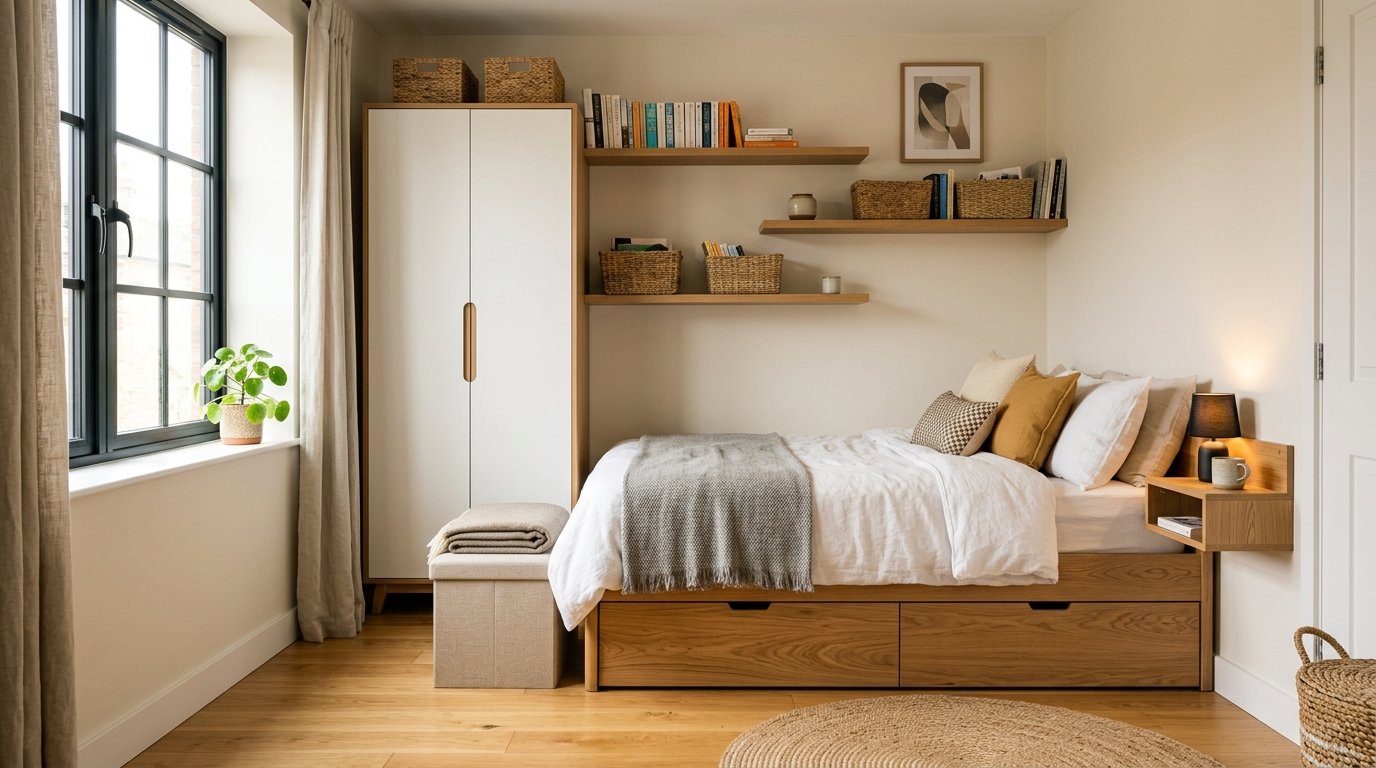
18 Small Bedroom Storage Ideas That Actually Work in Tight Space
A small bedroom fills up fast. One dresser, one nightstand, a stray pile of shoes by the door, and suddenly there’s no floor left to walk on. The usual advice — “just declutter” — only goes so far when the room itself doesn’t have enough closet, wall, or floor space to begin with.
This isn’t another list of the same five ideas repeated with new photos. It’s organized by the actual problem you’re solving: no closet, low bed clearance, a room you share, or walls you can’t drill into as a renter. Skim the section that matches your situation, or read straight through if you’re starting from scratch. You won’t need every idea here — most small bedrooms only need three or four of these done well.
Measure Before You Buy Under-Bed Storage
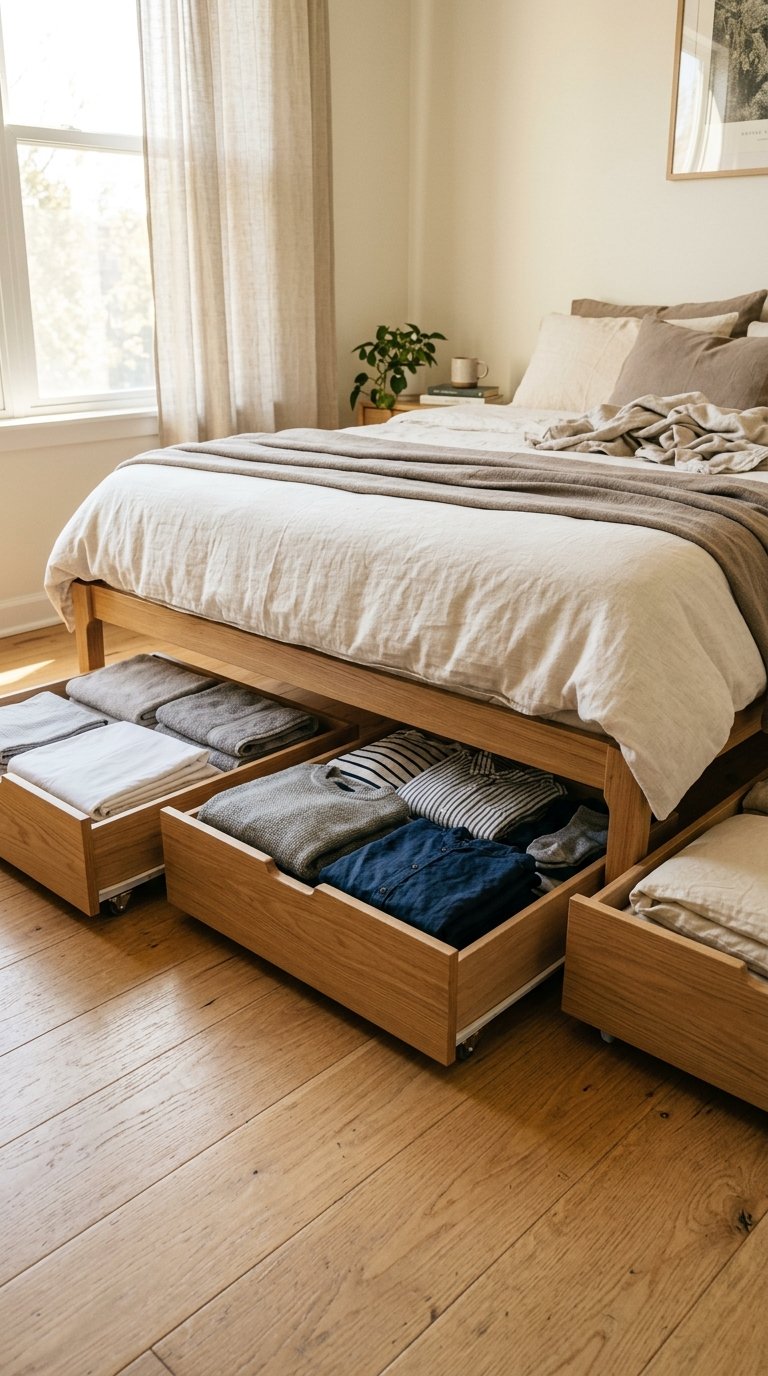
Under-bed storage gets recommended constantly, and for good reason — it’s the one stretch of floor space every bedroom already has, and almost nobody uses. But it only works if it actually fits, and that’s where most people get it wrong.
Get down and measure the clearance between your floor and the bottom of your bed frame before you buy anything. Standard bed frames leave anywhere from 4 to 9 inches, and that range determines what you can actually use. Low-profile fabric bins with reinforced sides handle the tightest gaps — under 6 inches — and work well for off-season clothes or extra bedding you don’t need daily access to. If you’ve got 7 inches or more, rolling wooden or plastic drawers make more sense, since you can pull them out fully without scraping the frame.
Clear bins beat opaque ones here, mostly because you won’t remember what’s in a solid black bin three months from now. If you want a cleaner look, go with woven bins in a neutral tone and just label the short ends.
Practical Tip
If your bed sits on a platform with no clearance at all, skip bins entirely and look at bed frames built with drawers already integrated into the base — it solves the problem at the furniture level instead of trying to squeeze storage in after the fact.
A Storage Bed Frame Instead of Bins
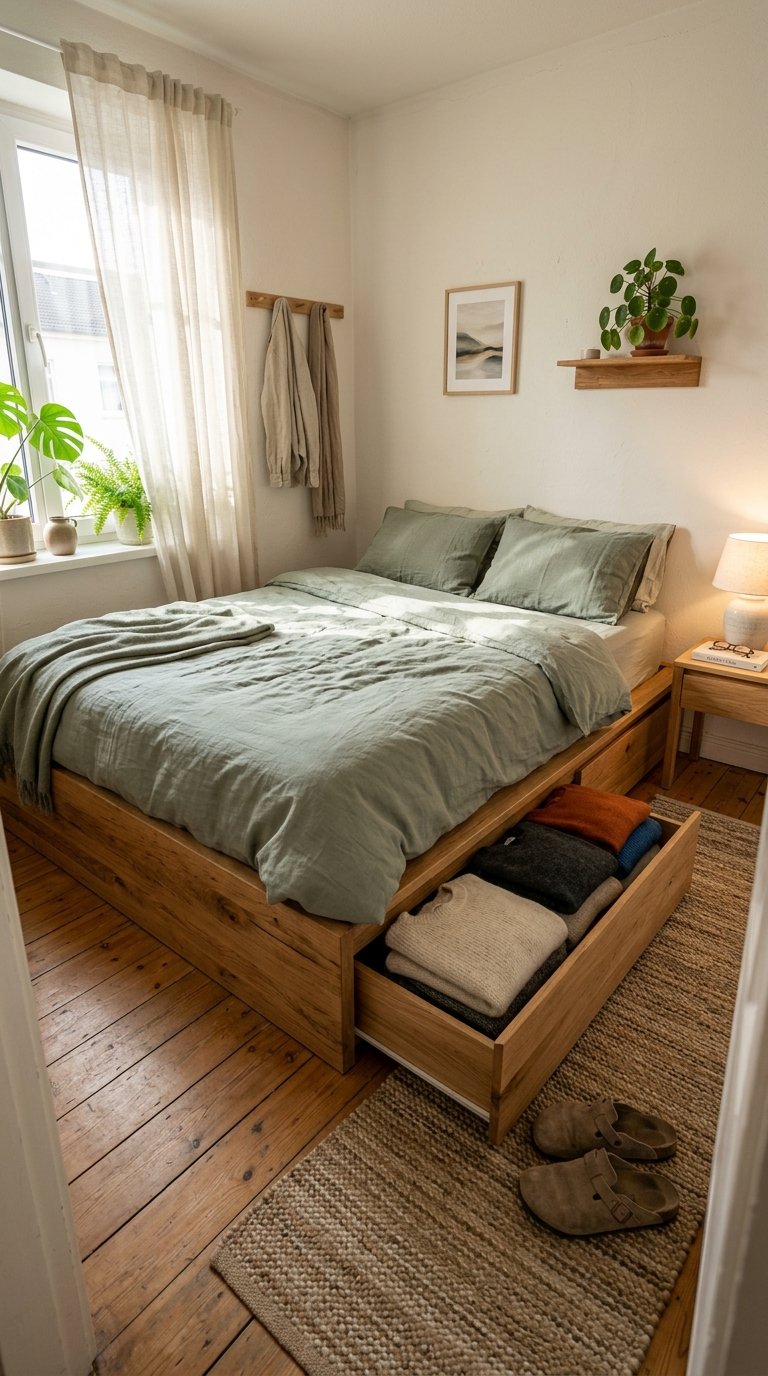
If you’re furnishing the room from scratch, a storage bed frame solves the clearance problem before it starts. These frames build drawers or a lift-up base directly into the structure, so you get a full-depth storage compartment instead of working around whatever gap happens to exist.
Drawer-style frames (drawers built into the sides) suit rooms where you need frequent access — daily clothes, shoes, linens you swap often. Lift-up/ottoman-style frames, where the entire mattress platform hinges up, hold more volume but are better for things you grab less often, since you have to clear the bed to get in.
The trade-off is upfront cost and weight — these frames are heavier to move and pricier than a standard frame plus separate bins. But if you’re buying new furniture anyway, it’s the more space-efficient choice than adding storage after the fact.
A Freestanding Wardrobe for Rooms With No Closet
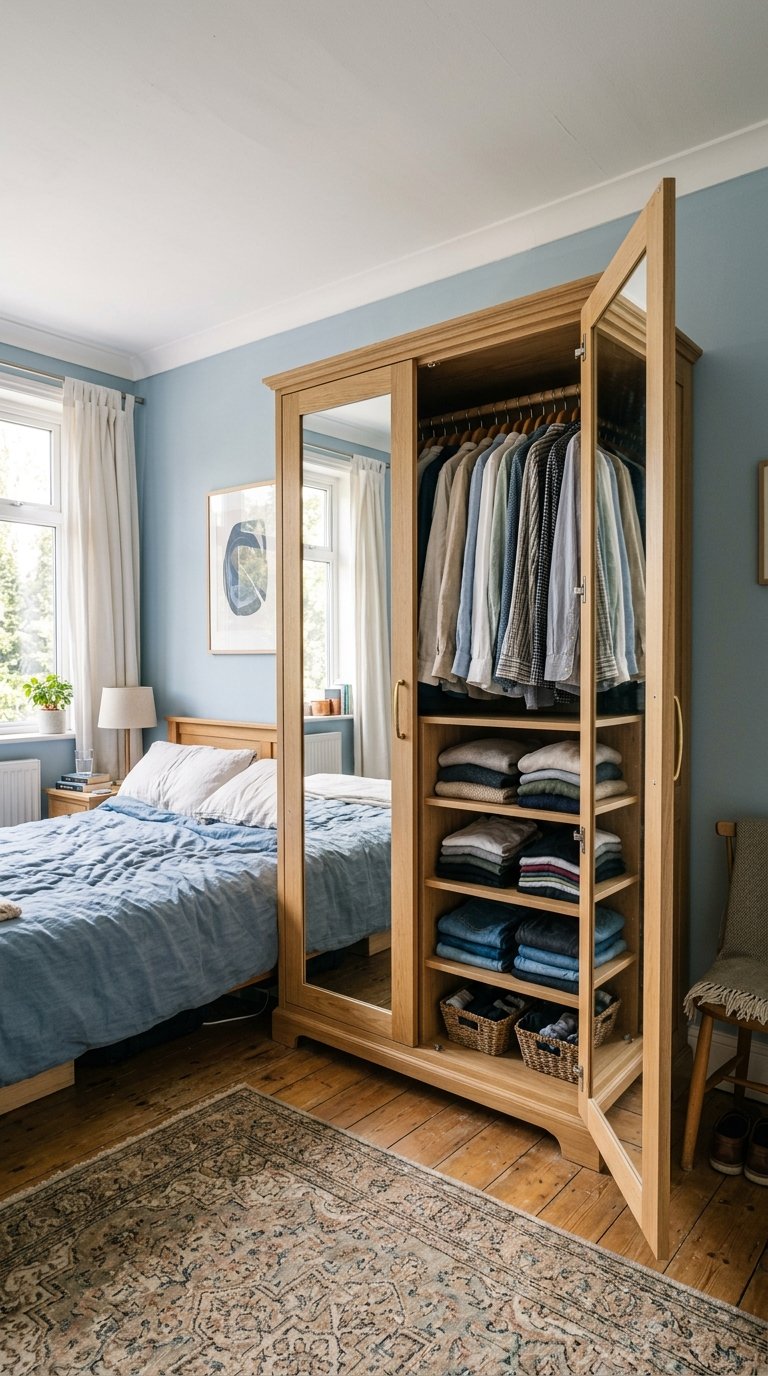
Older homes, converted offices, and studio layouts often skip a closet entirely, which throws off every other storage plan in the room. A freestanding wardrobe or armoire is the direct substitute — it gives you a hanging rod, and usually a shelf or two, in a footprint you control instead of one built into the wall.
Look for a narrow depth (around 20–22 inches) rather than a standard 24-inch closet-style unit; the extra two inches matter more than you’d think in a tight room. Place it against the shortest wall if possible, so it doesn’t interrupt your main walking path. A wardrobe with a mirrored front does double duty — hanging storage plus something a small room genuinely needs, which is a full-length mirror that doesn’t eat wall space on its own.
The downside is visual weight. A tall, solid wardrobe in a small room can feel like a wall if the finish is dark or the piece is oversized for the room. Lighter wood tones or a two-tone finish (light body, darker doors) keep it from dominating.
An Open Hanging Rack Hidden Behind a Curtain
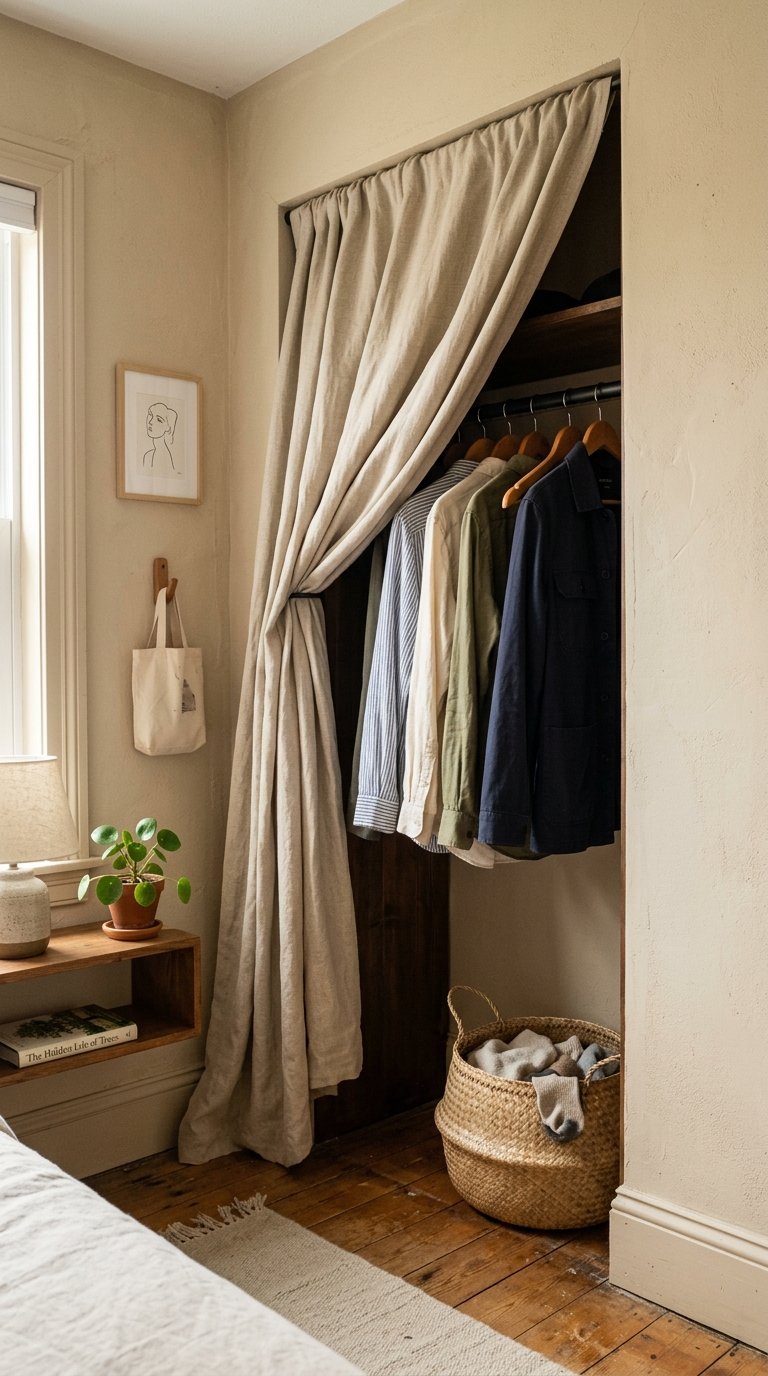
A wardrobe isn’t always the right call — sometimes there’s no floor space for one, or the budget doesn’t stretch that far. An open hanging rack solves the same no-closet problem in a fraction of the footprint, and a curtain in front of it hides the visual clutter that comes with exposed clothing.
Mount the rack into a corner or an alcove if the room has one; even a shallow 12-inch-deep nook fits a rod and hanging clothes. Run a tension rod or a simple curtain track along the front, and choose a fabric close to your wall color so the whole setup reads as a built-in rather than an obvious workaround. This is one of the few small bedroom storage ideas that costs under fifty dollars and can come down entirely if you move.
One real limitation: open racks hold less than a full wardrobe, since there’s no shelf space for folded items. Pair it with a floating shelf above the rod for that.
A Desk That Doubles as a Nightstand
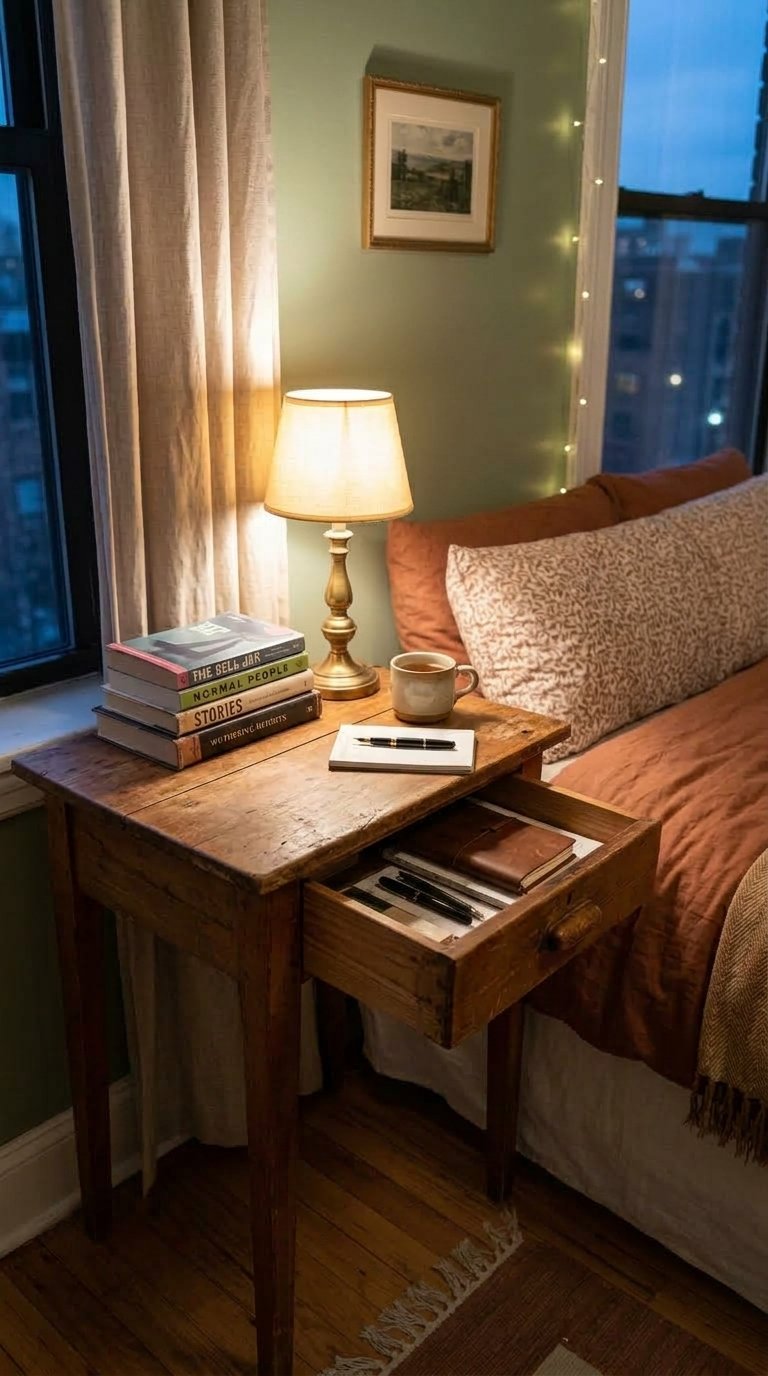
Multi-functional furniture gets recommended so often it’s become a meaningless phrase — “buy furniture that does two things” doesn’t tell you what to actually buy. Here’s one specific, workable version: a narrow writing desk positioned beside the bed, used as both a workspace and a nightstand.
This works best when the desk sits at roughly the same height as your mattress, give or take a few inches, so a lamp and a glass of water are still within reach at night. Choose one with at least one drawer — that’s where the nightstand function actually lives, holding chargers, glasses, or whatever usually clutters a bedside surface. During the day, it’s a real desk with legroom, not a decorative shelf pretending to be one.
It suits rooms where a home office and a bedroom are forced to share space, which is common in studio apartments and one-bedroom setups where a second desk area simply doesn’t exist.
A Storage Ottoman at the Foot of the Bed
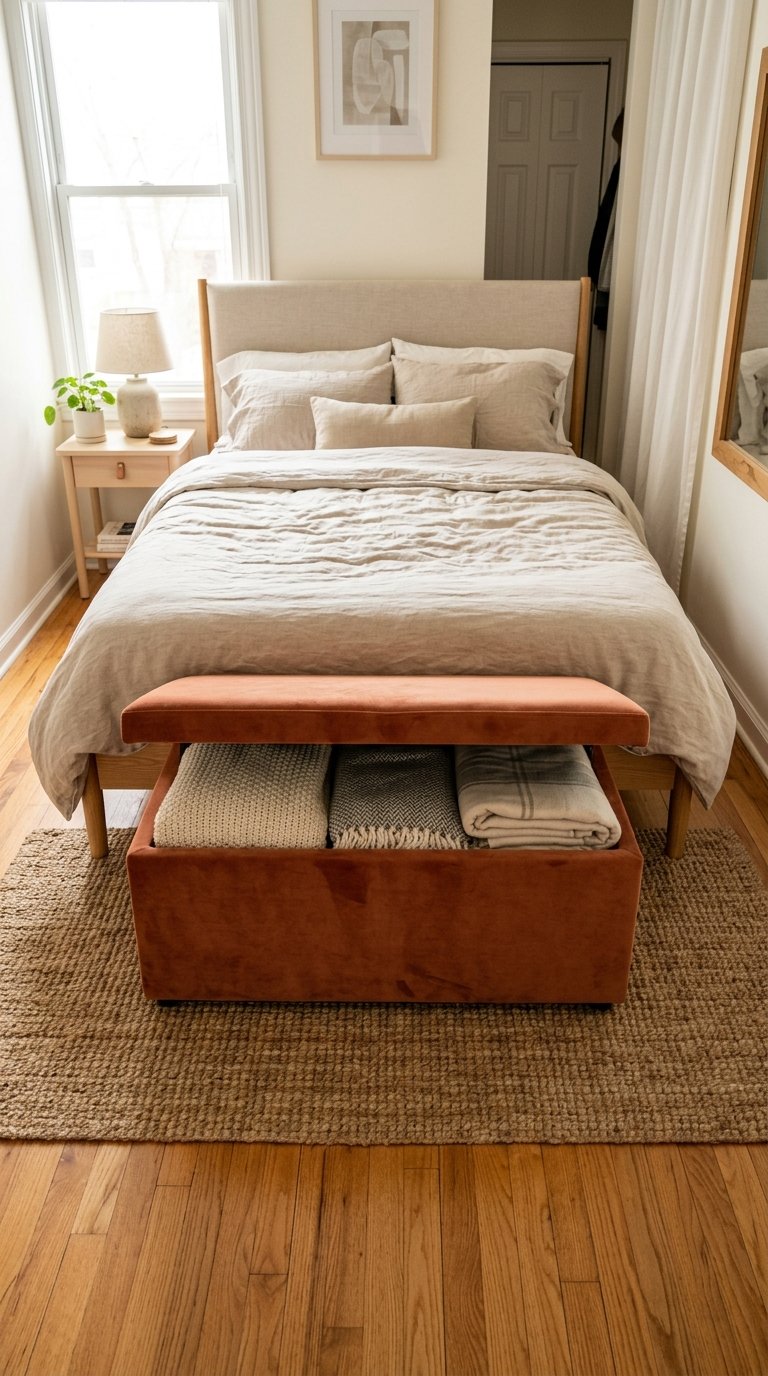
A storage ottoman or bench solves a specific problem: where do extra blankets, out-of-season pillows, or shoes go when there’s no linen closet nearby?. Placed at the foot of the bed, it also gives you a spot to sit while getting dressed — something small bedrooms rarely have room for otherwise.
Size matters more here than with almost any other piece on this list. In a tight room, keep the bench under 16 inches deep and leave at least 24 inches of walkway between it and the door or dresser — anything tighter turns it into an obstacle instead of a feature. A lift-top lid is more practical than a removable one, since you won’t have to find somewhere to set the lid down every time you open it.
Upholstered versions in a performance fabric handle daily use better than velvet or linen, which show wear faster at a pressure point like this.
Floating Shelves With Staggered Depth
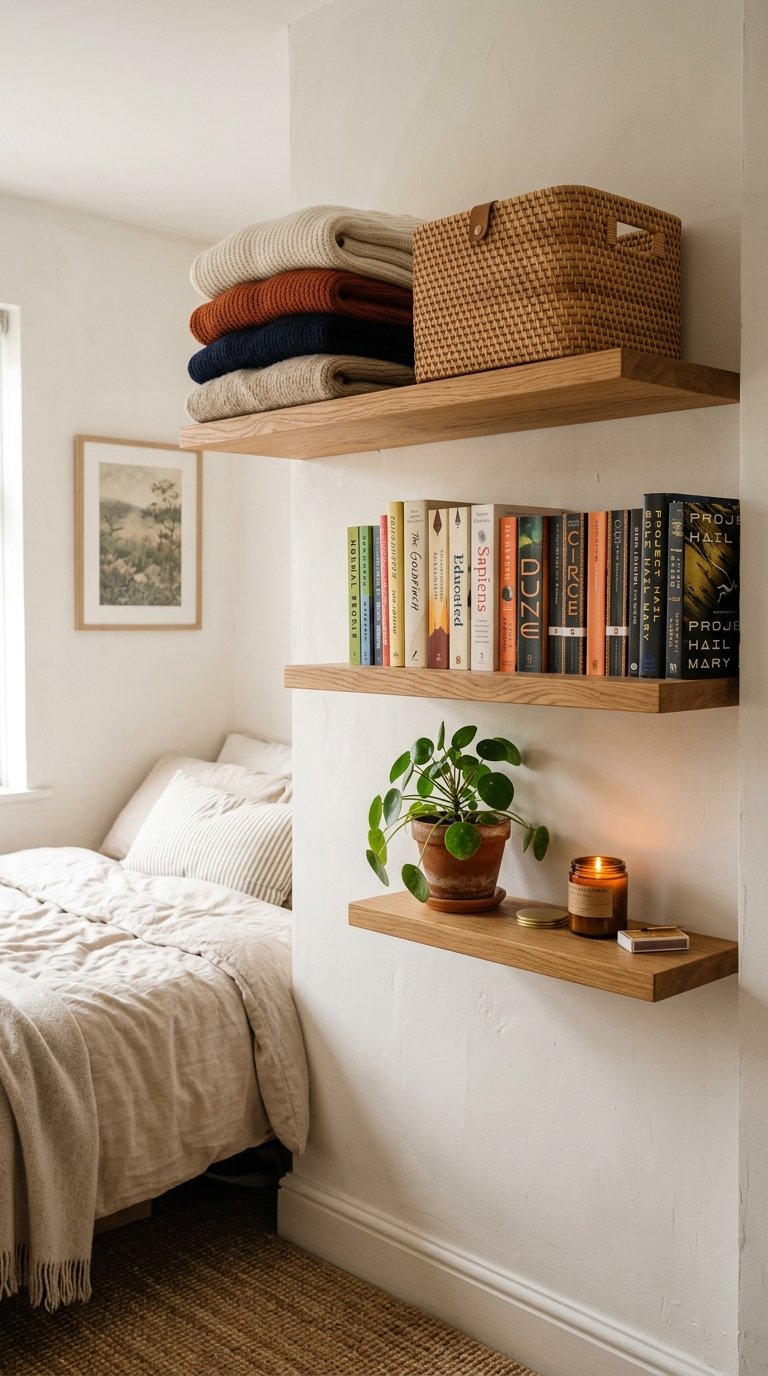
“Add floating shelves” is close to useless as advice on its own, because the depth and spacing decide whether the result looks intentional or just crowded. The fix is staggering shelf depths instead of installing three identical ones in a row.
A 10-inch shelf holds bulkier items — a stack of folded sweaters, a small basket, a row of larger books. An 8-inch shelf below or beside it works for standard paperbacks and framed photos. A 6-inch shelf is for the smaller stuff — candles, a plant, a single vase — that would look lost on anything deeper. Mixing these depths on the same wall reads as styled rather than stacked, and it also means each shelf is actually the right size for what’s sitting on it, instead of everything getting crammed onto matching shelves that don’t quite fit.
Mount into wall studs wherever possible, especially for the deeper shelf — a 10-inch shelf loaded with books is heavier than it looks, and anchors alone won’t always hold that weight long-term.
An Over-the-Door Organizer for the Small Stuff
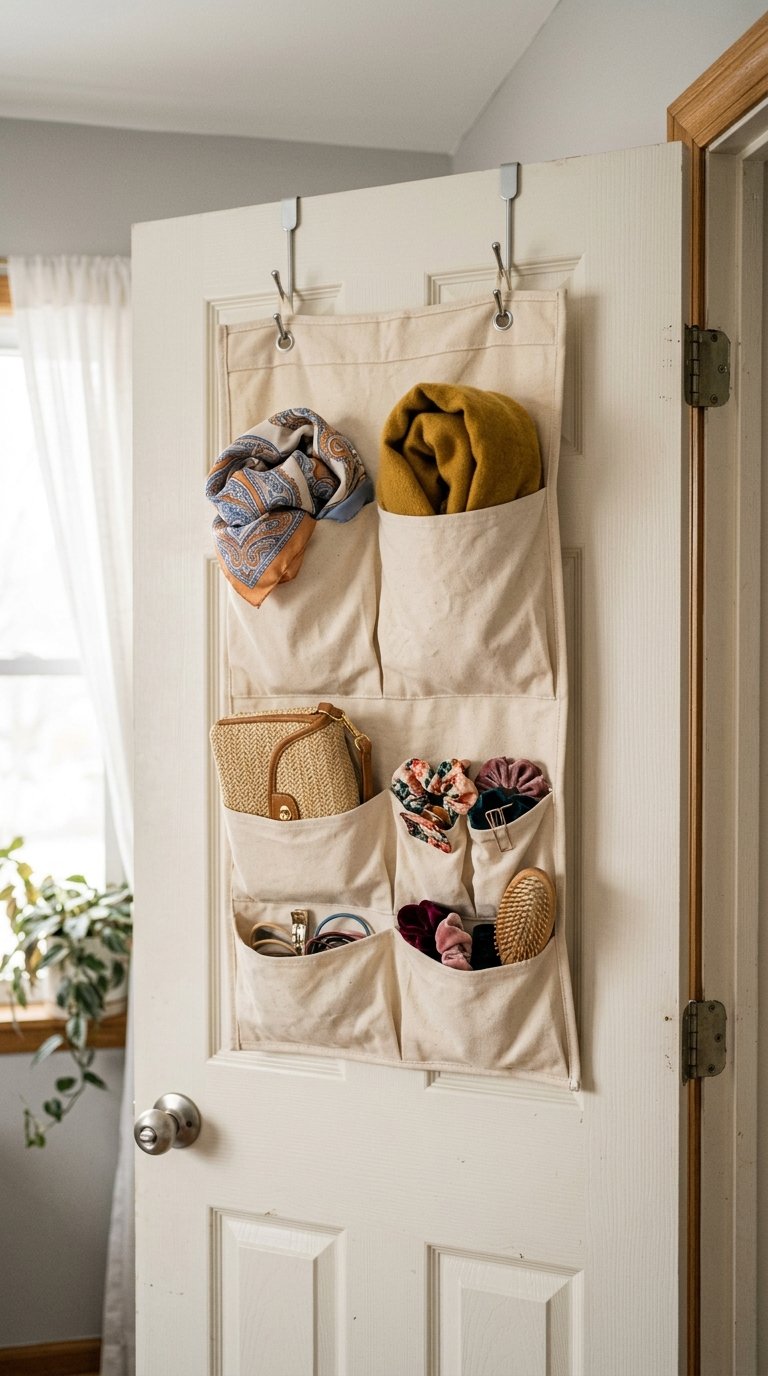
Every bedroom door represents wasted vertical space, and an over-the-door organizer is the fastest way to reclaim it without touching a wall. It’s especially useful for the category of belongings that don’t have an obvious home — jewelry, hair accessories, phone chargers, folded scarves — the small items that otherwise end up scattered across a dresser top.
Fabric pocket organizers work well for anything you want visible and easy to grab. A hook-based version suits bulkier items like bags, robes, or a hanging mirror. Either style installs over a standard door in minutes with no drilling, which makes this one of the more renter-friendly options here.
The one thing to watch for: an organizer on the back of a bedroom door is only useful if the door actually opens fully against a wall. If your door swings into a tight space, the organizer becomes something you have to squeeze past.
Corner Storage for the Space Everyone Skips
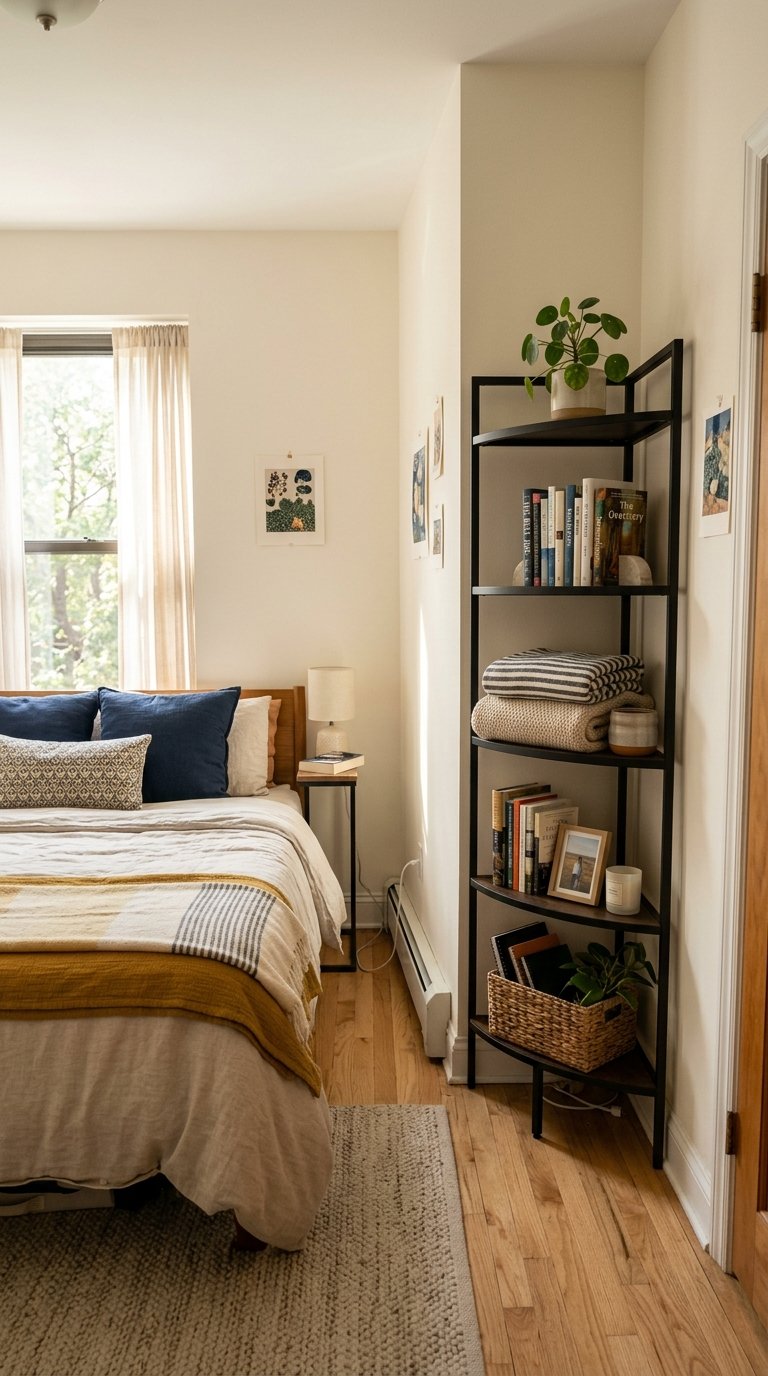
Corners are the most consistently wasted space in a small bedroom, mostly because standard furniture is built for straight walls, not angles. A corner shelf unit — either floating triangular shelves or a slim corner bookcase — claims square footage that would otherwise sit empty.
This works particularly well behind a door, beside a window, or in the corner diagonally opposite the bed, where a normal dresser or nightstand wouldn’t fit anyway. A tall, narrow corner unit (five or six shelves stacked vertically) holds a surprising amount without ever intruding on your walking space, since the footprint stays small even as the height increases.
Keep the styling loose here rather than packing every shelf edge to edge — a corner unit filled solid from top to bottom starts to look like storage overflow instead of a considered part of the room.
Renter-Friendly Storage That Leaves No Damage
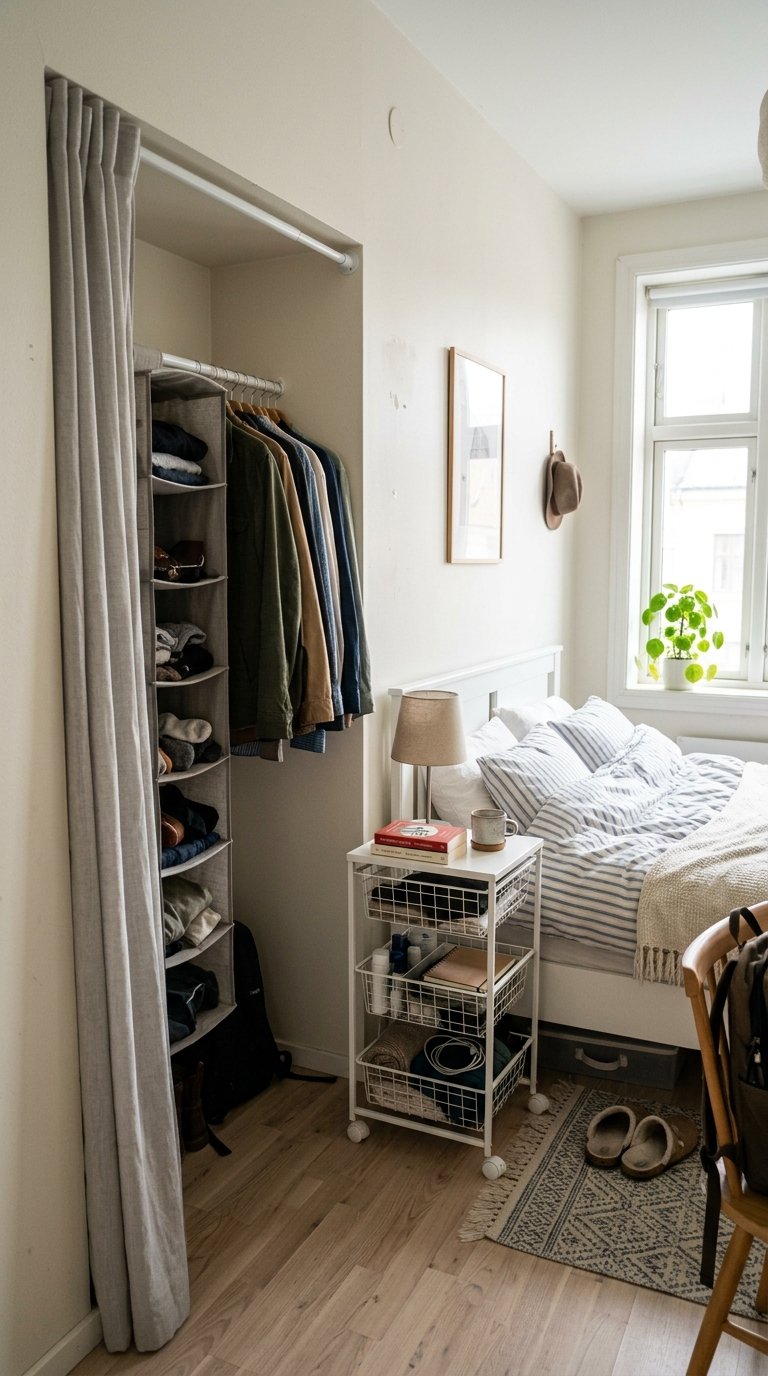
If you’re renting, half the ideas typically recommended for small bedrooms — built-ins, mounted shelving, anything that needs a drill — are off the table. But there are real alternatives that don’t risk a security deposit.
Command-strip hooks and shelf brackets rated for at least 5–7 pounds handle lightweight storage like a small basket, a bag, or a lightweight mirror; check the weight rating on the packaging before you hang anything, since exceeding it is the most common reason these fail. Tension rods work inside closets or alcoves without a single screw, and they’re strong enough to hold a curtain, a hanging organizer, or even light clothing if you brace them properly. Freestanding furniture — anything on this list that doesn’t require wall mounting, like a wardrobe, an ottoman, or a rolling cart — sidesteps the issue entirely, since it moves with you.
The trade-off is capacity. No-drill solutions generally hold less weight than anything anchored into a stud, so reserve wall-mounted, no-drill options for lighter, everyday items rather than heavy storage.
Zoned Storage for a Shared Small Bedroom
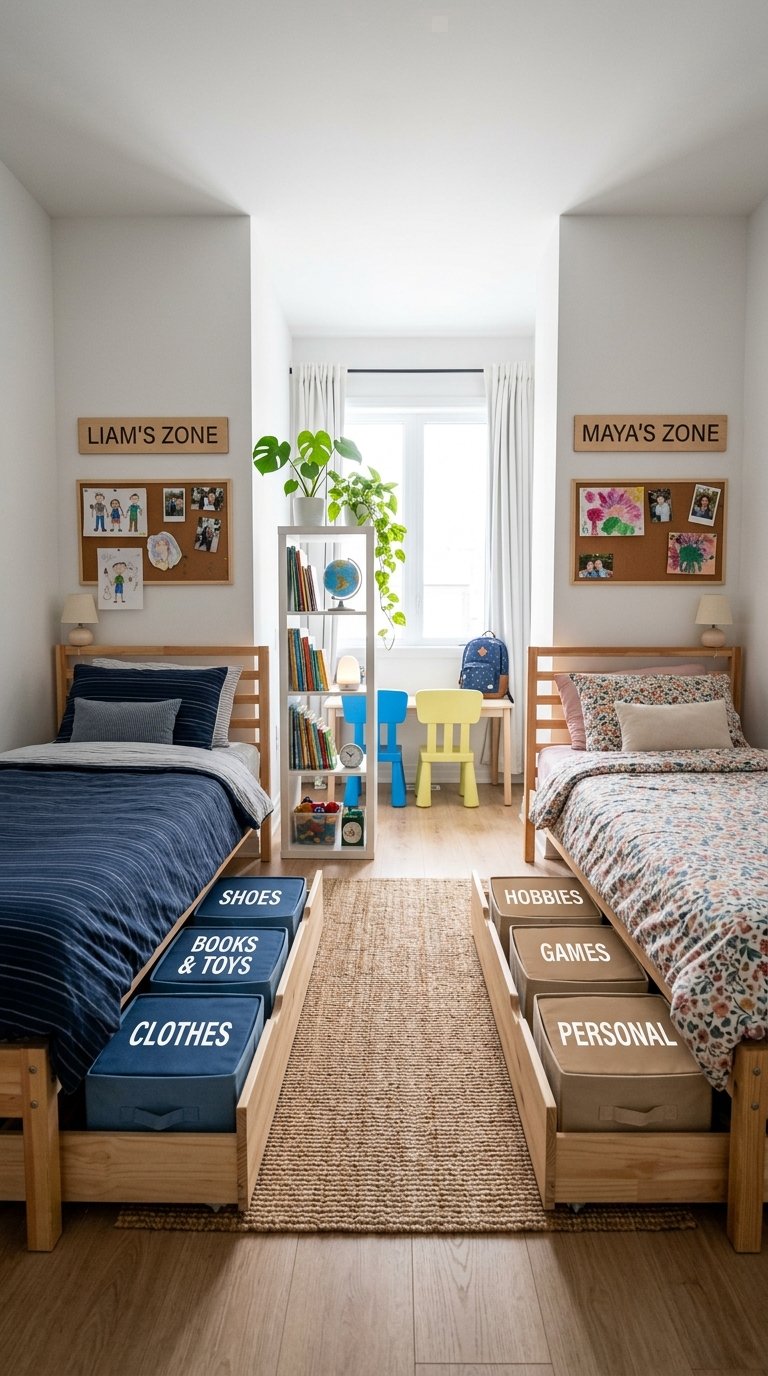
A shared small bedroom multiplies every storage problem, since two people’s belongings compete for the same limited space — and without a clear system, it’s usually one person’s stuff that quietly takes over.
The fix that actually holds up over time is zoning: each person gets a defined vertical column of space — one side of the closet, one stack of shelves, one under-bed section — rather than storage being communal and unlabeled. Color-coded or labeled bins make this obvious at a glance, which matters most in kids’ shared rooms but works just as well for two adults splitting a small guest room or studio. A room divider, even a simple curtain track down the middle, can reinforce the boundary without requiring a full wall.
Bunk beds free up meaningful floor space in a shared room, but they only help if the freed-up floor is actually used for storage — a dresser or shelving unit — rather than left empty out of habit.
A Headboard Built for Storage
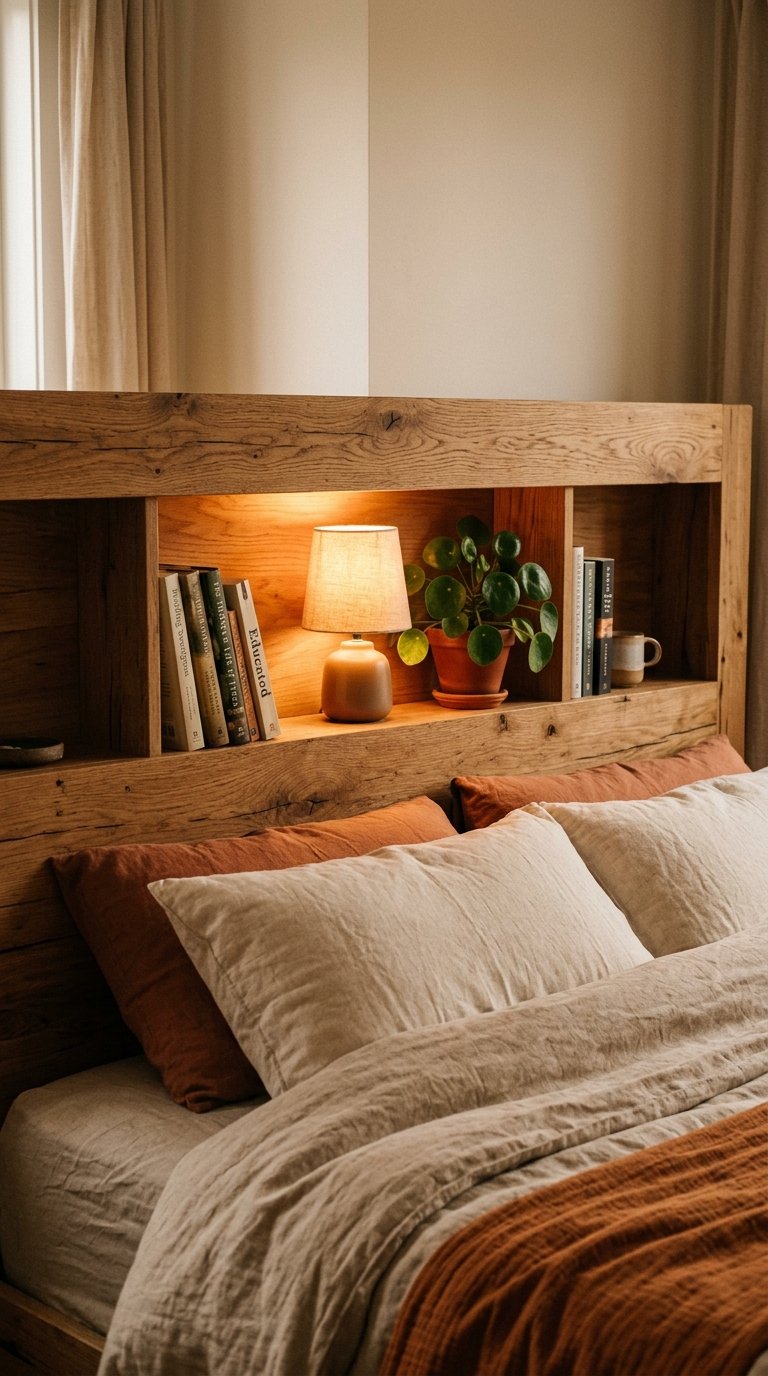
A headboard with built-in shelving or cubbies replaces two problems at once: the empty wall space above the bed, and the lack of a nightstand surface in a room too tight for a full one. Instead of adding furniture beside the bed, the storage moves into the headboard itself.
Look for shallow cubbies (4–6 inches deep) rather than deep shelving — anything deeper starts to feel like a bookcase leaning over the mattress, which can make the sleeping area feel enclosed. A headboard with a built-in reading light solves another small-bedroom problem in the same piece: no room for a separate lamp.
This only works in bedrooms with enough clearance above the bed frame, so measure the wall space between your mattress top and the ceiling before assuming a tall storage headboard will fit comfortably.
A Ladder Shelf for the Wall Above the Door
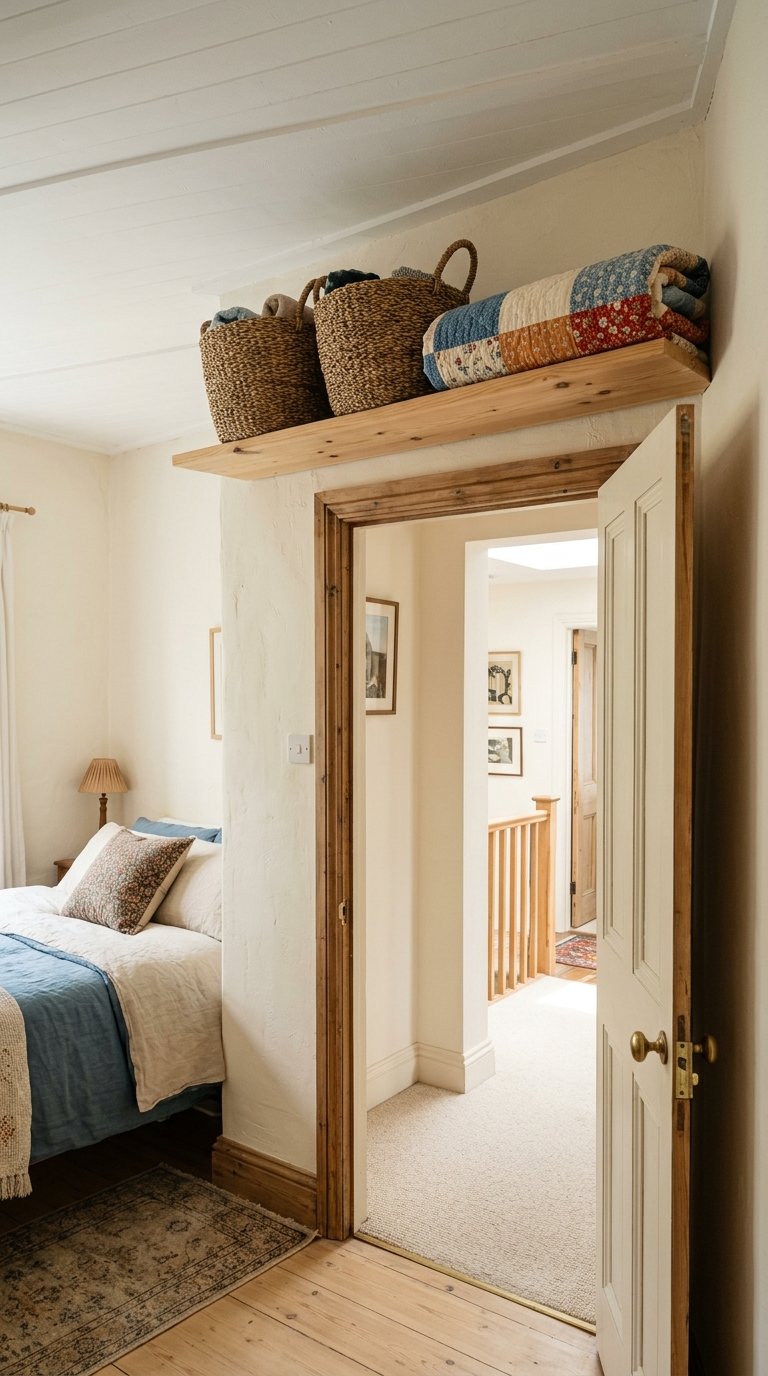
The wall space above a bedroom door is almost always empty, and it’s tall enough to hold real storage if you use the right piece. A ladder-style leaning shelf, or a slim floating shelf installed just above the door frame, claims that height without needing floor space at all.
This spot suits items you don’t need daily — spare blankets, decorative boxes, a rarely-used bag — since reaching it usually means standing on something. A shallow basket on the shelf keeps loose items from looking messy up there, since anything visible at that height draws the eye more than you’d expect in a small room.
Skip this one in rooms with lower ceilings, where storage above the door starts to feel like it’s pressing down on the room rather than adding to it.
Drawer and Shelf Dividers Inside What You Already Have
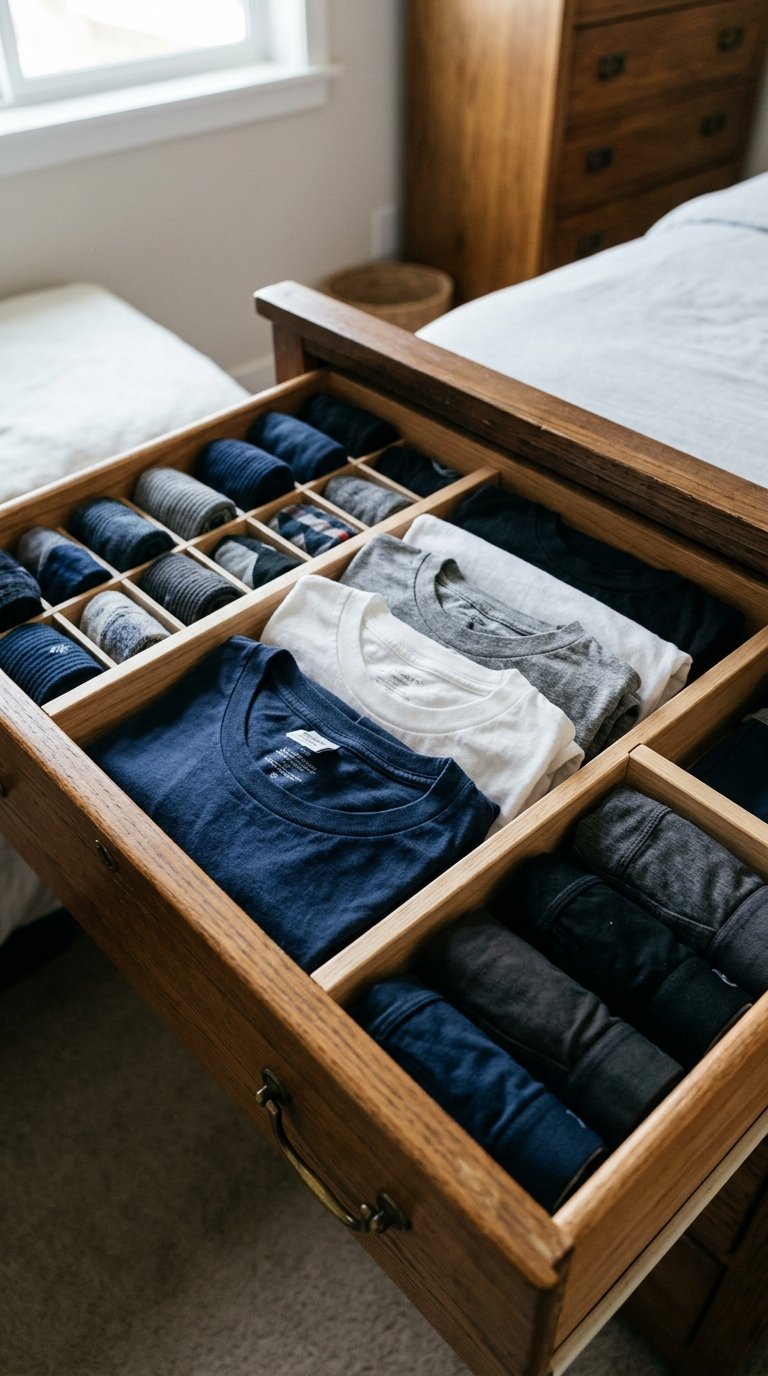
Not every storage fix requires new furniture. Sometimes the dresser or closet shelving already in the room has enough capacity — it’s just disorganized enough that it feels full when it isn’t. Drawer dividers and shelf dividers solve this without adding a single new piece of furniture to a room that doesn’t have space for one.
Adjustable drawer dividers split a single deep drawer into two or three defined sections, so folded shirts stop sliding into the sock pile the moment you open it. Acrylic shelf dividers do the same job on closet shelving, keeping stacked sweaters upright instead of toppling sideways every time you pull one out from the middle.
This is the lowest-cost idea on this list, and often the one with the biggest immediate impact, since it makes existing storage function properly instead of trying to add more of it.
A Window Seat With Storage Underneath
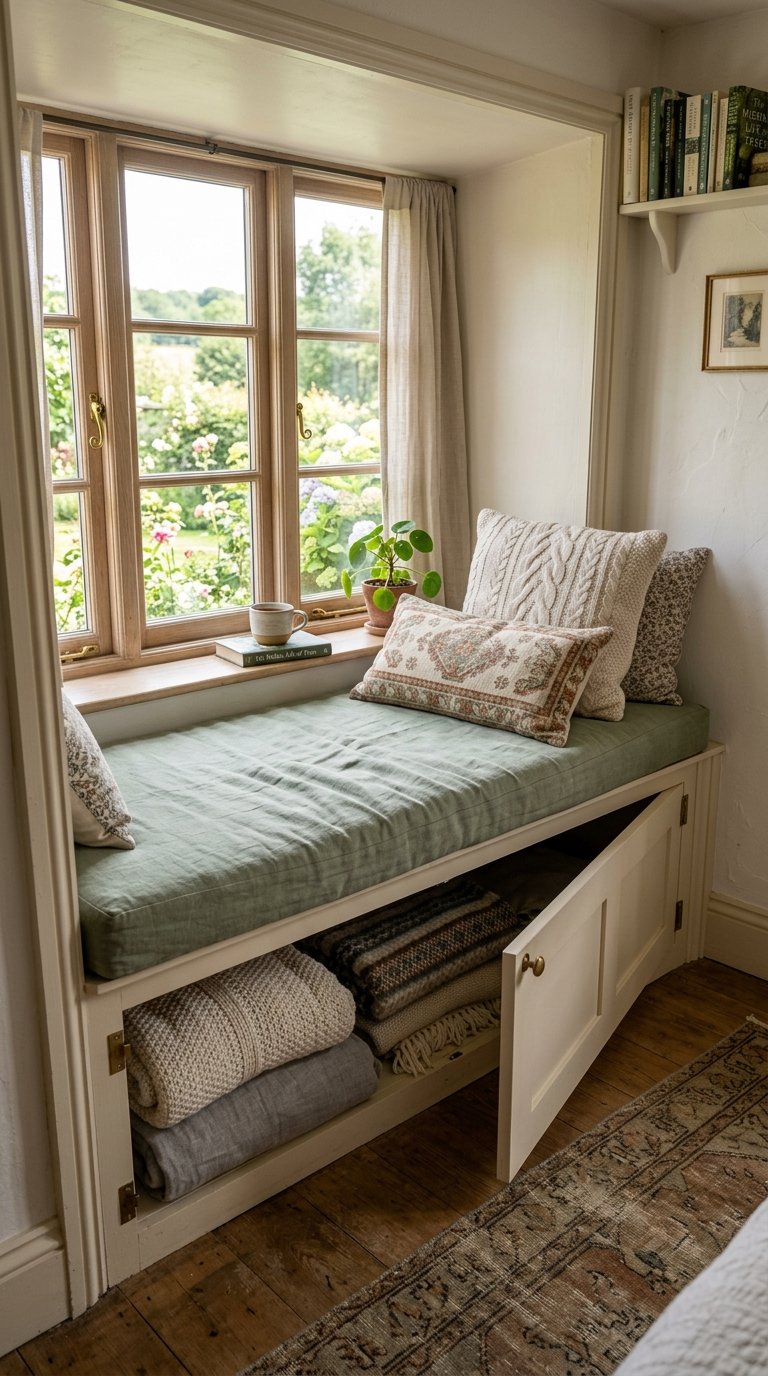
If your small bedroom has a window with a deep enough sill or a built-out alcove, a window seat turns an awkward architectural feature into genuine storage capacity — and a place to sit, which most small bedrooms lack entirely.
The bench base can be built or bought with a lift-top lid, functioning almost exactly like a storage ottoman but fixed in place and framed by the window itself. This suits rooms where floor space is too tight for a freestanding bench but where a window recess already creates a natural, otherwise-unused nook. Add a cushion and a couple of pillows, and the same spot that used to hold nothing now handles both seating and storage for linens or off-season clothing.
This only works with the right window architecture — a standard flush window with no depth won’t support it without construction, so it suits older homes or rooms with a genuine recess more than a typical modern apartment.
A Wall-Mounted Vanity for Getting Ready
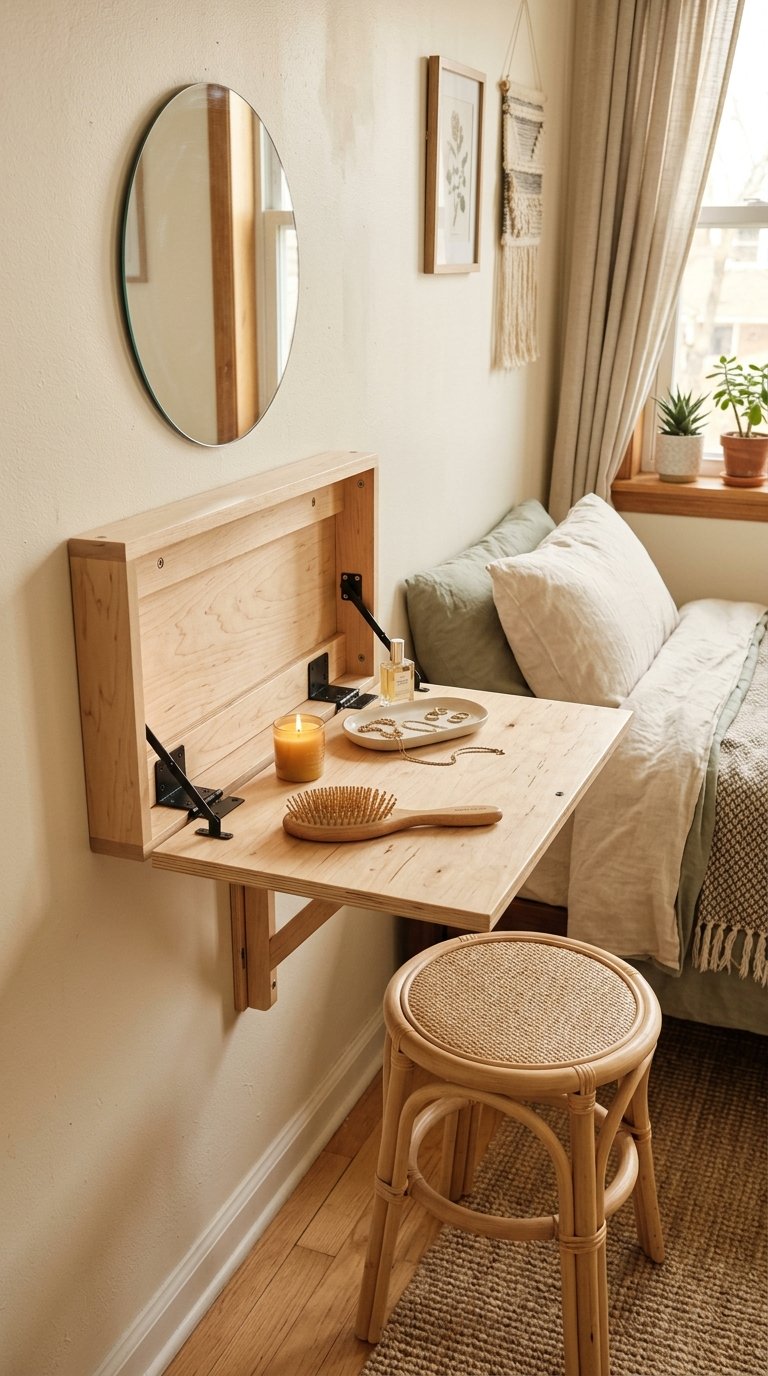
A small bedroom rarely has room for a full dressing table, but getting ready still needs somewhere to happen — a mirror, a spot for jewelry, a surface for a hairdryer. A wall-mounted, fold-down or floating vanity solves this without a floor footprint.
A slim floating shelf with a mirror above it handles the basics. A fold-down vanity — a hinged surface that lies flat against the wall when not in use — works even better in genuinely tight rooms, since it disappears entirely outside of the ten minutes a day you actually need it. Add a small stool that slides fully underneath when not in use, rather than one that has to be moved elsewhere.
This idea suits bedrooms without a shared bathroom counter, or households where morning routines happen in the bedroom out of necessity rather than choice.
Labeled Baskets for Open Shelving
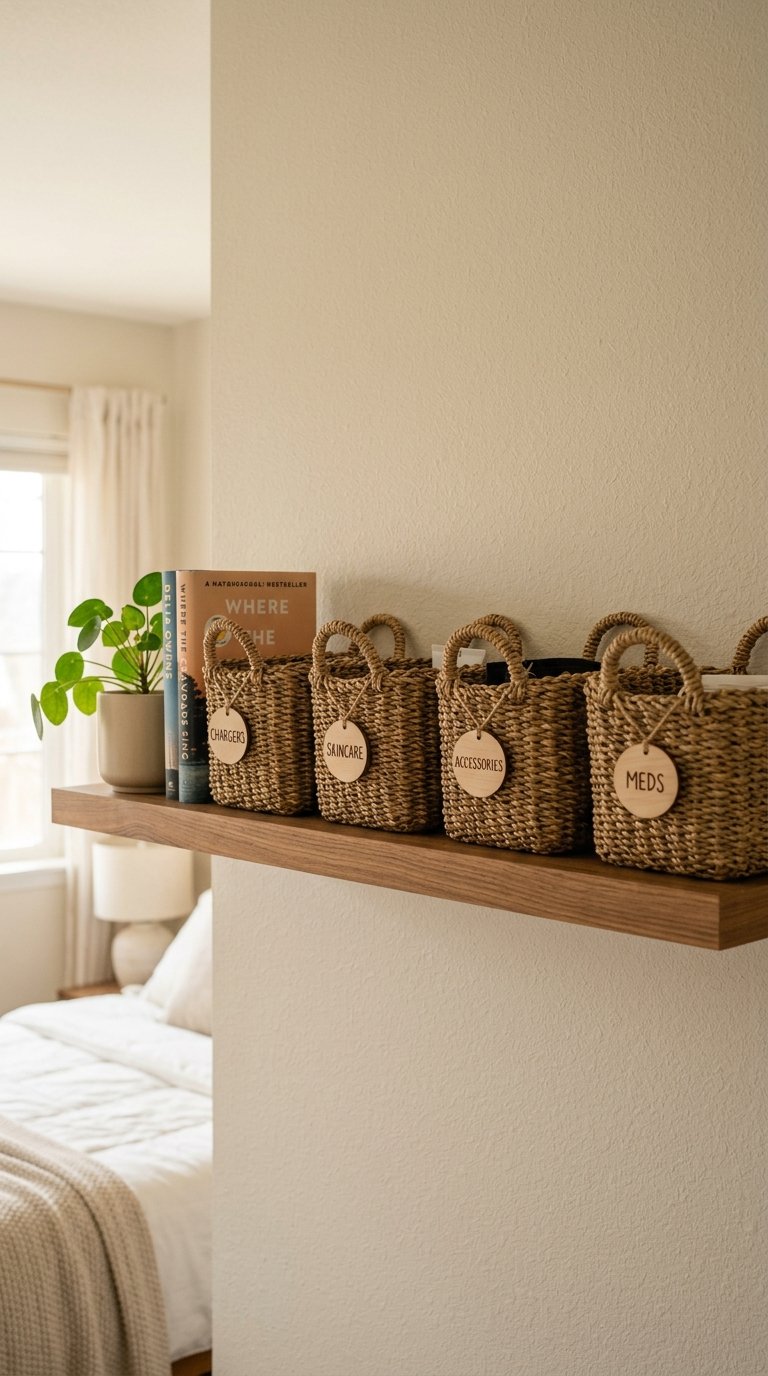
Open shelving looks appealing in every bedroom inspiration photo, but it comes with a real maintenance cost — everything on an open shelf is visible all the time, which means it needs to actually look tidy, not just be technically organized. Labeled baskets are the fix that lets open shelving stay functional without turning into a constant styling project.
Group items by category rather than by size — all hair and skincare in one basket, all miscellaneous cables and chargers in another — so retrieving something doesn’t mean checking three baskets first. A simple tag or a small chalkboard label on the front takes this from “storage bin” to “styled organization,” and it matters more than it sounds like it should, since an unlabeled basket tends to become a catch-all within a few weeks regardless of good intentions.
Woven or linen baskets suit a softer bedroom aesthetic; wire or acrylic baskets suit a more minimal, modern one. Either way, keep the basket sizes consistent across a single shelf — mismatched sizes read as clutter even when the contents inside are perfectly organized.
FAQs
What’s the best storage solution for a small bedroom with no closet?
A freestanding wardrobe is the most direct substitute, since it replicates a closet’s hanging rod and shelving in a footprint you control. If floor space is too tight for a full wardrobe, an open hanging rack behind a curtain uses a fraction of the space for a fraction of the cost.
How do you store clothes in a small bedroom without a dresser?
Under-bed drawers handle folded clothing well once you’ve measured your bed’s clearance, and a hanging rack or wardrobe covers everything that needs to hang. Drawer dividers inside whatever storage you do have make a bigger difference than most people expect, since disorganized existing storage often feels smaller than it actually is.
Can renters add real storage without drilling into walls?
Yes — tension rods, command hooks rated for the weight you’re hanging, and freestanding furniture (wardrobes, ottomans, rolling carts) all add meaningful storage with zero wall damage. Weight-rated command hooks are best reserved for lightweight items rather than anything heavy or frequently used.
How much floor clearance do you need under a bed for storage bins?
Under 6 inches of clearance calls for flat, low-profile fabric bins. Once you have 7 inches or more, rolling wooden or plastic drawers become a practical option, since you can pull them fully open without catching on the frame.
What’s the most space-efficient nightstand alternative?
A narrow desk positioned at roughly mattress height works as both a nightstand and a small workspace, particularly useful in a studio or one-bedroom setup where a separate desk area doesn’t exist. A wall-mounted floating shelf is the lighter-footprint option if you don’t need drawer storage.
How do you organize a shared small bedroom for two people?
Assign each person a clearly defined zone — one side of the closet, one stack of shelves, one section under the bed — rather than leaving storage communal. Color-coded or labeled bins reinforce the boundary at a glance, and a room divider or curtain track can reinforce it physically.
Is a storage bed worth it over a regular bed frame plus bins?
It depends on how often you need access to what’s stored. A storage bed frame holds more volume and looks more finished, but a standard frame with separate bins is usually cheaper and easier to access for items you need daily.
How do you keep vertical storage from making a room feel cluttered?
Stagger shelf depths instead of installing identical shelves in a row, and resist filling every shelf edge to edge. Leaving some visual breathing room between items matters more in a small room than in a larger one, where the eye has more space to rest elsewhere.
Conclusion
Most small bedrooms don’t need all eighteen of these ideas — they need the two or three that solve the specific problem the room actually has. Start with whatever’s causing the most daily friction, whether that’s clothes with nowhere to go, a lack of surface space, or two people sharing a room built for one. Get that piece right, measure carefully before you buy anything, and the rest of the room tends to follow more easily than it looks like it will from where you’re standing now.