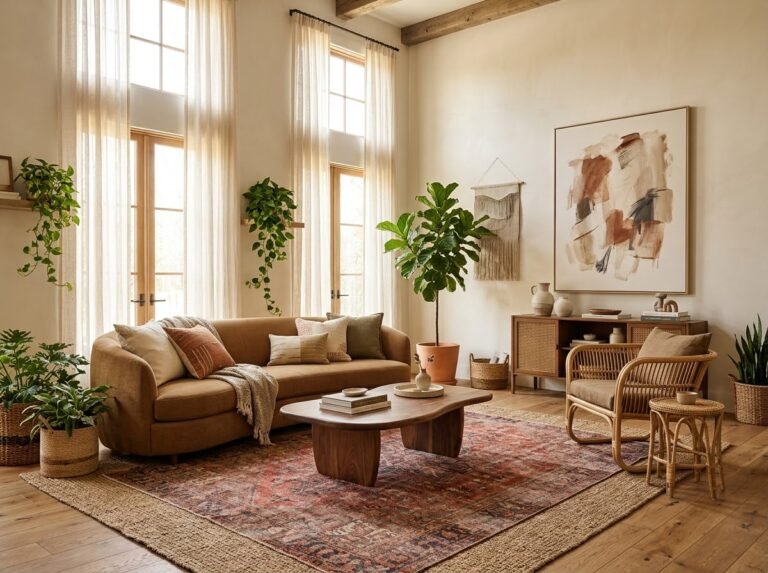
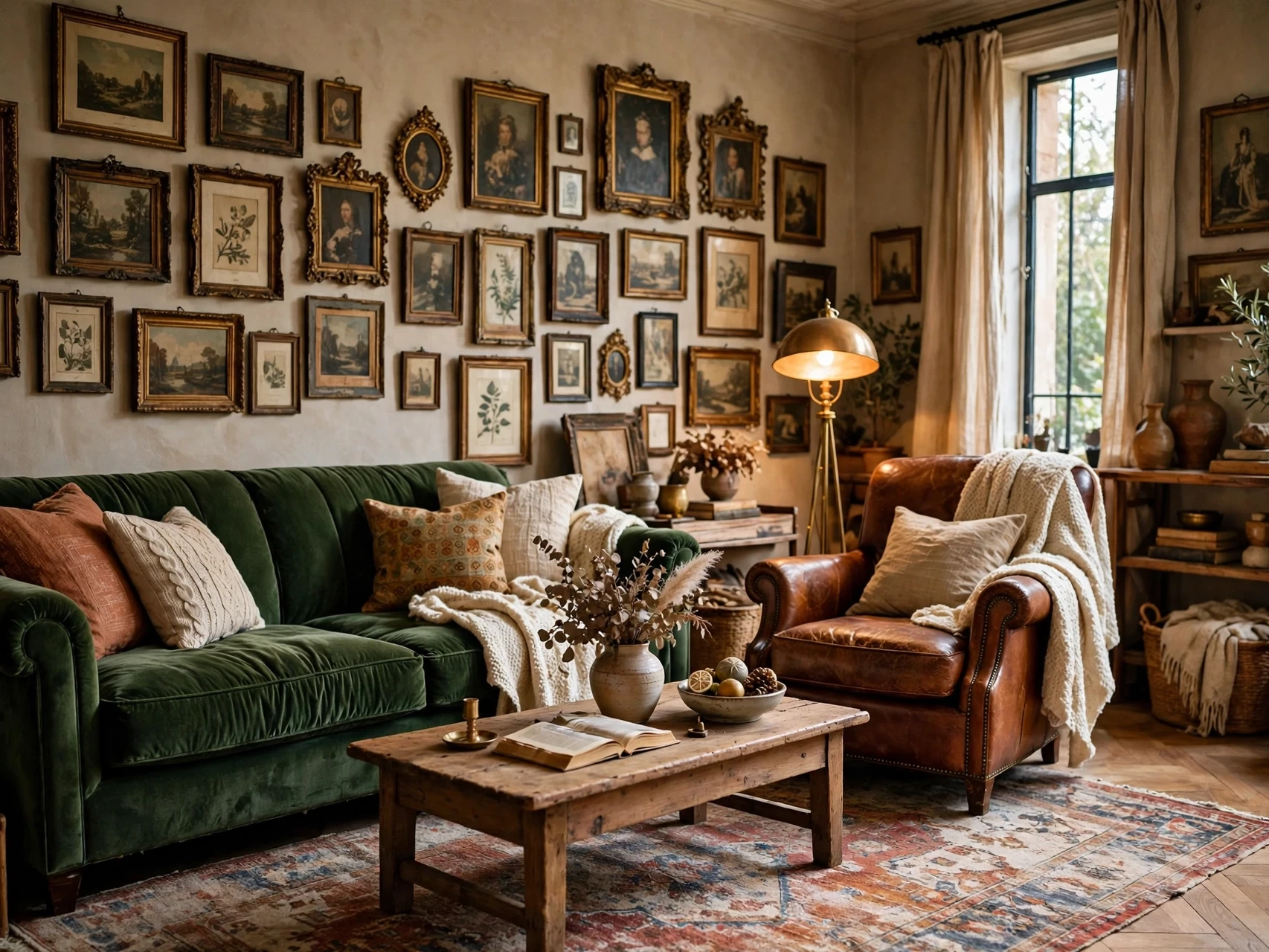
15 Modern Vintage Living Room Decor Ideas for a Warm, Collected Home
Modern vintage living room decor ideas work on one simple tension: old pieces with patina and history sitting beside new pieces with clean lines, held together by a single palette and a few repeated materials. The room should look like it came together slowly, over years of finding things you love, even if you actually put it together in a few weekends. That collected feeling is the whole point, and it comes from restraint, not from buying more.
This article follows the order that actually builds a calm room. It starts with the palette and the big pieces, then moves to walls and light, then to texture and detail, and it ends with the step most galleries skip: the final edit. Each idea solves a real problem, from choosing colors before you spend money to keeping a small room from feeling cramped, so you can borrow one idea or follow the whole build.
Pick your palette first, then your sofa or rug, and let every later choice answer to those anchors. A room built that way rarely goes wrong, because every piece has a reason to be there.
1. Start With Two Anchor Colors and One Metal Finish
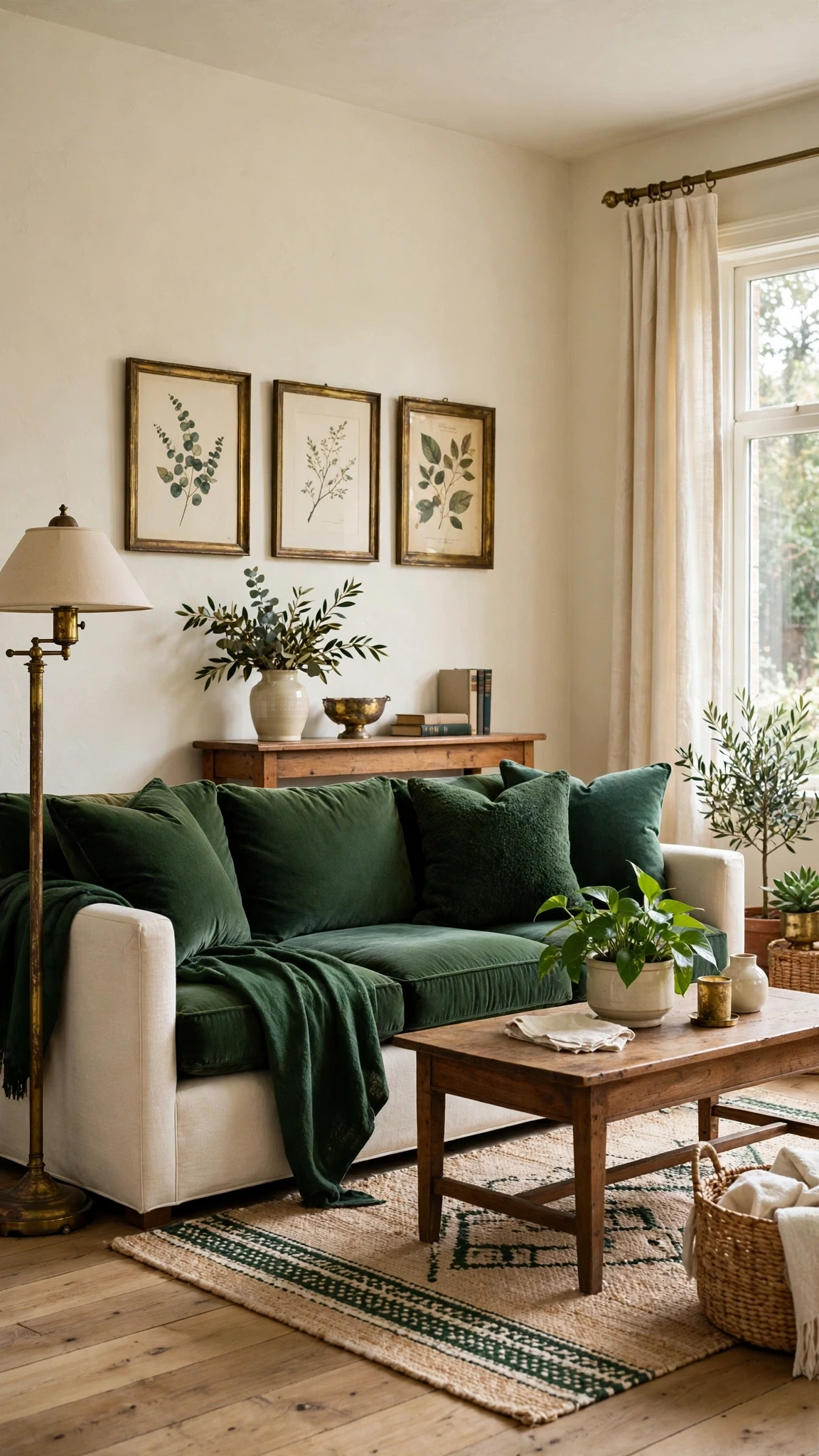
Before you buy a single thing, pick two anchor colors and one metal finish, and let that trio run the room. One warm neutral, like cream, warm gray, or soft oatmeal, keeps the room calm, and one deeper tone, like forest green, burgundy, or navy, gives it weight. Aged brass is the metal that ties old and new together best, because it shows up on both vintage lamps and modern hardware without shouting. When every later purchase has to match those three choices, mixed eras stop looking random and start looking intentional, which is exactly how a collected room earns its calm.
- Anchor colors: One warm neutral plus one deep tone, never three competing colors fighting for attention.
- Metal finish: Aged brass repeated on lamps, frames, and hardware so old and new pieces share a finish.
- Test it first: Hold fabric and paint swatches against your existing furniture in daylight and again in the evening before committing.
- Repeat rule: Each anchor color should appear at least three times in the room, in different spots, so the eye reads it as a plan.
2. A Velvet Sofa as the Room’s Soft Center
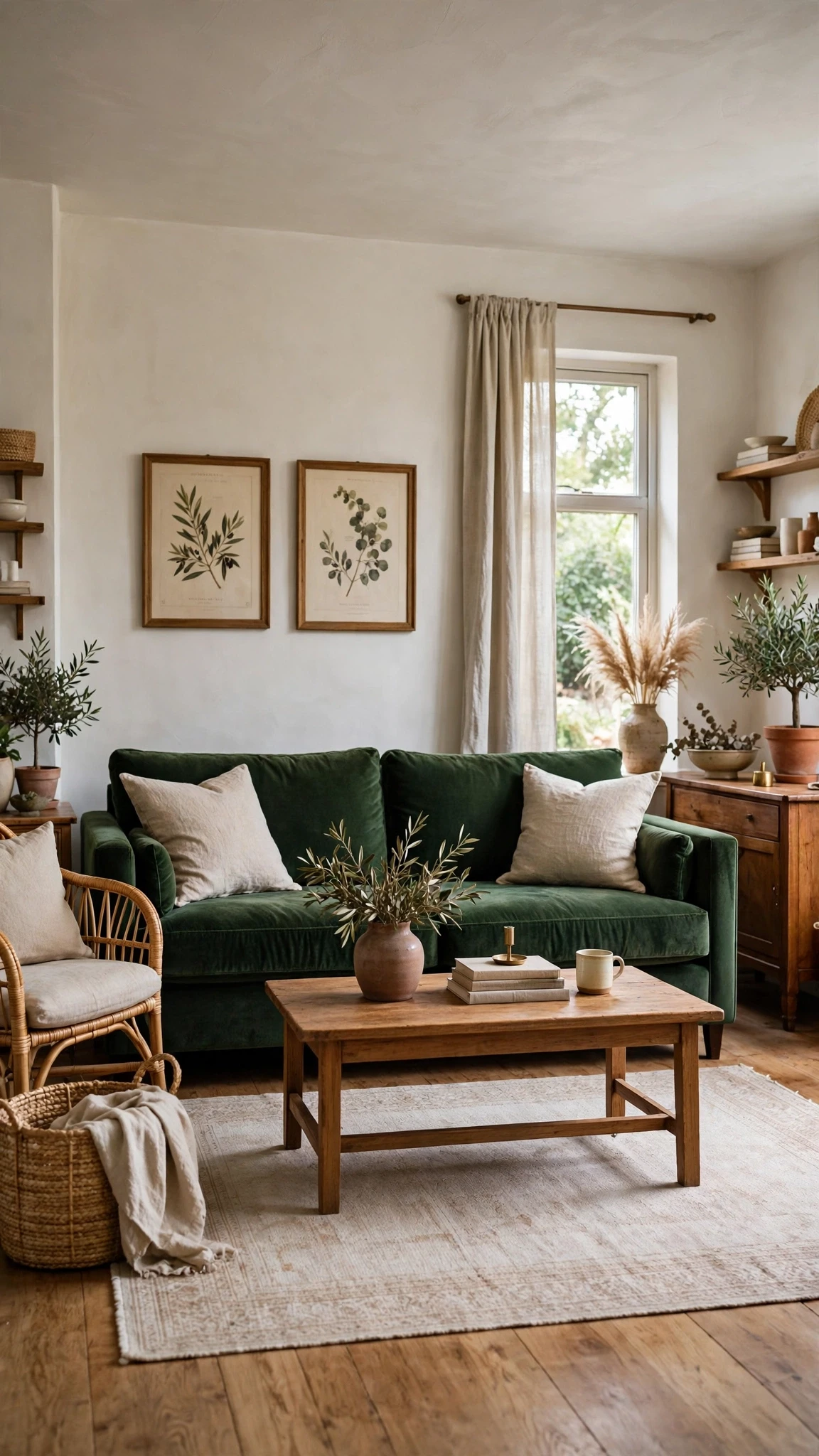
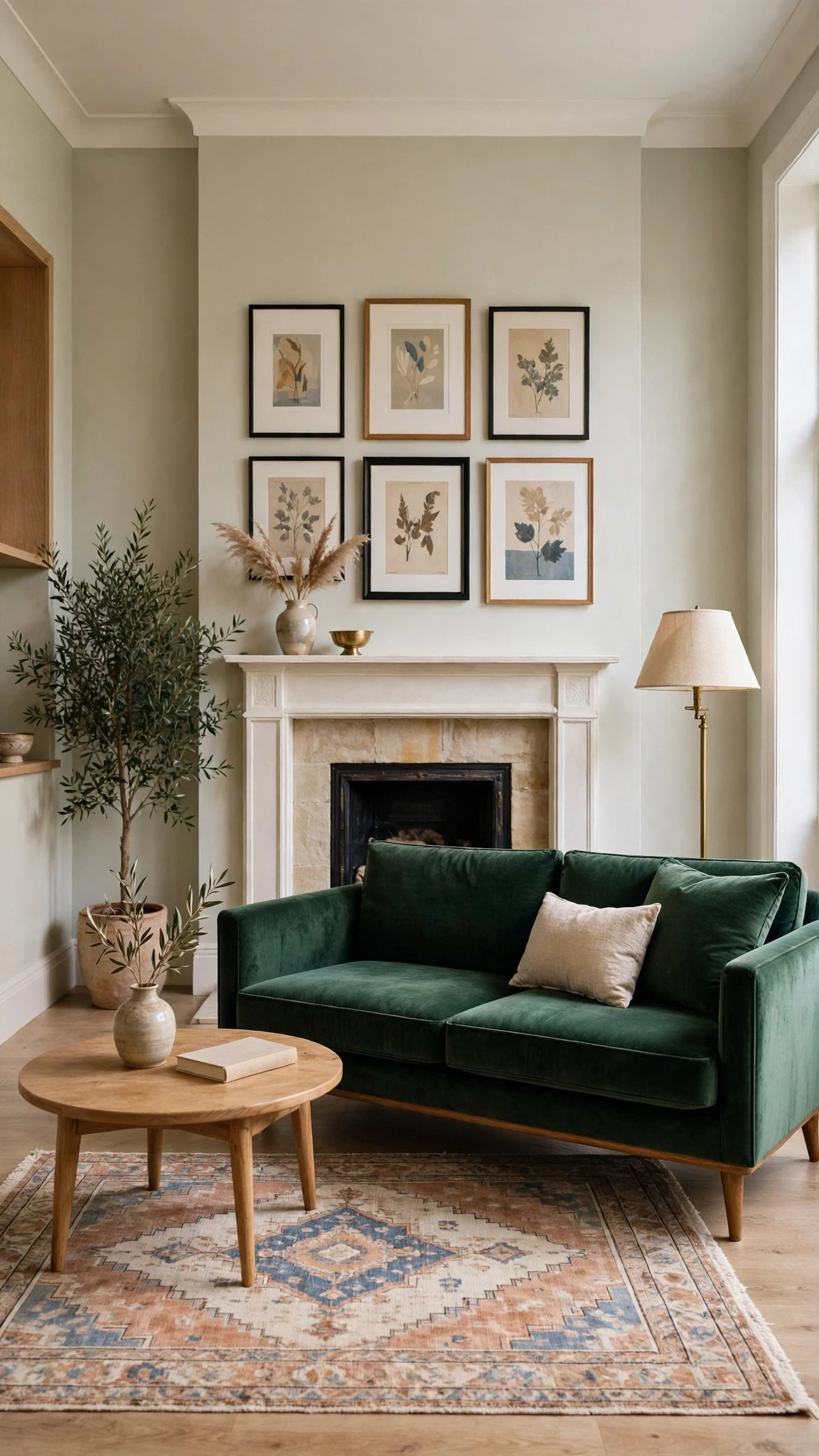
A velvet sofa does two jobs at once: it gives the room its softest seat and its strongest color, which makes it the natural center of a modern vintage living room. Choose a deep, livable color, like emerald, rust, or dusty blue, rather than a bright shade that will tire you in a year, and keep the sofa’s lines simple so the velvet itself carries the vintage feeling. Pair it with lighter pieces around it, linen cushions, a pale rug, a wood coffee table, so the sofa reads as inviting rather than heavy, and brush it weekly to keep the pile sitting evenly.
- Color that ages well: Deep, muted jewel tones hold up for years; bright or neon shades date fast.
- Pair it with: Linen cushions and a light rug so the sofa feels soft, not dominating.
- Cushion care: Fluff and rotate cushions weekly, and brush the velvet in one direction to keep the pile even.
3. A Leather Chair That Adds Patina, Not Heaviness
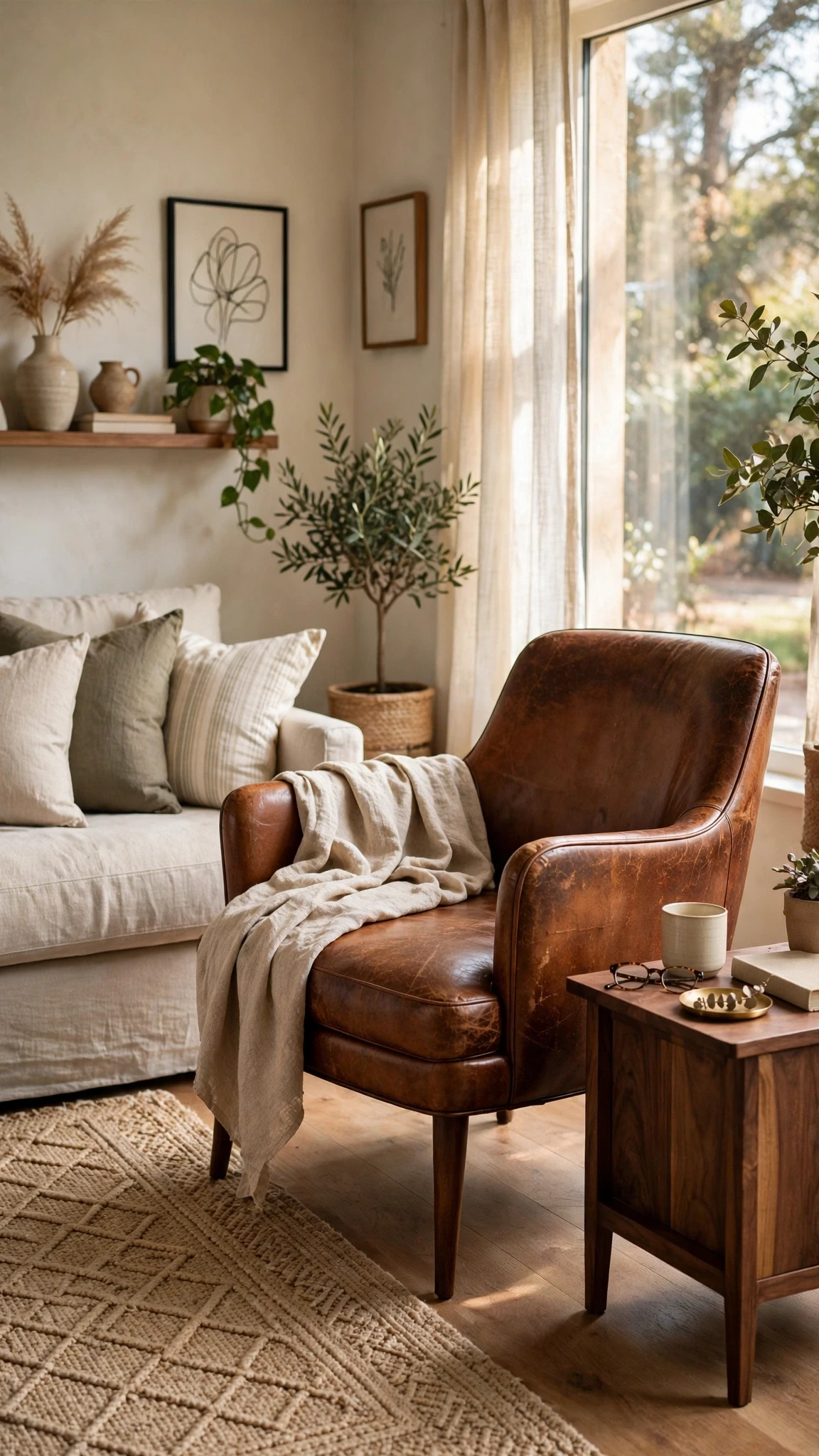
One leather accent chair brings warmth and age into the room in a way no new fabric chair can, because leather gains character as it wears. Cognac leather suits most rooms better than very dark brown, since it reads warm in daylight and does not swallow a corner, and it pairs naturally with linen throws, walnut side tables, and the rug underfoot. Place the chair where it catches light, angled toward the sofa rather than flat against a wall, and keep a light fabric nearby, a linen cushion or a wool throw, so the leather never makes the seating area feel dark.
- Choose cognac: It warms a room without darkening it, and it ages into a richer tone over time.
- Balance with linen: A linen cushion or wool throw beside the leather keeps the corner from feeling heavy.
- Placement: Angle the chair toward the sofa to join the conversation instead of lining it against a wall.
- Condition it: A light leather conditioner twice a year keeps the patina rich and prevents cracking.
4. A Distressed Rug That Grounds Mixed Furniture
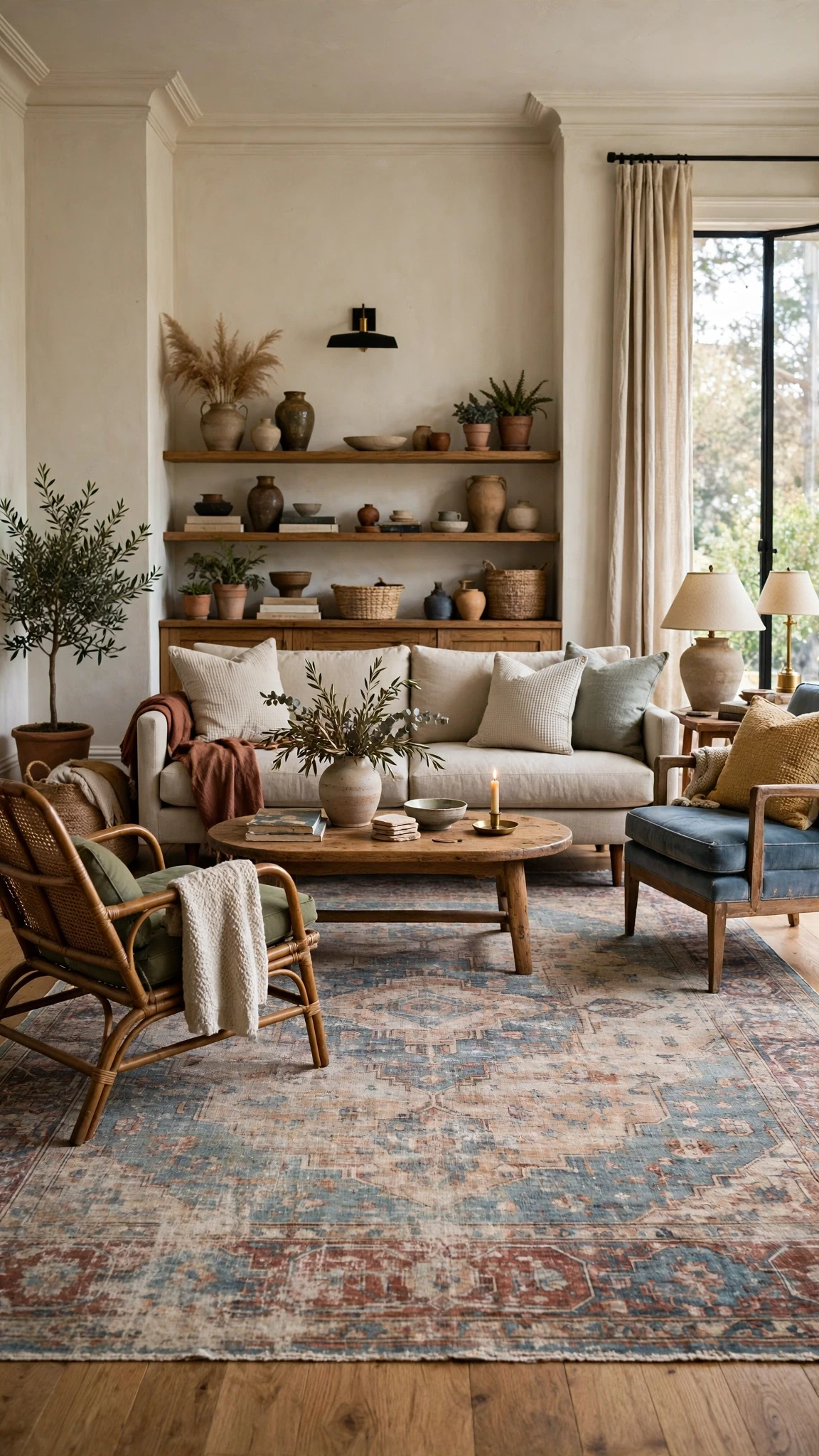
A rug is the meeting point of a mixed room: when the sofa, chairs, and coffee table all sit on one large rug, different eras suddenly belong to the same zone. Size matters more than pattern here. The front legs of the sofa and chairs should rest on the rug, which usually means going larger than you first think, and a faded or distressed pattern forgives daily wear far better than a bold, high-contrast design. If your budget only stretches to a plain rug, layer a smaller vintage-style rug on top of it, centered under the coffee table, for the same collected look at a lower cost.
- Size rule: Front legs of all seating on the rug; when in doubt, size up, not down.
- Pattern choice: Faded, low-contrast patterns hide wear and let furniture patterns breathe.
- Layering trick: A smaller vintage rug over a larger plain one adds character without a big spend.
- Underfoot feel: A low pile keeps chairs sliding easily and vacuuming simple.
- What to avoid: A rug so small it floats in the middle of the seating area, which shrinks the whole room.
5. A Statement Coffee Table With a Story
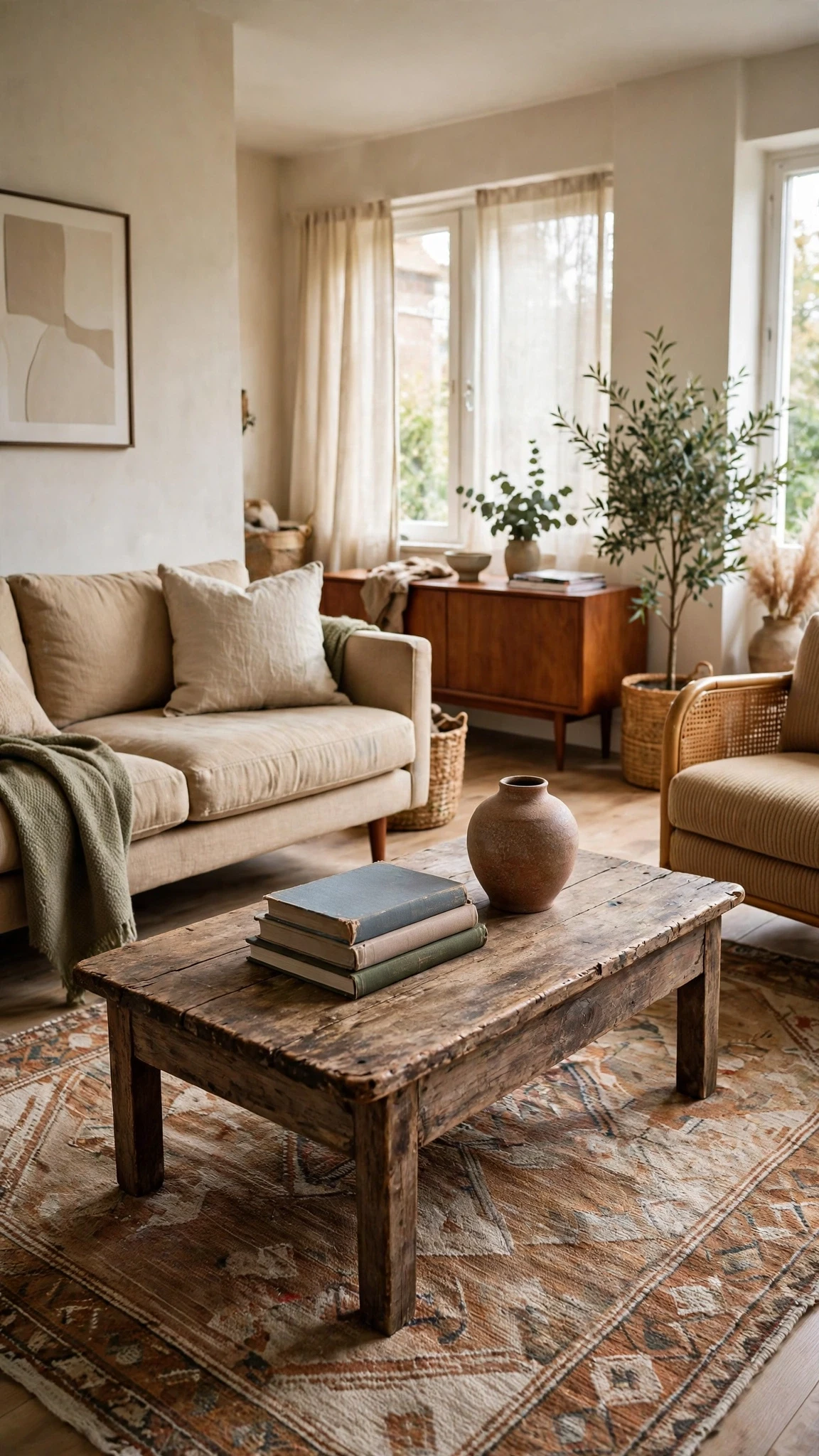
Every collected room needs one piece with a past, and the coffee table is the best place for it, because it sits in the middle of everything and gets looked at all day. A weathered wood table, a marble-top find, or a brass-and-glass piece from a thrift shop gives the room its history object, and it works best when styled simply, with a stack of books and one ceramic or candle, so the table itself stays visible. Keep the height close to the sofa seat, within a couple of inches either way, and leave enough clearance around it for knees and walking, roughly eighteen inches, so the statement piece never gets in the way of the room actually being used.
- Height rule: Within a couple of inches of the sofa seat height, so reaching for a cup feels natural.
- Material options: Weathered wood for warmth, marble for polish, brass and glass for a lighter look.
- Styling rule: Books plus one object, not a crowd; the table should stay visible.
6. Layout First: One Focal Point and Clear Walking Paths
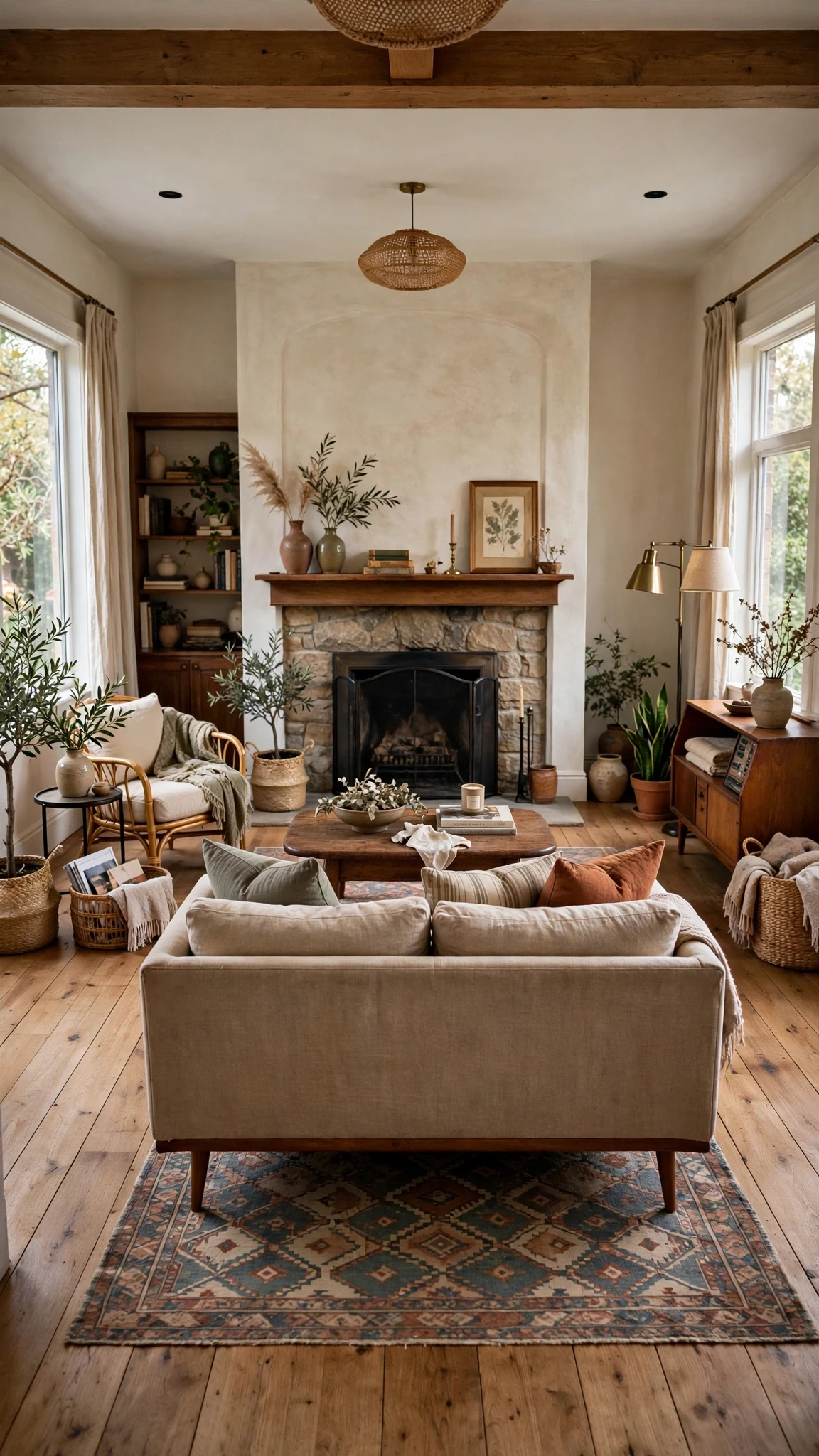
The step most decorating galleries skip is also the one that decides whether a room feels calm or chaotic: layout. Arrange seating around one focal point, a fireplace, a big window, or a gallery wall, and keep every walking path open before a single decorative object enters the room. Conversation works best when seats face each other at a comfortable distance, roughly seven to eight feet apart at most, and paths need about thirty inches of clear width to feel easy rather than squeezed. Furniture pushed flat against every wall often makes a room feel emptier, not bigger, while floating the sofa even a few inches off the wall gives the arrangement shape.
- Pick one focal point: Fireplace, window, or art wall, and point the main seating at it.
- Conversation distance: Seats facing each other within about eight feet, so nobody has to raise their voice.
- Path widths: Roughly thirty inches of clear walking space through every route in the room.
- Float or push: Pull the sofa a few inches off the wall to give the arrangement shape and depth.
7. A Gallery Wall That Mixes Antique Frames and Modern Art
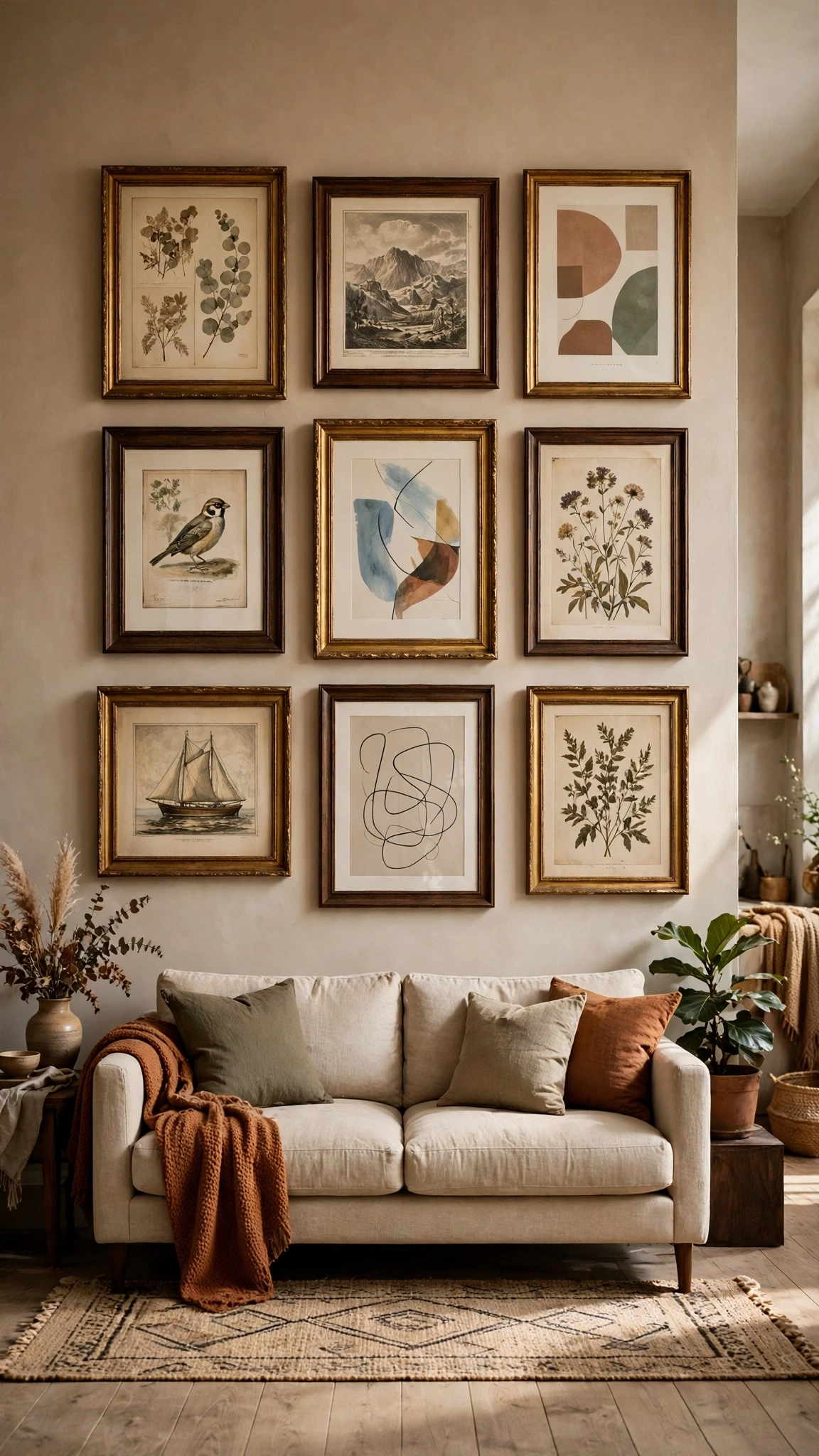
A gallery wall is where old and new meet most visibly, and the trick is letting the frames do the unifying while the art itself spans eras. Antique-style frames in one or two finishes, aged gold and dark wood, for example, hold vintage prints and modern art side by side without the wall looking random. Plan the arrangement on the floor first, keep spacing even at two to three inches between frames, and hang the center of the arrangement at eye level, around fifty-seven inches from the floor, so the wall reads as one composed piece rather than a collection of holes in the plaster.
- Frame finishes: One or two repeated finishes, like aged gold and dark wood, unify the whole wall.
- Spacing rule: Two to three inches between frames, kept even across the arrangement.
- Plan on the floor: Lay the full arrangement out on the floor and photograph it before hanging anything.
- Mix sizes: One large anchor piece plus smaller works around it, never all the same size.
- Height rule: Center the arrangement at eye level, around fifty-seven inches from the floor.
8. Layered Lighting: Overhead, Task, and Warm Glow
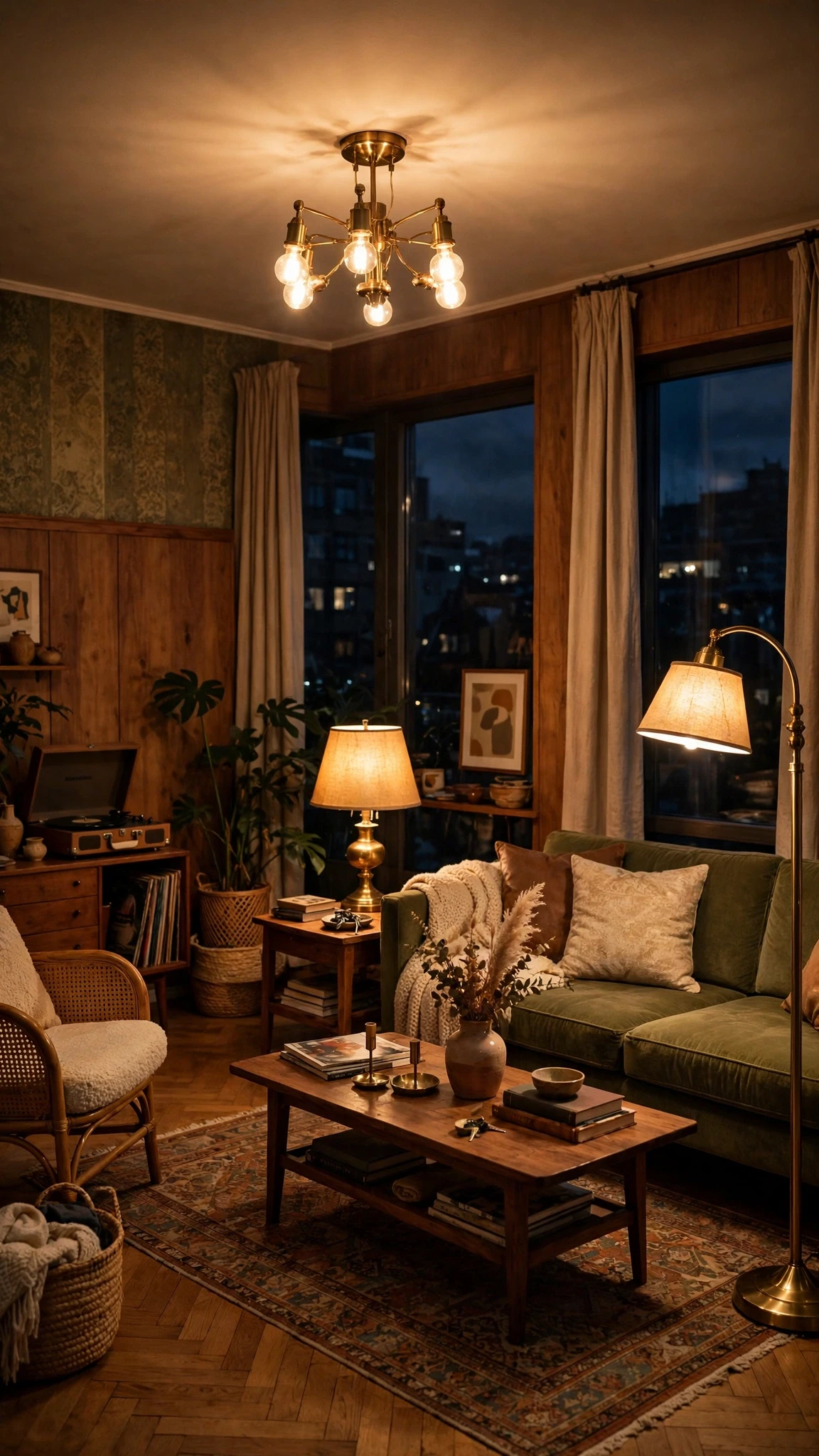
Lighting is the mood-maker that makes old and new pieces feel like one room after dark, and it needs three layers, not one ceiling fixture doing all the work. Overhead light sets the general level, task lamps beside seating make reading comfortable, and a warm ambient glow from a brass floor lamp or a retro table lamp gives the room its vintage note. Warm bulbs, around 2700K, flatter wood, leather, and velvet far better than cool white, and dimmers on at least one layer let the room shift from bright daytime to soft evening without changing a single object in it.
- Overhead: One central fixture for general light, on a dimmer if possible.
- Task: A lamp beside each main seat, at shoulder height when seated, for reading.
- Ambient: A brass floor lamp or retro table lamp for the warm evening glow.
9. Weathered Wood Shelves and Side Tables for Warmth
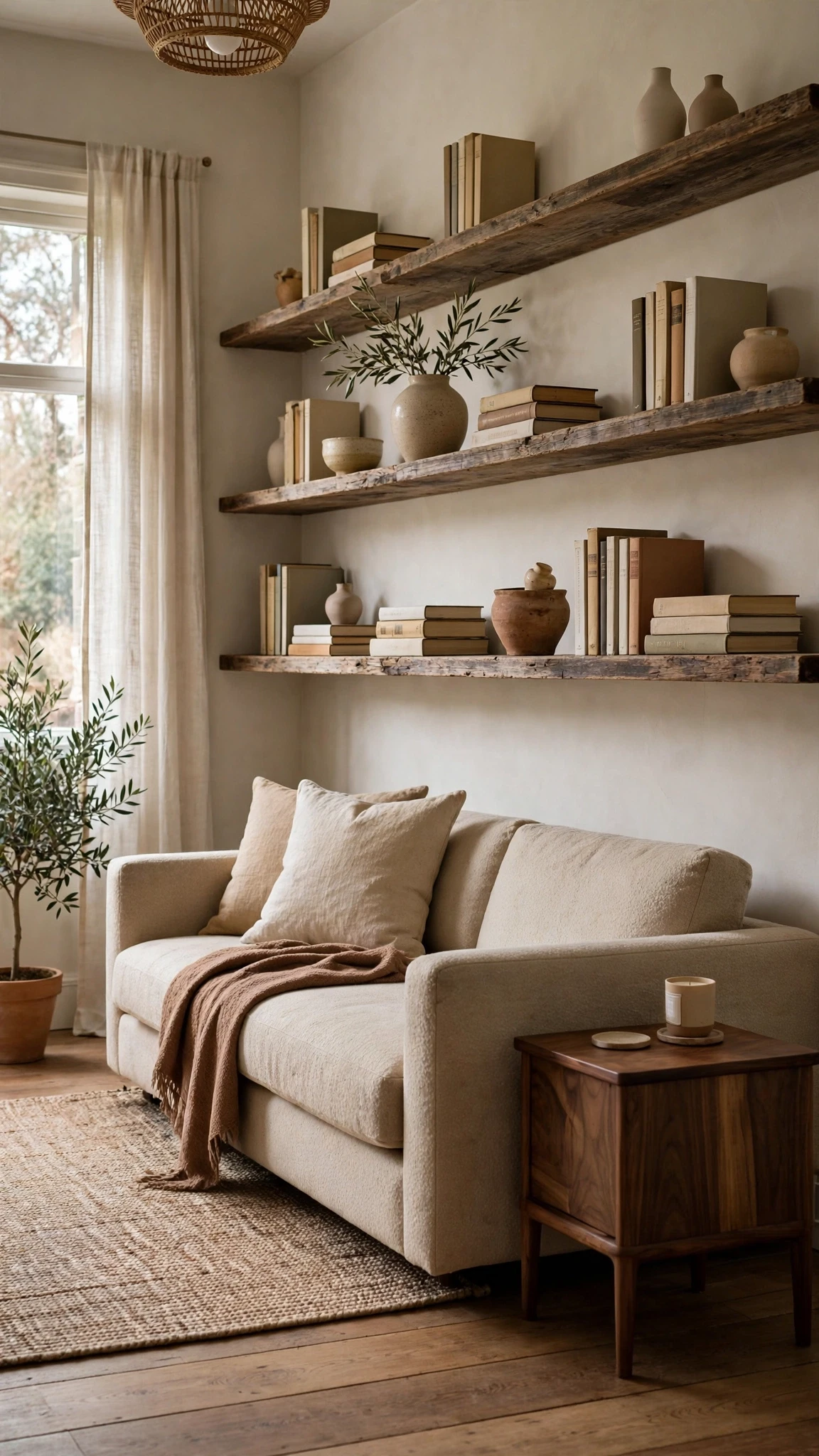
Weathered or reclaimed wood on shelves and side tables adds warmth without forcing everything to match, and it works as the repeated material that ties different eras together. Choose one wood-tone family, warm walnut or weathered oak, and repeat it on a shelf, a side table, and a frame or two, so the eye finds the connection without the room turning into a matching set. Style shelves with breathing room, books standing and lying in small groups with a ceramic or plant between them, and stop before every shelf is full, because a half-empty shelf looks curated while a packed one looks like storage.
- Wood tone family: One warm family, like walnut or weathered oak, repeated in three spots.
- Shelf styling: Small book groups with a ceramic or plant between them, never a solid wall of books.
- Side tables: Match the wood family, not the exact piece, so the room stays collected.
- What to avoid: Filling every shelf to the edge, which turns display into clutter.
10. Layered Textures That Make the Room Feel Lived In
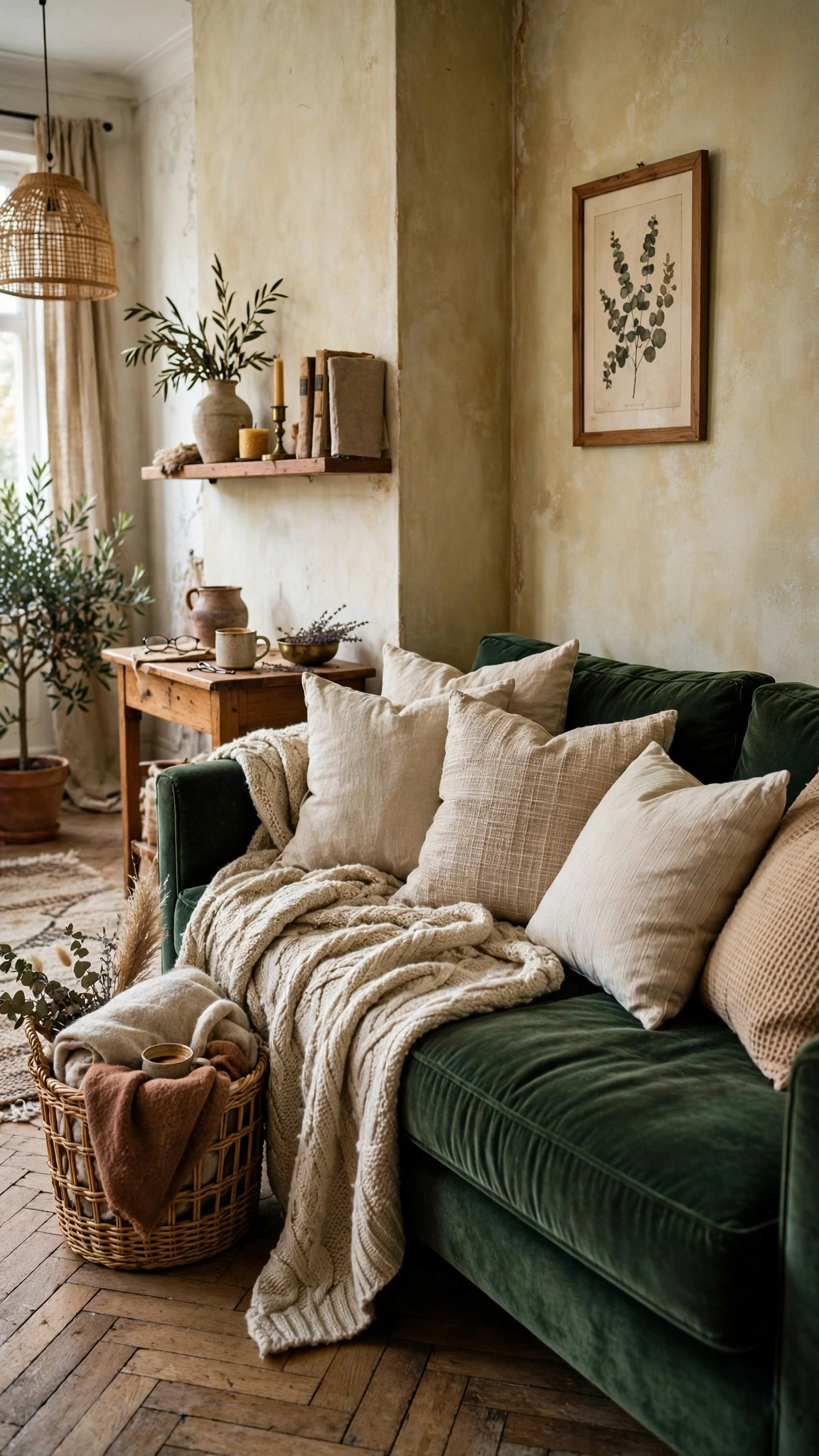
When the palette stays calm, texture does the decorating work, and a modern vintage room needs several of them to feel lived in rather than staged. Linen cushions, a wool throw, a rattan basket, and the velvet sofa together give the eye and the hand something different at every seat, and the mix is what makes a new room feel like it has been enjoyed for years. Limit the count to about four textures so the room stays coherent, swap the throw and cushion covers with the seasons for a cheap refresh, and let one natural material, rattan or cane, repeat in a basket and a chair back to tie the textures together.
- Texture count: About four, like linen, wool, rattan, and velvet, so the room stays coherent.
- Seasonal swap: Change throws and cushion covers with the seasons for a low-cost refresh.
- Repeat one natural material: Rattan or cane in two spots ties the textures together.
11. Retro Touches in Small Doses, Not a Theme Park
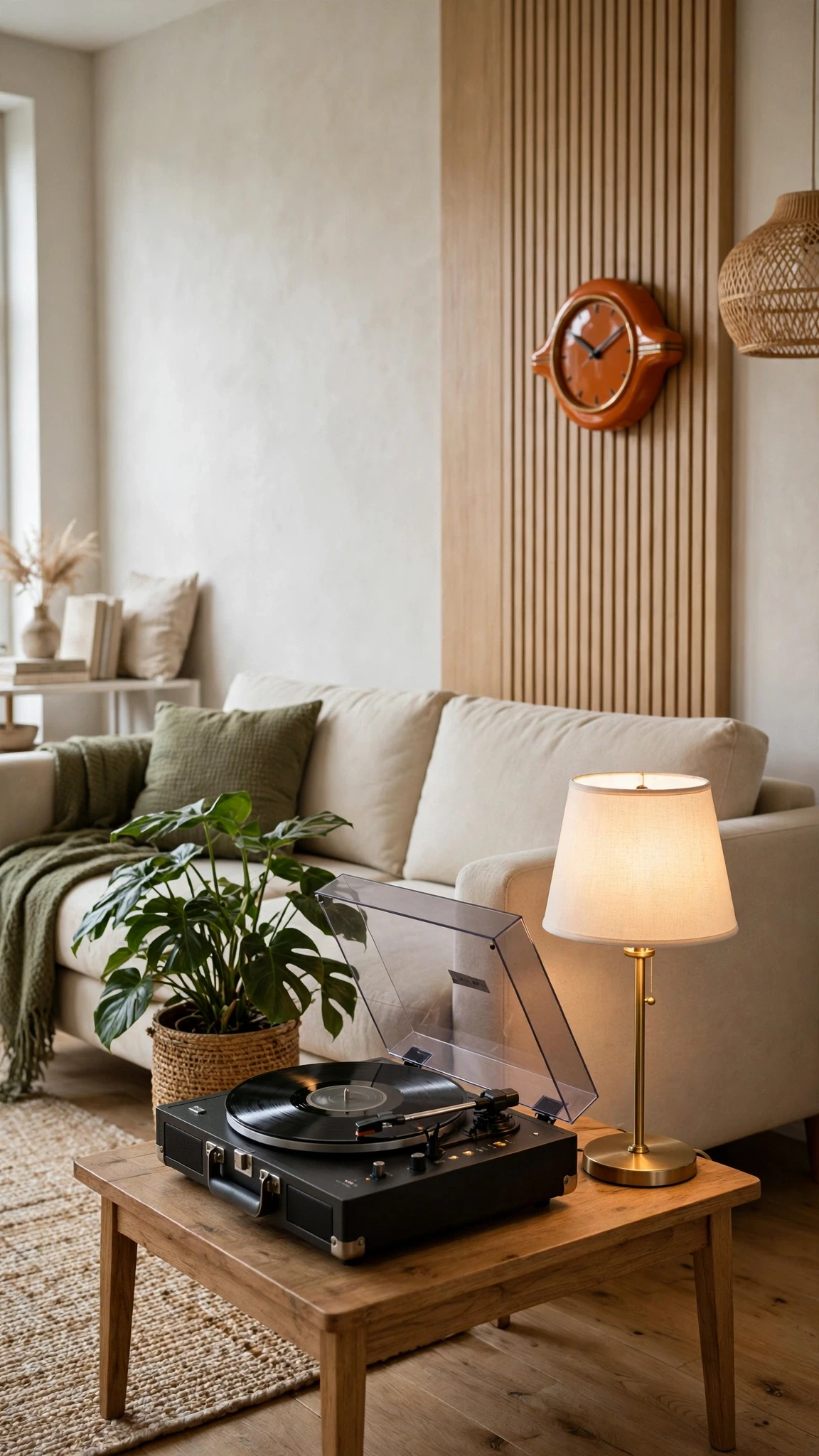
Retro accessories charm a room only in small doses; a record player, a vintage radio, or a rotary-style phone as a single accent adds character, while a full set of retro objects turns the room into a costume. Pick one hero retro piece that actually works, a record player you play or a radio you listen to, and give it a clear spot, a side table or a shelf corner, where it can be noticed without crowding anything else. Keep modern tech discreet nearby, with cables tucked away, so the retro piece reads as a choice rather than a contradiction, and resist adding a second or third retro gadget just because the first one looked good.
- Pick one hero piece: A working record player or radio, not a shelf of display-only gadgets.
- Keep tech discreet: Tuck modern cables and remotes out of sight beside the retro accent.
- Placement: A clear spot, like a side table or shelf corner, where the piece can breathe.
- What to avoid: A full retro set, which tips the room from charming into a theme park.
12. Vintage Books and Objects Styled With Breathing Room
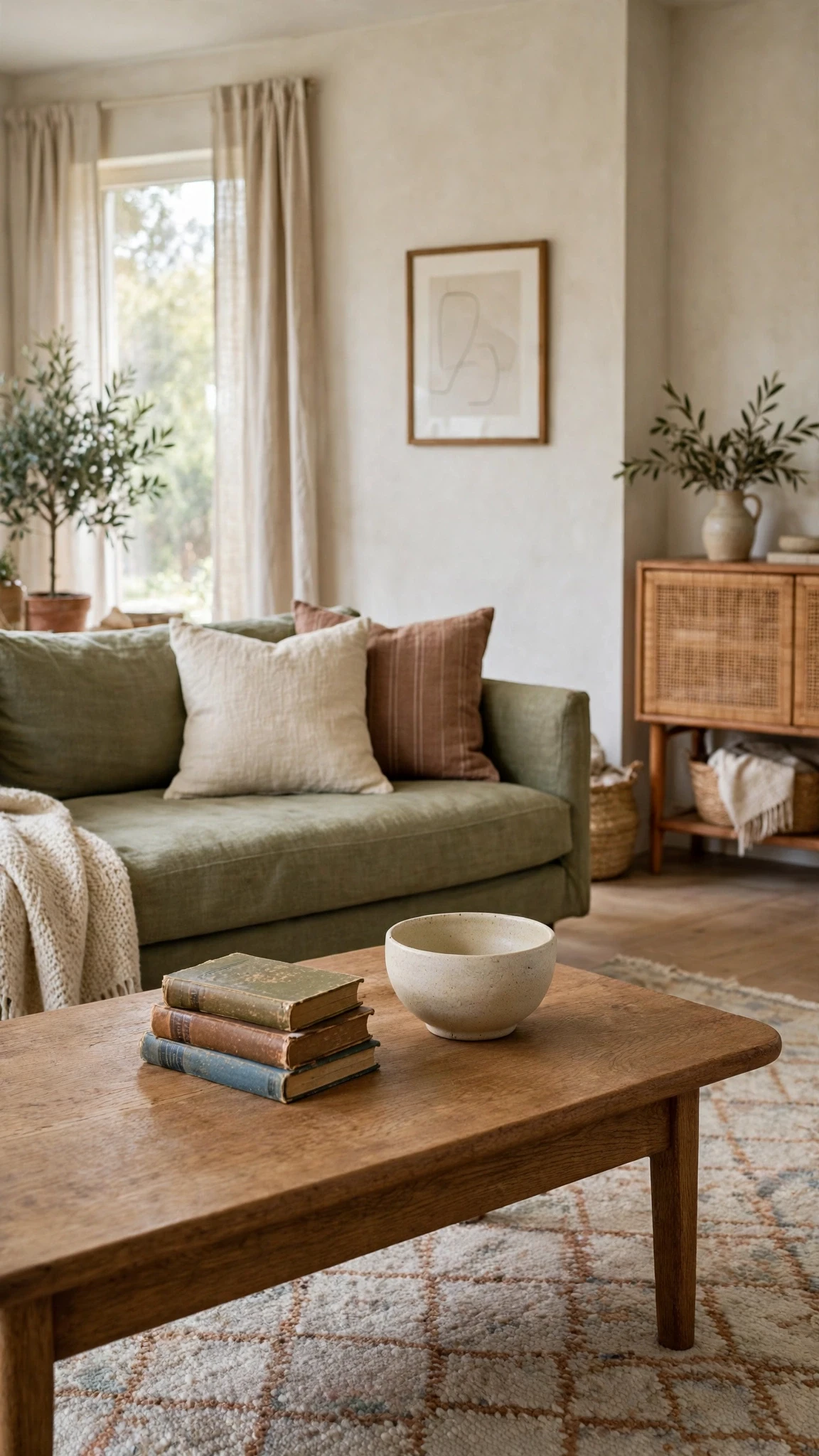
Vintage books, ceramics, and small finds look curated only when they have space around them, and breathing room is the difference between a collection and a crowd. Group objects in odd numbers, three or five, stack books no more than three or four high, and leave part of every surface visibly empty so each object can be seen. Rotate the display with the seasons, swapping a few pieces in and out, which keeps the room feeling fresh without buying anything new and stops surfaces from slowly filling up until nothing stands out.
- Group in odd numbers: Threes and fives read as intentional; even rows read as a shop shelf.
- Stack heights: No more than three or four books per stack, topped with one small object.
- Leave space: Part of every surface stays bare, so each object can be seen.
- Rotate seasonally: Swap a few pieces in and out to refresh the room without spending.
- One hero object: Let one taller or older piece anchor each group, with smaller pieces around it.
13. Thrift Smart: What to Buy Secondhand and What to Buy New
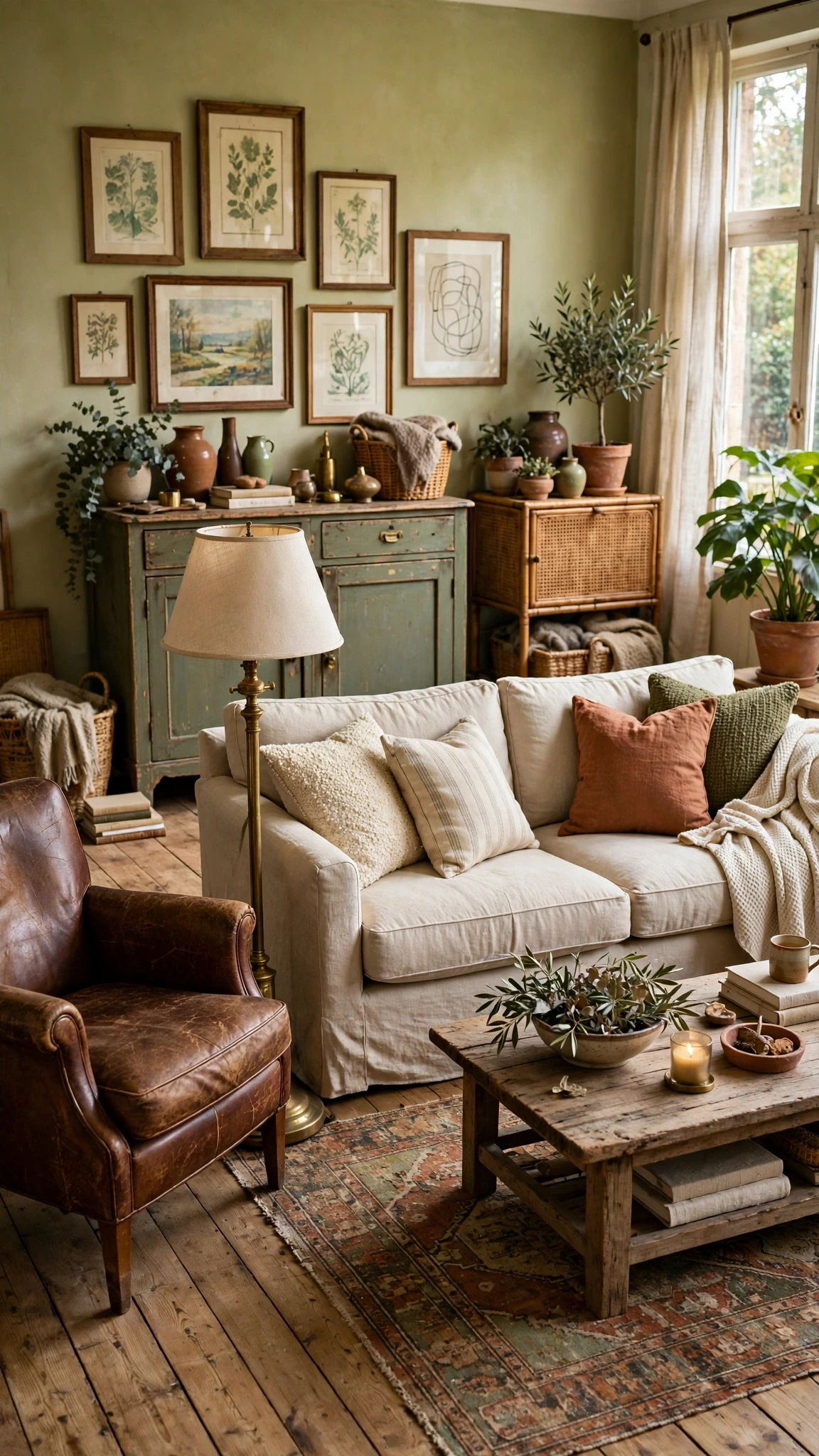
Thrift shopping builds a collected room at a fraction of new prices, but only with a method: buy character pieces secondhand and buy comfort and safety pieces new. Solid wood tables, brass lamps, ceramic vases, and leather chairs age well and reward a secondhand hunt, while sofas for daily sitting, mattresses, and anything electrical are safer bought new. Before buying secondhand, check the structure for wobble, sniff for smoke or damp, measure it against your door and your room, look at the finish in daylight, and buy in phases, one hero piece at a time, so the room grows instead of filling up in one weekend.
- Buy secondhand: Solid wood, brass, ceramics, and leather pieces with good bones.
- Buy new: Daily-use sofas, anything electrical, and items where safety or comfort matters.
- Check before buying: Structure, smell, size against your door and room, and finish in daylight.
14. A Small-Space and Rental Plan for Vintage Style
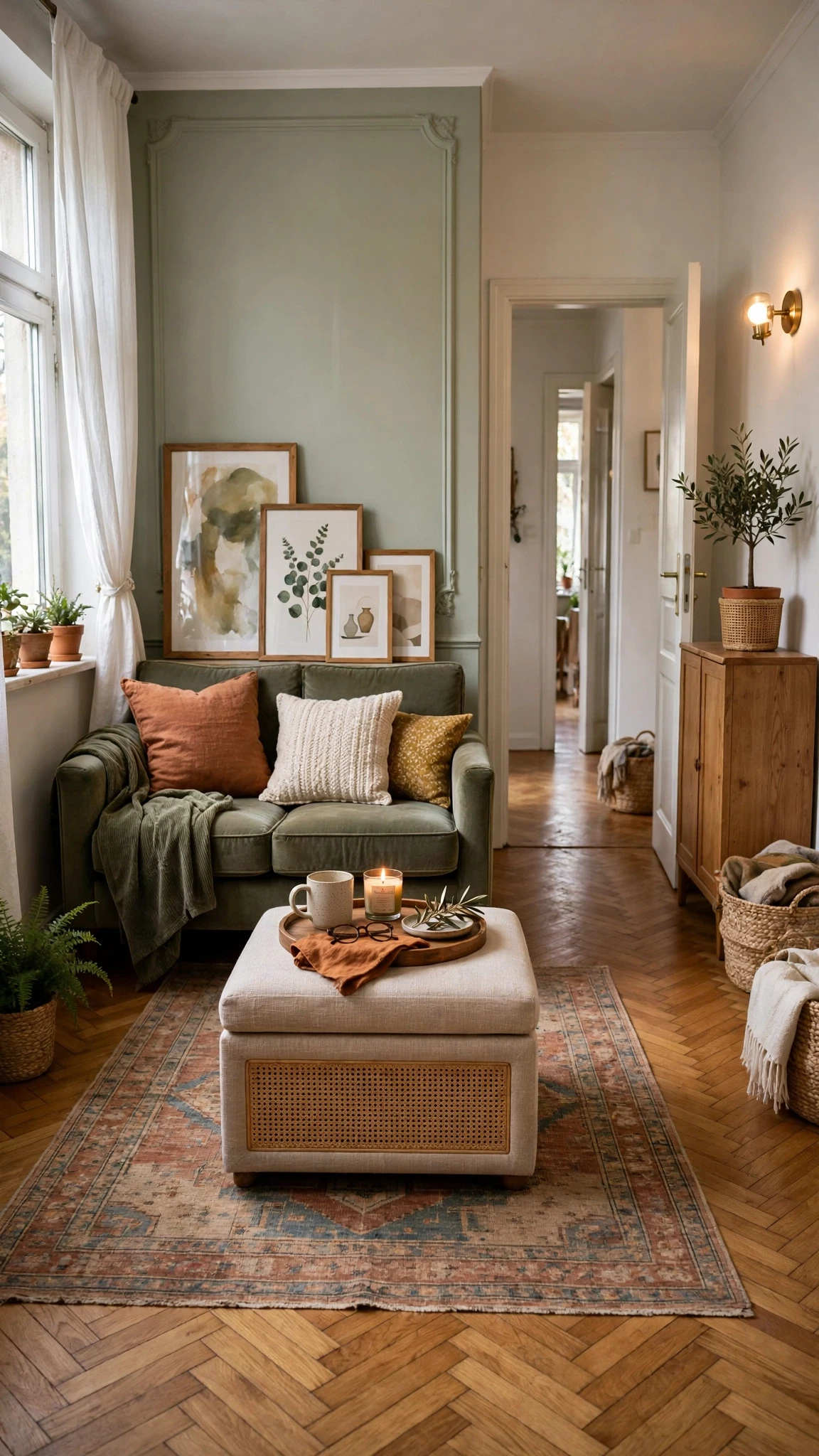
Small rooms and rentals can carry vintage style just as well as large ones, as long as the pieces stay lighter and fewer. Choose apartment-scale seating, a loveseat instead of a full sofa, or a slim armchair; lean art against the wall instead of drilling a gallery; and use removable touches like fabric panels or peel-and-stick wallpaper for vintage pattern without permanent changes. Multi-use pieces earn their floor space twice over: a storage ottoman as a coffee table, or a vintage trunk as both a table and blanket storage, and keeping one clear walking path through the room matters even more when space is tight.
Also read boho living room ideas.
- Apartment-scale furniture: A loveseat or slim armchair instead of a full-size sofa.
- Leaning art: Large frames leaned on furniture or the floor, no drilling needed.
- Removable touches: Fabric panels or peel-and-stick wallpaper for pattern without permanent change.
- Multi-use pieces: A storage ottoman as a coffee table, or a trunk as a table and blanket storage.
15. The Final Edit: Remove One Thing Before You Call It Done
The last decorating step is not adding something; it is removing something, and it is the guard that keeps a collected room from sliding into kitsch. Walk the room surface by surface and take one object off each, then check the palette, the light, and the walking paths once more before deciding anything is finished. Photograph the room from the doorway, because a photo shows clutter the eye has learned to ignore, and live with the edited room for a week before adding anything back, since most rooms feel better after the edit than they did before it.
- Edit checklist: One object off every surface, then palette, light, and paths checked once more.
- Photograph it: A photo from the doorway shows clutter the eye has learned to ignore.
- Live with it a week: Wait before adding anything back; most rooms feel better after the edit.
- Palette check: If a new object breaks the two-color rule, it stays out until something else leaves.
- Surface by surface: Work through one surface at a time, so the edit stays quick and focused.
How to Plan a Modern Vintage Palette and Layout Before You Buy
Planning before buying saves more money than any sale, because it stops the impulse pieces that fight the room. Start with the palette rule: two anchor colors plus one metal finish, and add an era limit: two eras at most, plus modern neutrals, so a mid-century chair and an Art Deco lamp can share a room while a third era would tip it into confusion. Then measure everything: the wall for the sofa, the floor area for the rug, the doorways a thrifted piece must pass through, and sketch the layout with one focal point and clear paths before spending. A room planned this way fills slowly and correctly, instead of filling fast and needing to be undone.
The layout order matters as much as the palette. Place the largest piece first, usually the sofa, facing the focal point, then the rug under it, then the chairs and tables, and only then the walls and shelves. This order keeps the room’s bones right, so later decoration sits on a sound arrangement instead of covering up a bad one. Measure twice for the two pieces people most often get wrong, the rug and the gallery wall, since both are expensive to fix once hung or laid.
Budget, Small Spaces, and Mistakes That Make Vintage Look Messy
A modern vintage room does not need a large budget, because its best pieces are often secondhand, but it does need a spending order: palette and layout first, hero pieces next, and small decor last, so money goes where the eye actually lands. Rentals and small rooms follow the same order with lighter pieces and removable touches, and the same restraint, since a small room forgives even less clutter than a large one. Spend on what you sit on and what lights the room, save on what merely decorates it, and phase the rest over months rather than buying the whole room in one weekend.
- Too many eras: Limit the room to two eras plus modern neutrals, and remove the piece that breaks the rule.
- Matching sets: Break up a matched set with one contrasting piece, so the room looks collected, not bought at once.
- Overfilled shelves: Take one object off every shelf and leave part of each shelf empty.
- Ignoring light: Warm bulbs and three light layers fix a room that looks flat after dark.
FAQS
What is modern vintage decor?
Modern vintage decor mixes old pieces with patina, like a leather chair or a weathered wood table, with new pieces that have clean, simple lines, held together by one palette and repeated materials. It is not about filling a room with antiques or copying one era. The goal is a room that looks collected over time, warm and personal.
How do you mix vintage and modern furniture without clashing?
Start with a palette of two anchor colors and one metal finish, and let every piece answer to it, so different eras share colors and materials even when their shapes differ. Limit the mix to two eras plus modern neutrals, and repeat one material, like walnut or brass, in several spots. Check the palette when a piece fights the room.
What colors work best in a modern vintage living room?
Warm neutrals like cream, oatmeal, and soft gray make the best base, paired with one deep tone such as forest green, burgundy, or navy for weight. Aged brass adds warmth as the metal finish, and warm white lighting keeps the palette glowing after dark. Two main colors plus one metallic keeps the room calm.
How can I decorate a modern vintage living room on a budget?
Buy character pieces secondhand, like solid wood tables, brass lamps, and leather chairs, and buy comfort pieces new, then phase purchases one hero piece at a time. Use what you already own as the base, add a thrifted rug or gallery frames for character, and spend first on seating and lighting, where the eye actually lands.
Can a small living room pull off vintage decor?
Yes, as long as the pieces stay apartment-scale and fewer in number, with one walking path open. Choose a loveseat instead of a sofa, lean art against the wall instead of drilling, and use multi-use pieces like a storage ottoman as a coffee table. Vintage style in a small room works through texture, color, and one character piece.
How do I keep a vintage living room from looking cluttered?
Edit before adding: remove one object from every surface, leave part of each shelf empty, and group objects in odd numbers with breathing room around them. Stick to two eras plus modern neutrals, and photograph the room from the doorway, since a photo reveals clutter the eye ignores. If a piece breaks the palette rule, it stays out.
Where is the best place to find vintage living room pieces?
Thrift shops, flea markets, estate sales, and secondhand marketplaces are the best sources for solid wood, brass, ceramics, and leather pieces with character. Check structure, smell, size against your door and room, and finish in daylight before buying. Local shops let you inspect pieces in person, while online sellers should provide clear photos and honest condition notes.
Conclusion
Modern vintage living room decor ideas are not a shopping list; they are a slow way of building a room: pick a palette, choose one or two hero pieces, and edit before adding more. The rooms that pull it off best are rarely the ones with the most objects. They are the ones where the sofa invites sitting, the light feels warm after dark, and every piece looks like it earned its place.
Start with the simplest first step today. Choose your two anchor colors and your metal finish, then look at your room with fresh eyes and remove one thing that breaks the rule. The collected, warm room you want is usually closer than it looks, and it starts with that one edit.