15 Tomato Trellis Ideas for Stronger Plants and an Easier Harvest
Tomatoes grow better when they grow up, not out. A good tomato trellis lifts the plant off the damp ground, so fruit stays clean, leaves dry faster, and every tomato gets sun and air. It also makes picking easy, because you can see all your fruit at once instead of searching through tangled stems.
The best support depends on your plant, since tall vining tomatoes need something different from short bush types. Below are 15 tomato trellis ideas, grouped by garden situation: simple backyard builds, row systems for bigger plantings, and small-space options for patios and walls. Each idea tells you which tomatoes it suits and how to set it up, so you can pick the one that fits your garden.
1. A Classic Wooden Frame That Holds Heavy Plants Season After Season
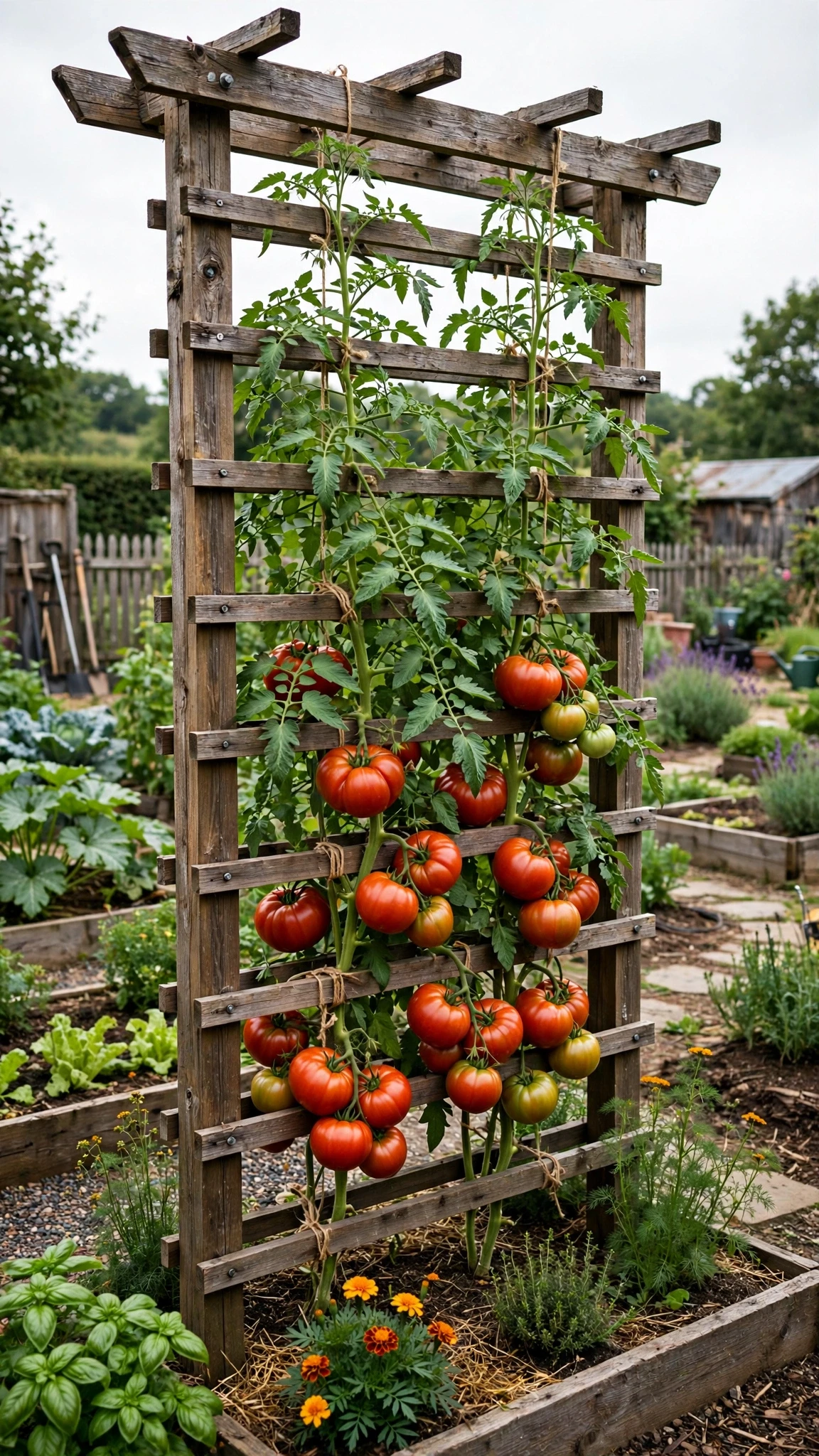
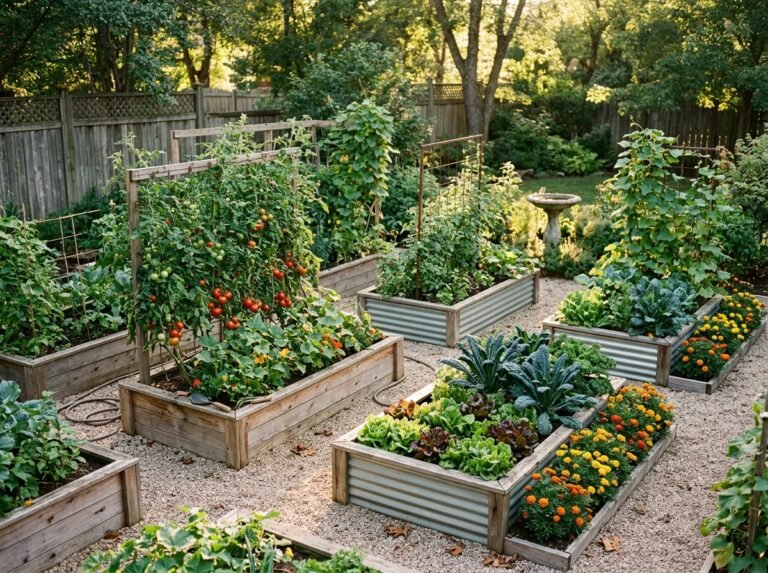
A timber frame with horizontal battens is the workhorse of the tomato garden. Two sturdy posts with battens fixed between them give you a flat plane to tie stems to at any height, and the structure easily carries beefsteak varieties whose fruit can weigh a plant down by late summer. Cedar, redwood, or pressure-treated timber all last for years outdoors and suit any garden style.
Set the posts at least 45 cm (18 in) into the ground and space the battens 25 to 30 cm (10 to 12 in) apart, so there is always a tying point near new growth. Built this solidly, the frame can stay up year-round and needs only a coat of wood oil and a check of the fixings each spring.
2. A Bamboo Teepee for Small Beds and Tight Corners
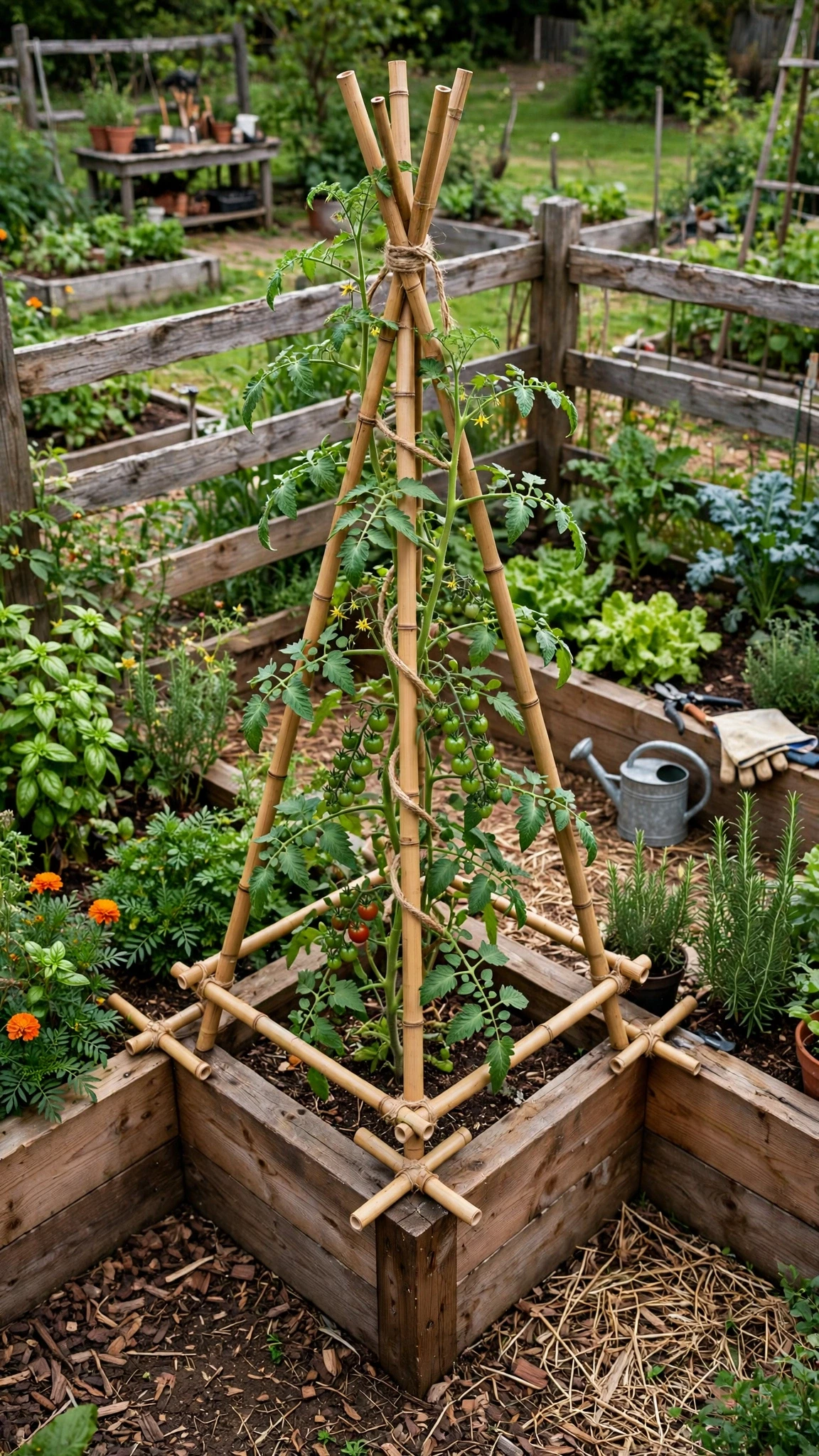
Three or four bamboo poles tied at the top make a teepee that suits small beds, corners, and gardens where a big frame would feel out of place. The poles lean inward, so vines climb in a gentle spiral while air moves freely through the foliage. It costs very little, goes up in minutes, and has a natural look that suits cottage gardens.
Choose poles long enough for the variety: around 2.4 m (8 ft) for tall indeterminate types, shorter for bush tomatoes. Wrap the apex several times with twine and push each pole at least 15 cm (6 in) into the soil. Bamboo weathers within a season or two, so replace poles each spring and use the chance to move the teepee to fresh soil for crop rotation.
3. A Sturdy Cage That Keeps Plants Contained Without Daily Tying
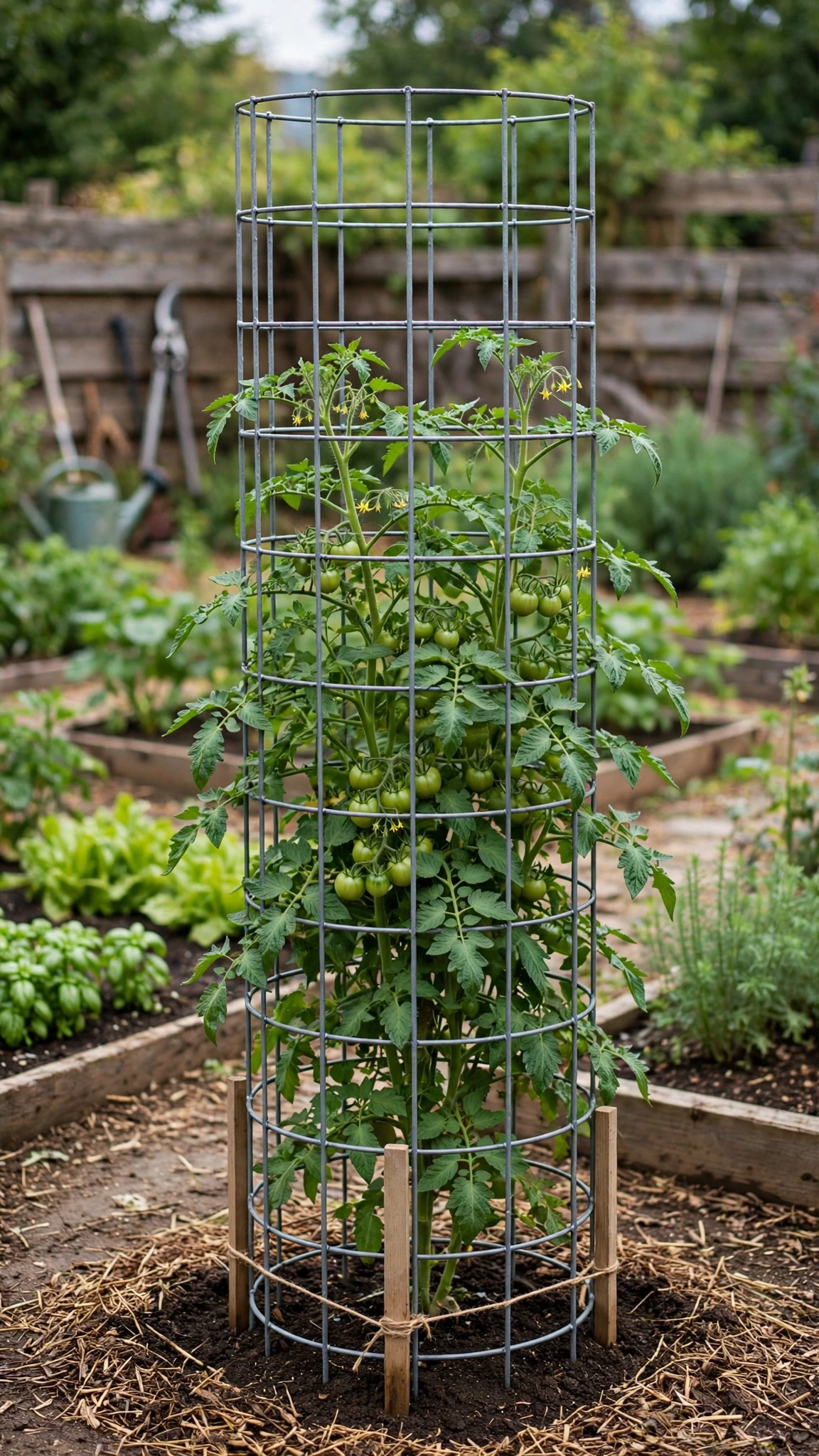
A cage suits gardeners who would rather let the plant do the work. The tomato grows up inside a round or square cage, stems threading through the openings, and you only step in now and then to tuck a stray branch back. That low-maintenance habit makes cages popular in raised beds, where one cage per plant keeps everything neat.
Size is where most cages fail. A cage 45 cm (18 in) across and 1.2 m (4 ft) tall suits bush varieties, but tall indeterminate plants pour over the top by midsummer, so choose a cage at least 1.5 m (5 ft) tall with wide openings for reaching fruit. Heavy-gauge wire lasts far longer than flimsy cages and is worth the extra cost.
4. A Wire Fence Trellis Along a Boundary or Bed Edge
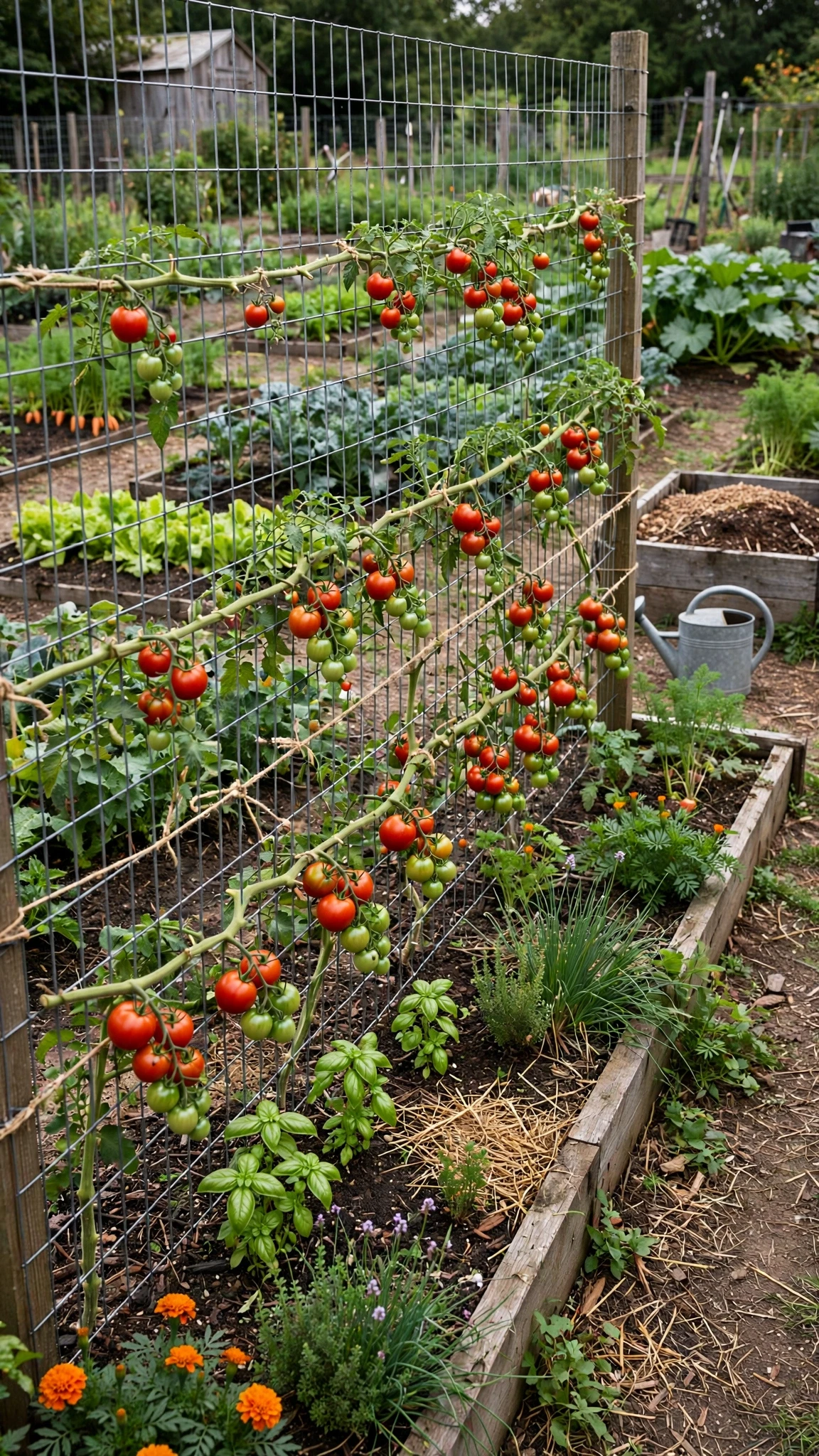
An existing fence can become a tomato trellis with almost no building. Vines tied flat to wire mesh use a garden edge that would otherwise grow nothing, which makes this ideal for narrow yards and long, thin beds. The flat plane also makes pruning and picking easy, since every stem and fruit sits within reach from one side.
Space horizontal wires about 20 cm (8 in) apart and keep access open from both sides where possible, so you can pick from the back as well as the front. If the fence belongs to a neighbour, agree the plan first and keep plants on your side of the line.
5. A Ladder Trellis That Moves Wherever You Need It
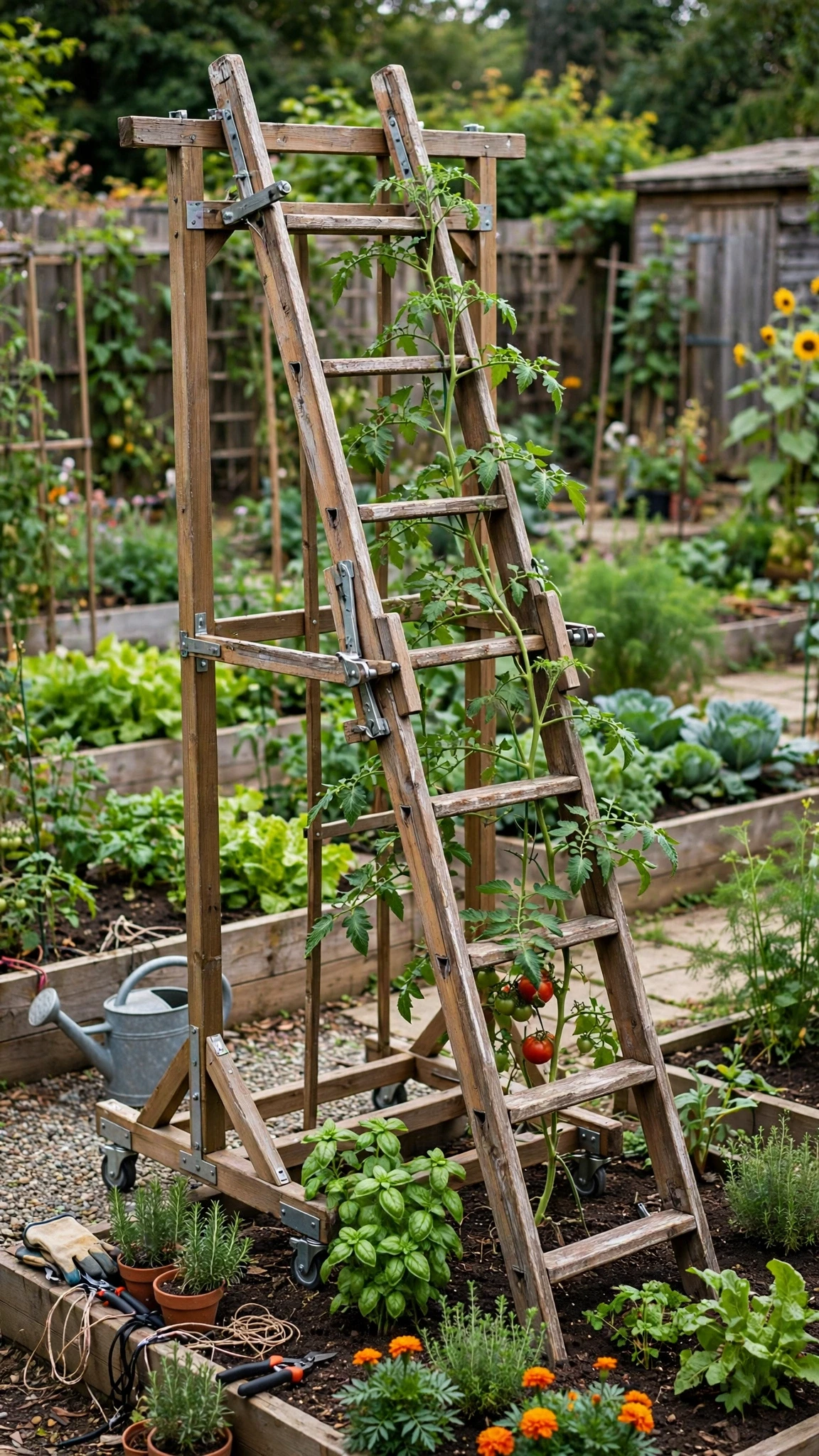
An old wooden ladder leaned against a wall or sturdy frame gives vines a ready-made set of rungs to climb. It is the most flexible support in this list: move it to a new bed each year, change the angle, or store it for winter. Trying a new spot costs nothing more than carrying the ladder across the garden.
A single leaning plane suits one or two plants rather than a whole row, and it works best for medium-height varieties that will not outgrow the top rung by mid-season. Reclaimed ladders are cheap and full of character, but check every rung for rot before trusting one with a loaded plant.
6. An A-Frame That Serves Two Rows at Once
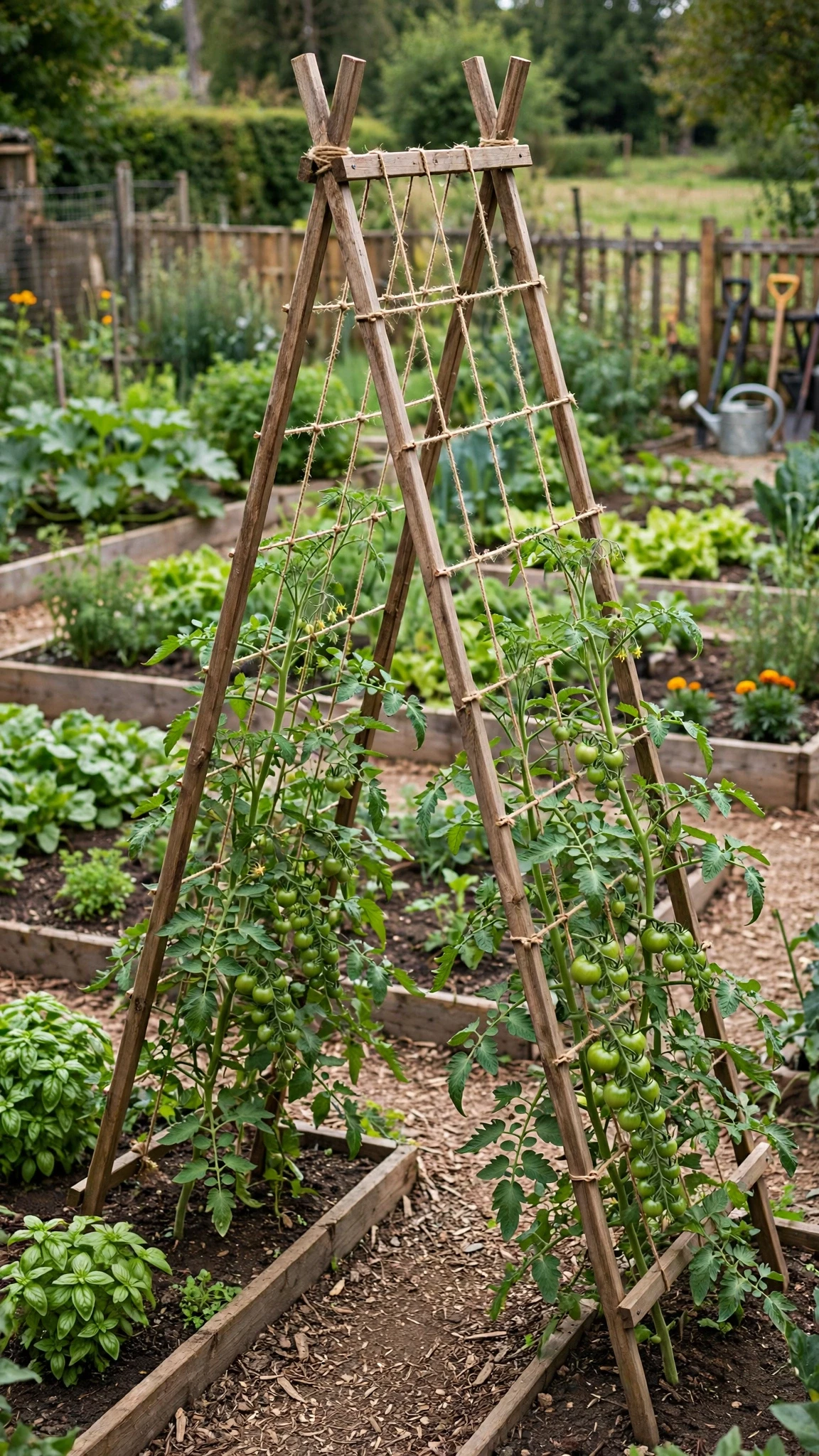
An A-frame is two leaning panels joined at the top, like a pitched roof without the roof, with tomatoes planted along both faces. It doubles the growing area of a single row while keeping the footprint narrow, and you can harvest from either side without reaching through foliage. The shaded interior stays cooler, which suits lettuce or herbs planted underneath as a bonus crop.
Make the base wide enough that the frame cannot rock, around 90 cm to 1 m (3 ft) for a frame 1.8 m (6 ft) tall, and brace the apex with a crosspiece so the panels cannot splay apart under load. Prune the inner faces lightly so air still moves through. An A-frame suits medium gardens where two rows are wanted, but space is short.
7. A String Trellis for a Clean, Minimal Look
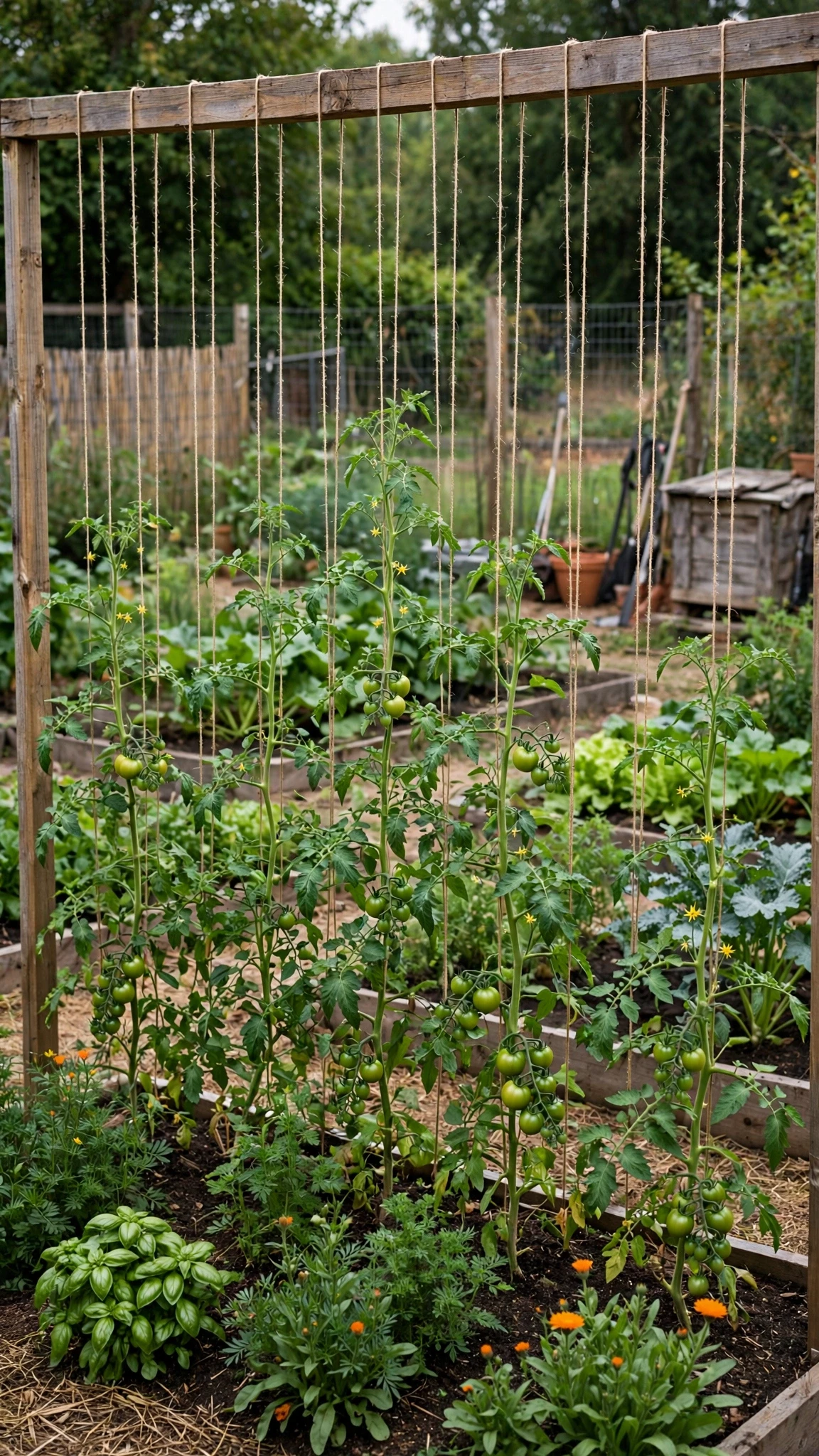
String trellising is the simplest vertical system there is: a top beam or frame, a length of garden string hanging from it, and a vine twined up the string as it grows. It costs almost nothing, looks tidy, and works in greenhouses and open gardens alike. Because each plant gets its own string, spacing and pruning stay simple and every fruit hangs where it can be seen.
Use strong twine, such as sisal or purpose-made tomato twine, and anchor the top beam firmly, since a row of loaded plants pulls hard by late summer. Wind new growth around the string once a week, always in the same direction. When the vine reaches the top, lower it and loop the extra length at the base to keep fruit within reach.
8. A Pallet Trellis Built From Reclaimed Wood
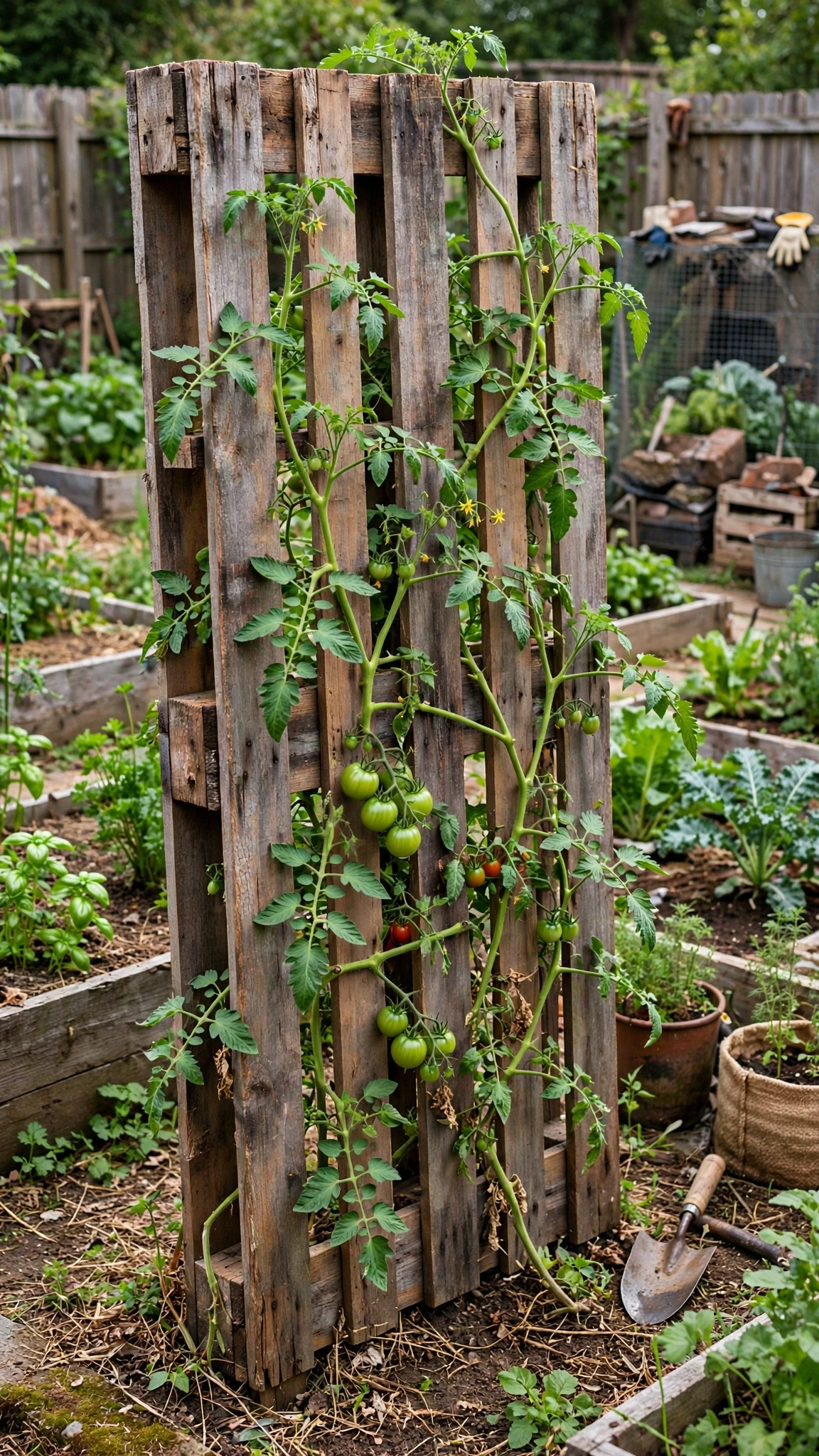
An upright wooden pallet, secured to posts or a wall, gives tomato vines a grid of slats to weave through, and it does so for next to nothing. Pallets are easy to find, the rustic look suits informal gardens, and the slatted face lets air move through while still supporting heavy stems. It is the natural choice for gardeners who enjoy building from reclaimed materials.
Check that any pallet you use is untreated and safe for food growing — look for the HT (heat-treated) stamp and avoid pallets marked MB or with unknown chemical stains. Fix the pallet firmly upright with posts driven into the ground, since a loaded pallet catches wind like a sail. Leave a small gap between slats for airflow, and weave stems through as they grow rather than tying every stem, which keeps the plant secure with less work.
9. A Spiral Support for Containers and Small Beds
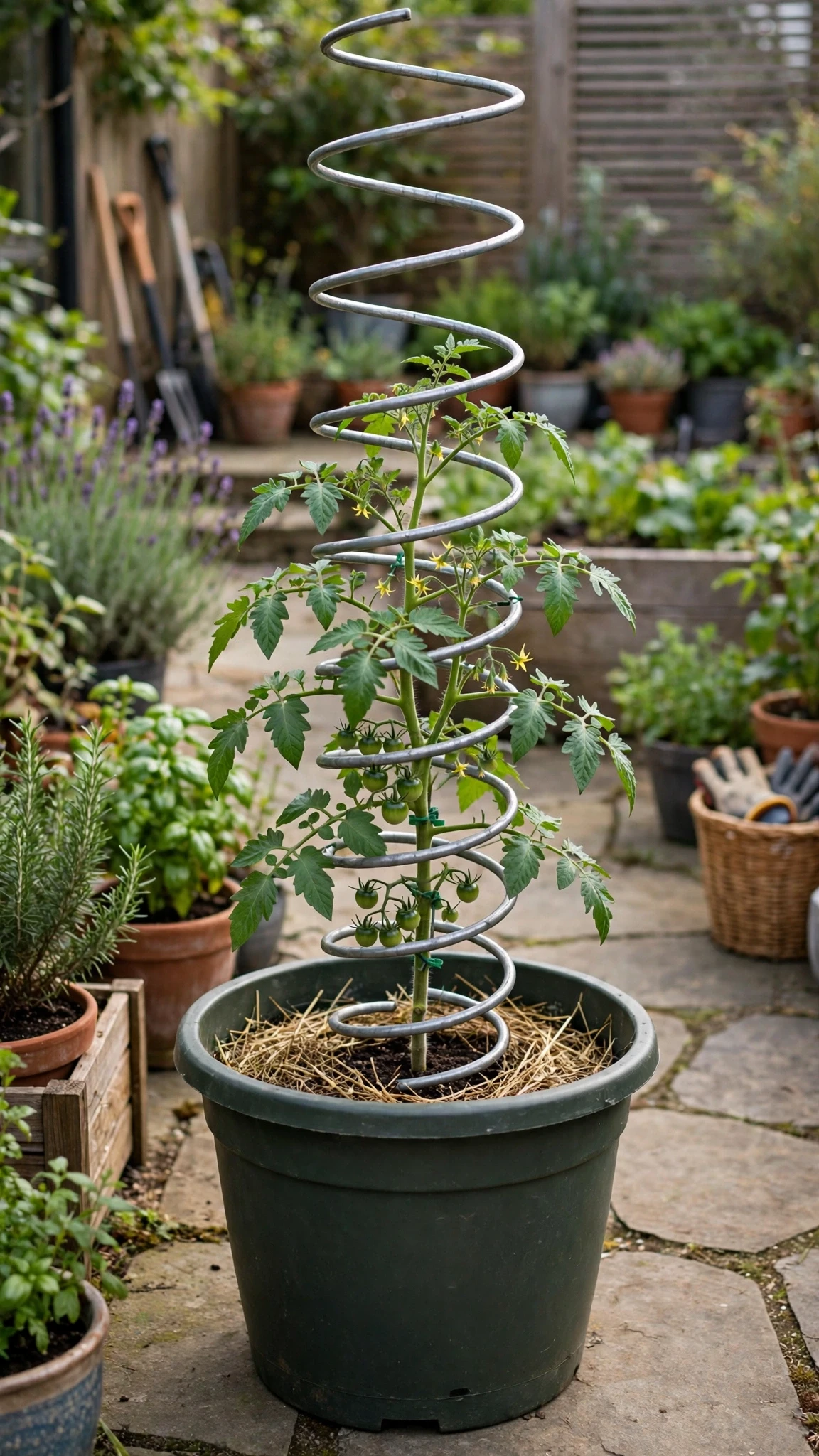
A metal spiral, pushed into the soil beside a single plant, guides one tomato upward in a tight, decorative column. It takes up almost no ground space, which makes it ideal for containers, small raised beds, and patios where a frame would dominate. The spiral shape also looks good in its own right, turning a single cherry tomato plant into a small garden feature.
Match the spiral to the plant: a 1.8-metre spiral suits tall cherry varieties, while compact bush types manage with a shorter one. Use a pot at least 30 centimetres across and heavy enough that the plant cannot topple it, and push the spiral deep into the compost before planting. Guide the main stem around the spiral weekly, and prune side shoots lightly so the column stays open to light and air.
10. A PVC Pipe Frame You Can Build, Move, and Store Flat
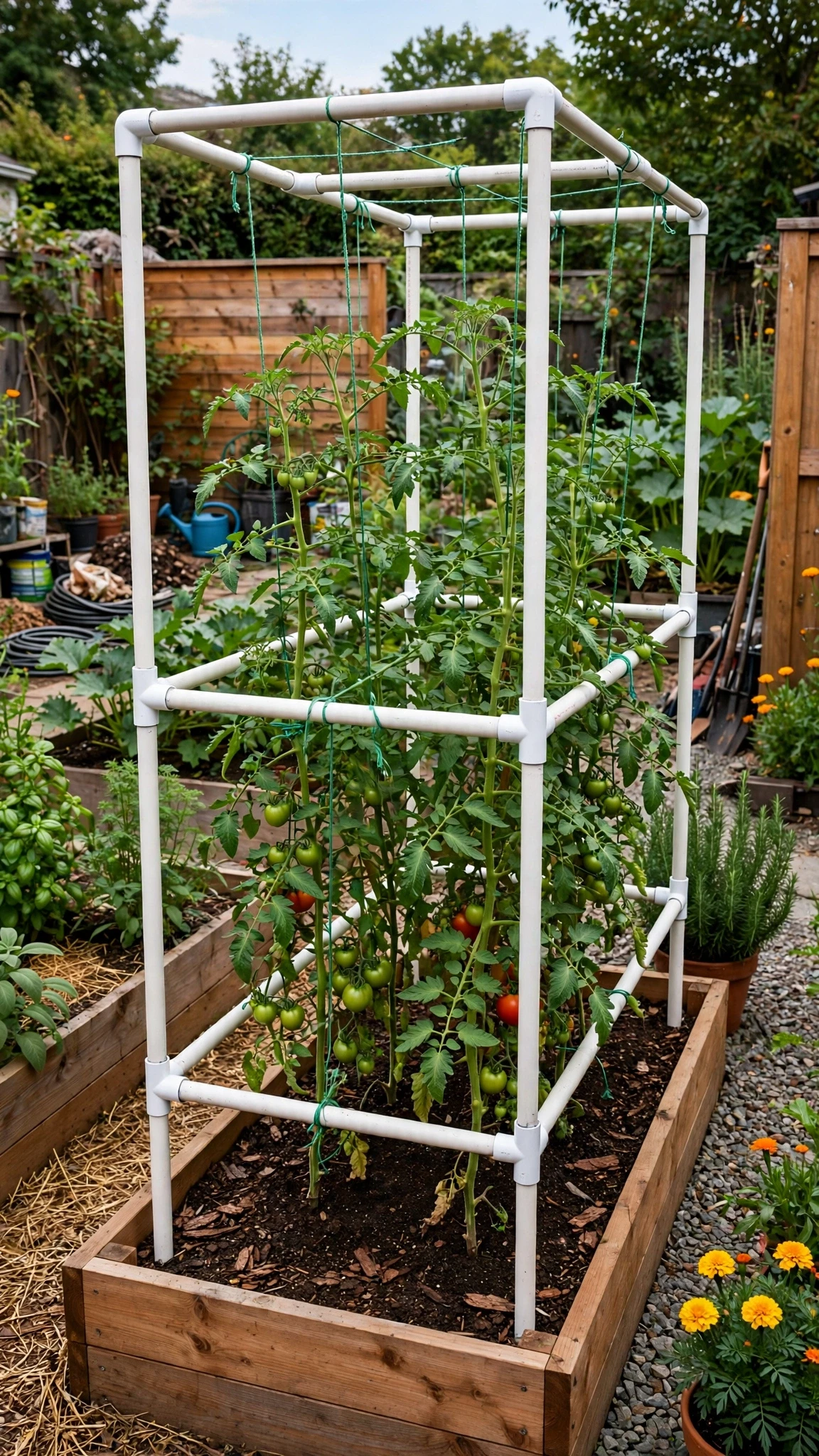
PVC pipe makes a trellis that is light, weatherproof, and easy to take apart. Lengths of pipe joined with elbow and tee fittings form a vertical frame or a small A-frame, and the whole thing can be carried by one person, moved to a new bed, or stored flat in winter. It never rots, never rusts, and costs far less than a metal equivalent.
Use pipe at least 25 millimetres in diameter so the frame stays rigid under a loaded plant, and glue only the joints you never want to separate, leaving the rest as push-fits for dismantling.
Anchor the feet with short stakes or by pushing the legs into the soil, since PVC is light and wind can shift it. Paint the pipe a garden colour if the bright white bothers you, and the frame will blend into the bed within a season.
11. A Cattle Panel Arch You Can Walk Under
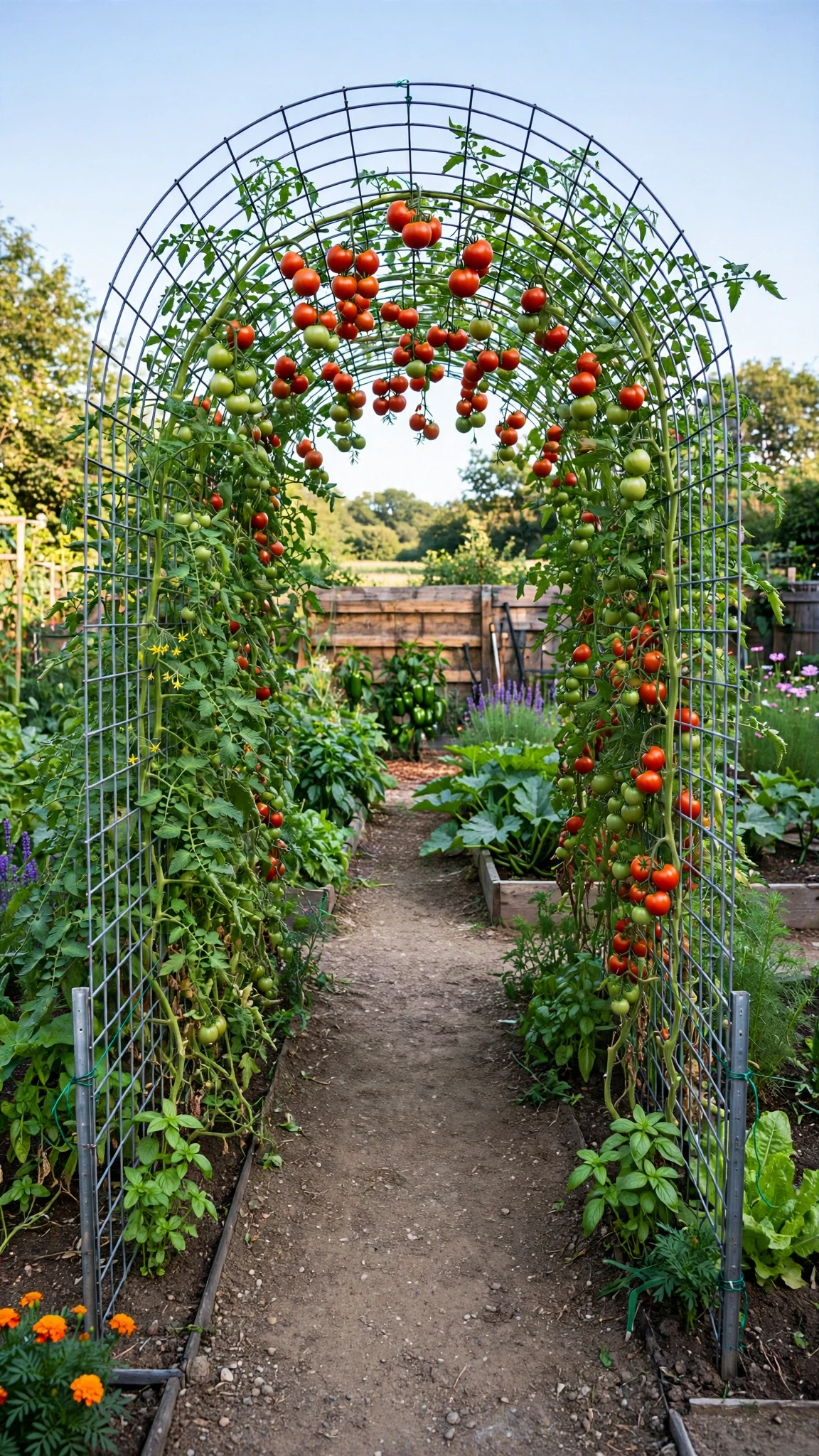
A cattle panel bent into an arch turns a garden path into a tunnel of tomato vines, with fruit hanging overhead at picking height. It is the most striking idea in this list and one of the most practical: two rows of plants climb the two sides, the arch shades the path on hot days, and harvesting means walking through and picking from above, below, and both sides.
A standard 5-metre panel bent into an arch gives a walk-through around 2 metres high, with the path beneath about 1.2 metres wide.
Anchor both ends firmly with T-posts driven deep, since a loaded arch pushes outward, and prune the inside of the tunnel so it stays open enough to walk through. Plant indeterminate varieties on both sides for the fullest tunnel, and keep the path surface firm so picking stays pleasant even after rain.
12. The Florida Weave for Long Rows of Tomatoes
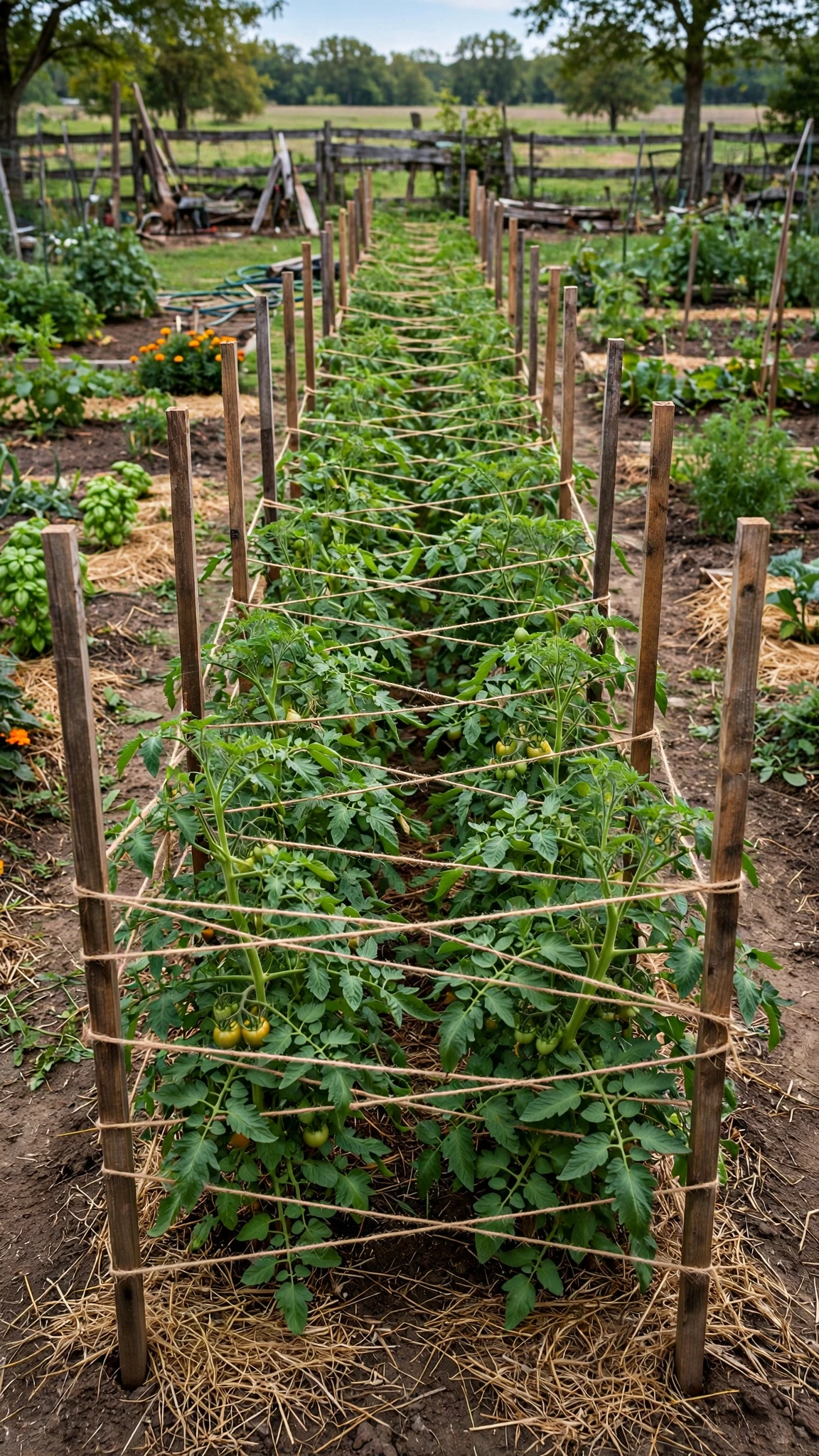
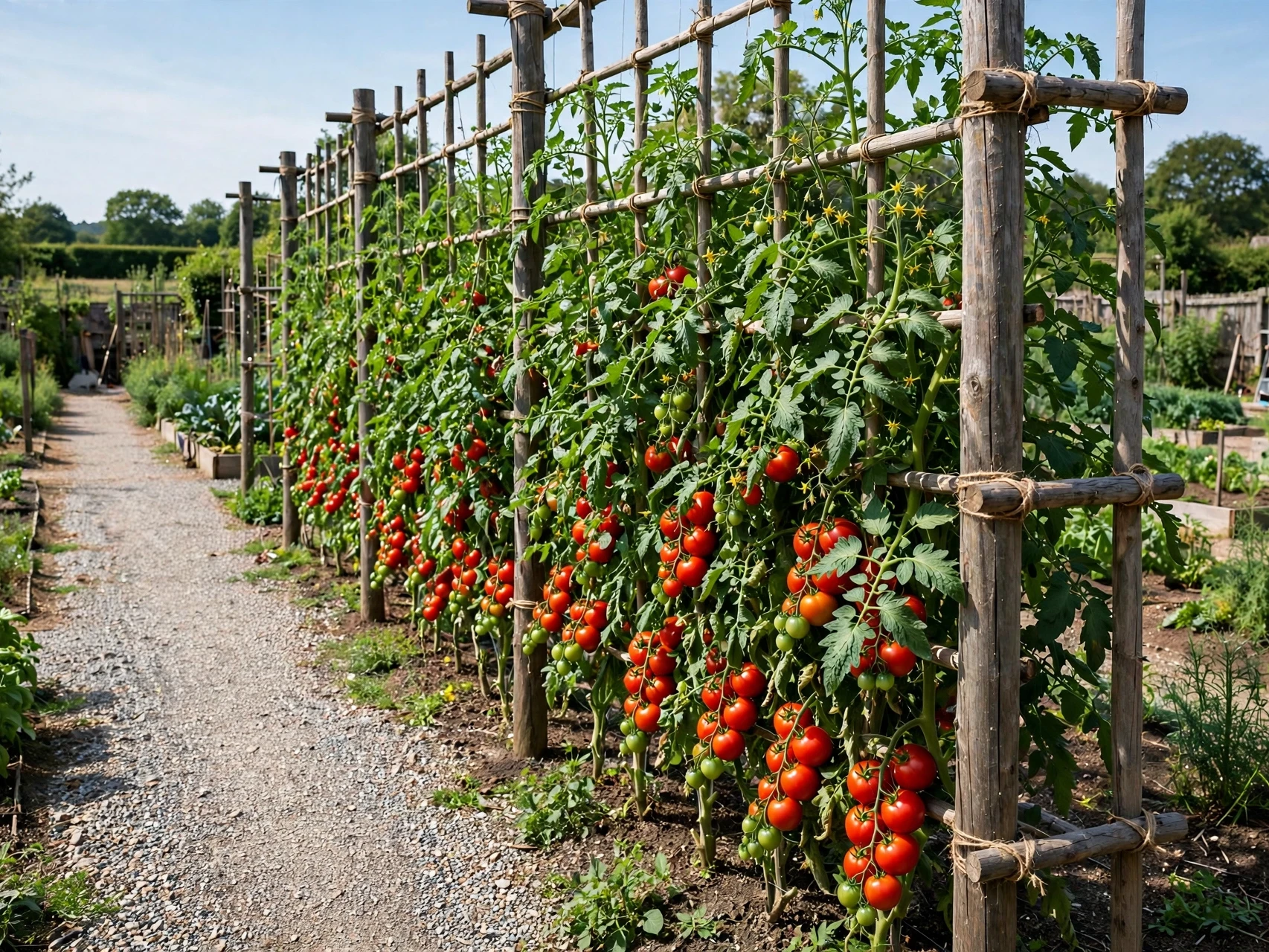
The Florida weave is the method market gardeners use for long rows, and it scales beautifully to a home garden with a dozen plants in a line. Stakes go in every two or three plants, and twine is woven back and forth down both sides of the row, sandwiching the stems between two lines of string. Each time the plants grow another 25 centimetres, a new weave level goes on, and the row stays upright all season.
Space stakes about 1.8 metres apart and drive them at least 30 centimetres into the ground, since a whole row of fruit pulls hard. Start the first weave when plants are about 30 centimetres tall, and keep the twine taut — slack twine lets plants lean and snap. The weave suits determinate and semi-determinate varieties best, whose growth stays within the row, and it uses far less material than a cage per plant.
13. An Overhead Wire System With Drop Strings
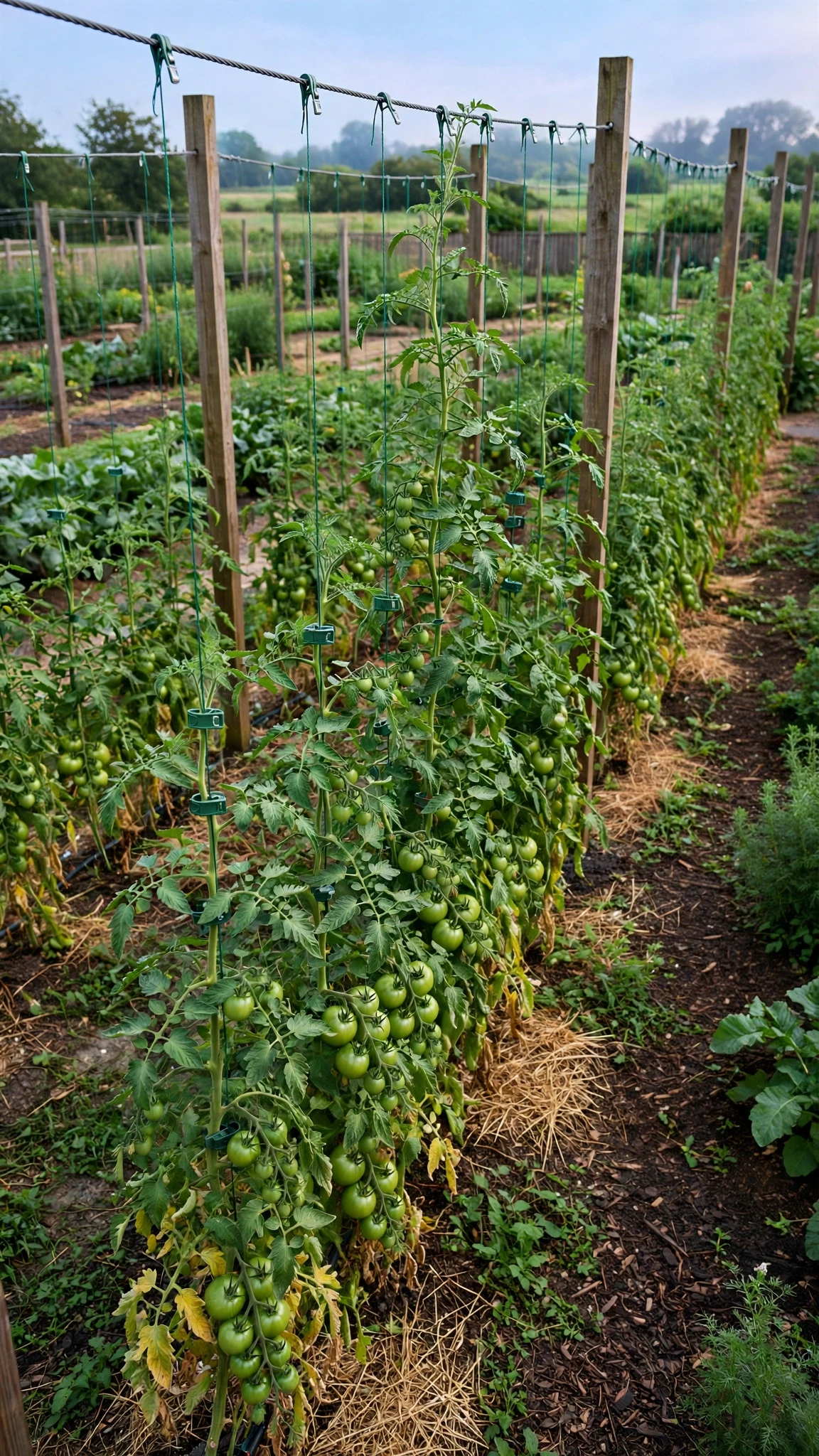
An overhead wire system borrows the greenhouse method for tall indeterminate tomatoes. A strong wire runs high above the row, supported by sturdy end posts, and a string drops from the wire to each plant. Vines are clipped to their strings and, as they grow past the wire, lowered and looped so fruit always hangs within reach — a plant can grow many metres long over a season without ever outgrowing its support.
Set the wire at least 2 metres high, and use end posts sunk deep with diagonal braces, since the whole row’s weight hangs from it. Tomato clips are faster than tying and gentler on stems, and lowering vines weekly keeps the picking zone at waist to shoulder height. This system suits gardeners with several tall varieties in a row and rewards a little weekly attention with the heaviest harvests of any method here.
14. A Wall-Mounted Grid for Patios and Balconies

A flat grid or mesh panel fixed to a sunny wall or balcony rail gives container tomatoes a trellis without taking a single centimetre of ground. The plant grows flat against the wall, fruit hangs where it can be seen and picked, and the wall itself radiates warmth that helps tomatoes ripen. It is the best answer for patios, balconies, and tiny yards where a freestanding frame simply will not fit.
Fix the grid with wall plugs and screws rated for a loaded plant — a mature tomato in a large pot can weigh 15 kilograms or more — and leave a small gap behind the panel so air moves and stems do not rub the wall. Use pots at least 35 centimetres across, water more often than beds since pots dry fast against warm walls, and choose cherry or compact varieties that will not outgrow the panel by midsummer.
15. A Slanted Lean-To Panel for Sunny Walls and Fences
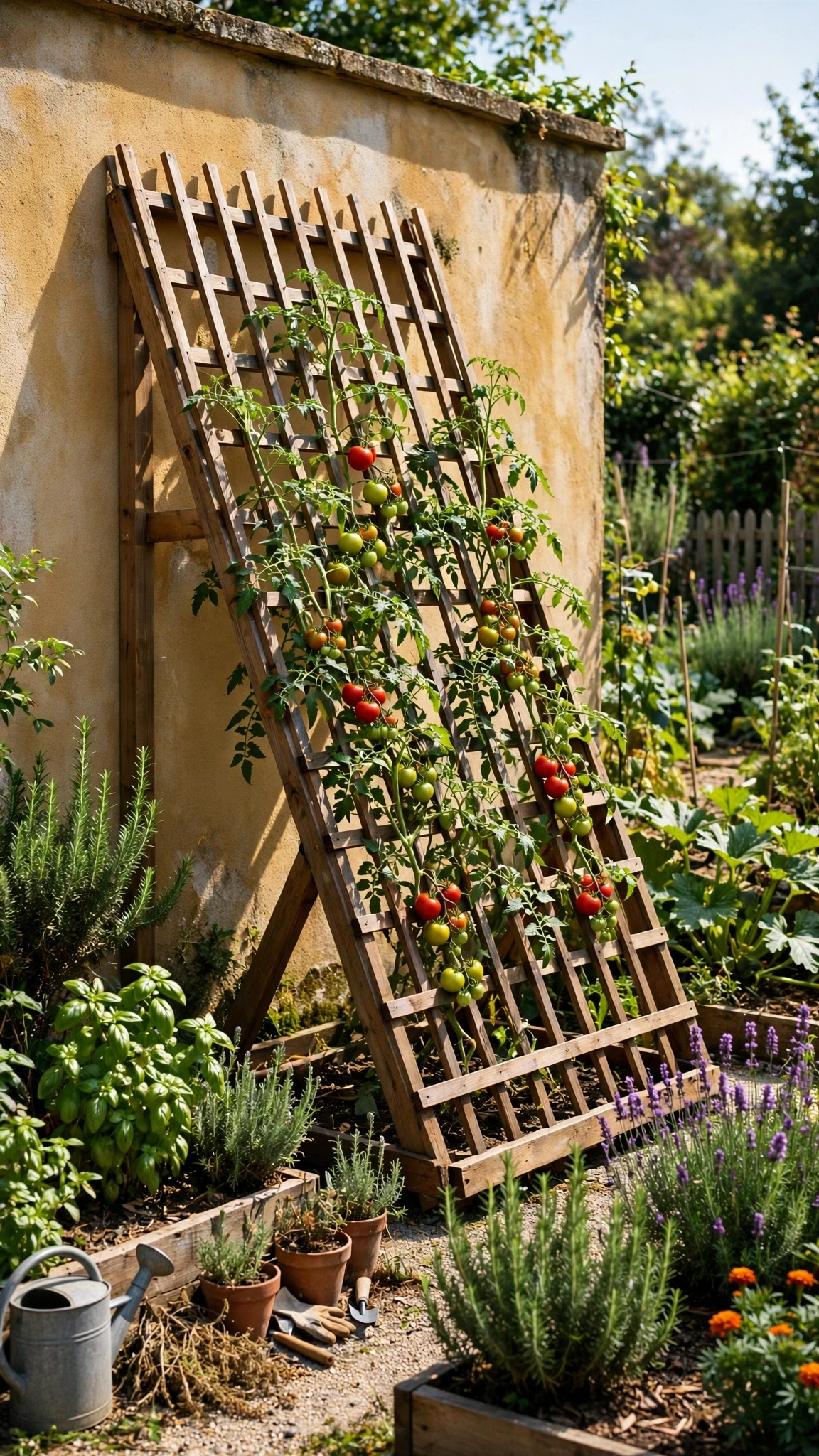
A panel leaned against a sunny wall or fence at a gentle angle catches sun on a warm, sheltered face, and tomatoes love it. The slant means fruit hangs slightly forward, easy to see and pick, while the wall behind stores daytime heat and releases it at night. It suits south-facing walls, fences, and the sunny side of sheds, turning dead vertical space into productive growing room.
Lean the panel at roughly 70 to 75 degrees from the ground — steep enough to hold plants upright, shallow enough to catch sun — and fix the top to the wall so wind cannot pull it forward. Leave a gap of 10 to 15 centimetres behind the panel for airflow, and watch watering on very hot walls, where reflected heat dries soil fast. A lean-to panel suits one or two plants per panel and pairs well with heat-loving varieties like beefsteak and plum tomatoes.
How to Match a Trellis to Your Tomato Type, and When to Set It Up
The single most important choice is matching the trellis to how your tomato grows. Indeterminate varieties keep growing and fruiting until frost, so they need tall, strong supports — string systems, overhead wires, tall frames, or arches — that can be extended or lowered through the season. Determinate varieties grow to a set height, fruit all at once, and stop, so a cage, a short frame, or a Florida weave row suits them perfectly and needs far less attention.
Timing matters as much as type. Set the trellis up at transplant time, before the plant has grown enough to sprawl, because wrestling a full-grown plant onto a support breaks stems and costs fruit. Start tying when plants reach about 30 centimetres, tie loosely with soft material, and check ties every week or two through the season, loosening any that have grown tight. A trellis installed early and tied gently will carry a plant through the whole season without drama.
FAQWS
What is the best trellis for tomatoes?
The best trellis depends on your tomato type and garden size. Tall indeterminate varieties suit string systems, overhead wires, or cattle panel arches, while bush determinate types do well in cages or short frames. For most home gardens, a sturdy wooden frame or string trellis gives the best mix of strength, airflow, and easy harvesting.
How tall should a tomato trellis be?
A tomato trellis should be at least 1.5 metres tall for bush varieties and 1.8 to 2.4 metres for tall indeterminate types. Plants that outgrow their support flop over and break, so check the mature height on the seed packet first. When in doubt, build taller — an extra 30 centimetres costs little and saves a mid-season rebuild.
Do tomatoes need a trellis?
Tomatoes do not strictly need a trellis, but supported plants grow healthier and crop far better. Unsupported plants sprawl on damp soil, where fruit rots and slugs and disease spread quickly. A trellis lifts fruit into light and air, keeps leaves drier, and makes harvesting much easier, so almost every gardener benefits from one.
What is the cheapest tomato trellis?
The cheapest tomato trellis is a simple string system or a bamboo teepee, both buildable for very little money. String, a top beam, and a few stakes support a whole row, while three bamboo poles tied at the top support one plant. Reclaimed pallets and ladders cost nothing if you already own them, making them excellent budget options too.
How do you tie tomatoes to a trellis?
Tie tomato stems loosely to the trellis with soft twine, cloth strips, or purpose-made tomato clips. Loop the tie around the stem first, then around the support, leaving room for the stem to thicken as it grows. Start tying when plants reach about 30 centimetres, and add new ties every 20 to 30 centimetres of growth through the season.
Can you grow tomatoes in containers with a trellis?
Yes, tomatoes grow very well in containers with a trellis. Use a pot at least 30 centimetres across, a spiral support, a small cage, or a wall-mounted grid for patios and balconies. Container plants dry out faster than beds, so water often and feed regularly, and choose cherry or compact varieties that suit the smaller root space.
When should you set up a tomato trellis?
Set up a tomato trellis at transplant time, before the plant grows large enough to sprawl. Installing support early avoids broken stems and lets you guide growth from the start. If you missed that window, install it as soon as possible and guide stems gently, but expect some breakage if plants are already large and tangled.
Conclusion
The right tomato trellis is the one that matches your tomato type, your space, and the time you can give it. A tall indeterminate vine wants a string system or an arch it can climb all season, a bush tomato is happy in a cage, and a patio gardener can grow a fine crop on a single wall grid.
Start with one build before planting season, whether a wooden frame, a bamboo teepee, or a simple string row, and see how much easier growing tomatoes becomes when plants stand upright and every fruit is within reach. The best trellis is the one you actually build.