

Small Bedroom Ideas: 19 Ways to Make a Tiny Room Feel Bigger
A small bedroom has a way of feeling like a puzzle you never quite finish. Every extra pillow or stray charger cable seems to shrink the room a little more. The good news: most of what makes a small bedroom feel cramped has nothing to do with square footage and everything to do with a handful of fixable choices, color, furniture scale, and how you use the walls. Anything under roughly 100 to 120 square feet counts as genuinely small, and the ideas below are built for exactly that range, whether your room is a tidy square, a narrow rectangle, or tucked under a sloped attic ceiling.

Get the Wall Color Right

Paint gets blamed for a lot in small bedrooms, and most advice stops at “go white.” That’s only half the story. A light, warm neutral, warm white, soft greige, or pale sage, reflects more light and pushes the walls back visually, which is what actually makes a room read as larger. Stark, cool white can flatten a room and make it feel clinical rather than calm.
Where this falls apart is when people treat “light and neutral” as a ban on color. It isn’t. A single wall in a deeper tone, charcoal, forest green, aged terracotta, works fine in a small bedroom as long as the other three walls stay light and the trim doesn’t fight it. The dark wall becomes a backdrop instead of a boundary, and it can make the room feel more intentional, not smaller.
Practical Tip: Best for bedrooms with decent daytime natural light, since a dark accent wall in a genuinely dim room can tip into gloomy rather than cozy.
Place a Mirror Where It Actually Works

Mirrors get recommended so often that the advice has gone stale, and placement rarely makes it into the article. A mirror doesn’t add space just by existing, it adds space by reflecting something worth reflecting. Hang one full-length or leaning mirror directly across from the window, not tucked into a corner, so it bounces daylight back into the room instead of reflecting a wall or a pile of laundry.
Skip the temptation to scatter several small decorative mirrors around the room. A cluster of little mirrors reads as decor, not depth, and adds clutter in a room that doesn’t have room for it. One larger mirror does more work than five small ones combined.
Practical Tip: A mirror facing the bed can be unsettling for some people to wake up to. Angle it toward a dresser or closet instead if that’s a concern.
Layer Your Lighting

A single ceiling fixture is doing more damage to a small bedroom than most people realize. One bright, central light source flattens the whole room and makes every shadow fall in the same predictable place, which reads as small and boxy rather than layered and calm.
The fix is to think in three layers: ambient light from a flush-mount fixture for general visibility, task light from a wall-mounted sconce or a small reading lamp near the bed, and accent light, a warm LED strip inside a closet or along a shelf, for texture after dark. None of this requires an electrician if you’re renting; plug-in sconces and battery LED strips get you most of the effect without any wiring.
Wall-mounted sconces free up the nightstand entirely, which matters more in a small room than it sounds like it would. Every inch of surface not covered by a lamp is an inch that can hold something else, or nothing at all.
Practical Tip: A pair of plug-in sconces typically costs less than one decorative table lamp, and skips the electrician entirely.
Choose a Low, Leggy Bed Frame

The bed is the biggest object in the room, so its shape sets the tone for everything else. A platform bed that sits flush to the floor, with no visible gap underneath, reads as heavier than it is, it blocks the eye from following the floor across the room, which is exactly the continuous sightline a small bedroom needs.
Look for a frame with legs that lift it a few inches off the ground, or a slim metal frame instead of an upholstered box. The visual difference is bigger than the physical one: seeing floor beneath the bed makes the whole room feel like it has more air in it, even though the bed itself hasn’t gotten any smaller.
Practical Tip: This trades off with storage, a bed with visible legs can’t double as under-bed storage the way a platform bed can. If you need that space, a storage bed with drawers built into the base is the better compromise than a solid platform.
Trade a Wide Dresser for a Tall, Narrow One

A wide, low dresser eats floor space and wall space at the same time, which is the worst combination in a small room. A tall, narrow chest of drawers holds a similar amount of clothing in a fraction of the footprint, and the vertical shape draws the eye up rather than sideways.
As a rough guide for what counts as small-bedroom-friendly:
| Furniture | Standard size | Small-bedroom-friendly size |
|---|---|---|
| Dresser | 60 in wide, 18 in deep | 30-36 in wide, 16-18 in deep |
| Nightstand | 24 in wide, 18 in deep | 14-16 in wide, 12-14 in deep, or wall-mounted |
| Walkway | – | at least 24-30 in clear on the main path |
Practical Tip: If the closet has more hanging space than you actually use, moving the dresser inside it, even a narrow one, can free up an entire wall in the main room.
Swap the Nightstand for a Floating Shelf

A standard nightstand can take up more floor space than people realize, especially in a room where every square foot matters. A floating shelf, even a simple 10 to 12 inch deep one, gives you a place to set a glass of water and a book without needing four legs on the floor.
If you’d rather keep a surface with a drawer, a slim wall-mounted table that folds down or a narrow console works, as long as it’s shallower than a standard 18-inch nightstand. In a very tight layout, it’s fine to use one nightstand instead of two and let the far side of the bed sit closer to the wall.
Practical Tip: Floating shelves mean less hidden storage, so anything you’d normally toss in a nightstand drawer needs another home, a small basket on the shelf works well.
Use the Back of the Door

The back of a bedroom door is one of the most overlooked storage surfaces in a small room, mostly because it’s not visible when the door is open. An over-the-door organizer with fabric pockets or a row of hooks can hold shoes, bags, scarves, or jewelry without touching a single wall or piece of furniture.
This works especially well for things you use daily and would otherwise leave out on a dresser top, a robe, a gym bag, tomorrow’s outfit. It keeps those items handled and visible without adding to the room’s visual clutter, since the door swings most of it out of sight when closed.
Practical Tip: Check that the door doesn’t need to stay flush for a fire code or building requirement, which is worth confirming in older apartment buildings before hanging anything on it.
Make the Under-Bed Space Work

Under-bed storage gets recommended constantly, but the advice usually stops at “use bins,” with no guidance on what actually belongs there. Reserve the space for things you don’t need weekly, off-season clothing, spare bedding, luggage, rather than everyday items that will mean crouching down and digging through bins every morning.
Low, flat storage boxes with lids work better than open bins, since a lid keeps dust out and keeps the space from reading as overflow storage if anyone glances underneath. Matching bins in one material or color also make the space look intentional rather than like the room ran out of storage everywhere else.
Practical Tip: A bed frame with built-in drawers is worth the extra cost if you’re buying new furniture anyway, it skips the crouching entirely and tends to hold more than loose bins in the same footprint.
Go Vertical With Shelving

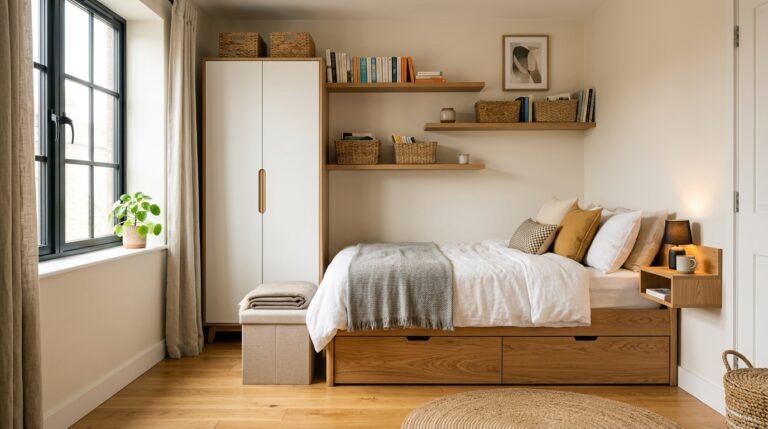
Floor space in a small bedroom is finite, but wall space almost never gets used to its full height. Floor-to-ceiling shelving beside the bed or flanking a window turns a narrow, often-wasted strip of wall into real storage and display space, and it draws the eye upward, which makes the ceiling feel higher than it is.
Open shelving works best when roughly a third of it stays empty or holds something plain, books spine-in, a plain ceramic vase, rather than filling every inch with small objects, which starts to look cluttered fast in a small room. Closed upper cabinets are the better choice if you’d rather not dust and straighten shelves regularly.
Practical Tip: Shelving that goes all the way to the ceiling needs a step stool for the top two shelves, so keep daily items lower and seasonal ones up high.
Pick Furniture With Built-In Storage

Multi-functional furniture is one of those phrases that shows up everywhere and means almost nothing on its own. What actually helps is naming the specific swap: a storage ottoman standing in for a bedside bench, or a headboard with built-in cubbies replacing a nightstand entirely.
A storage bed frame is the biggest version of this, drawers built into the base instead of a separate dresser can genuinely remove a whole piece of furniture from the room. A bench at the foot of the bed with a lift-up lid does something similar on a smaller scale, holding extra blankets while still working as a place to sit and put on shoes.
Practical Tip: Retrofitting existing furniture this way usually isn’t practical, this idea works best when furnishing the room from scratch rather than upgrading piece by piece.
Hang Curtains High and Wide

Curtains hung at the exact width and height of the window frame make that window look smaller, not bigger, which is the opposite of what a small bedroom needs. Mount the rod 4 to 6 inches below the ceiling rather than right above the frame, and extend it 6 to 10 inches past the window on each side.
The window itself doesn’t change size, but the eye reads the curtains, not the glass, so a wider and taller frame of fabric makes the whole wall feel taller and the window feel larger than it is. Floor-length panels finish the look; curtains that stop short of the floor tend to visually cut the wall in half.
Practical Tip: A tension rod skips the drilling entirely and still allows for the higher, wider mounting, ideal for renters.
Build One Focal Point, Not Many

A small bedroom with five different things competing for attention, a gallery wall, patterned bedding, a bold rug, and a statement light fixture, ends up feeling busy rather than curated, even if every individual piece is nice on its own. Picking one focal point and keeping everything else quiet around it does more for the room than adding more decor.
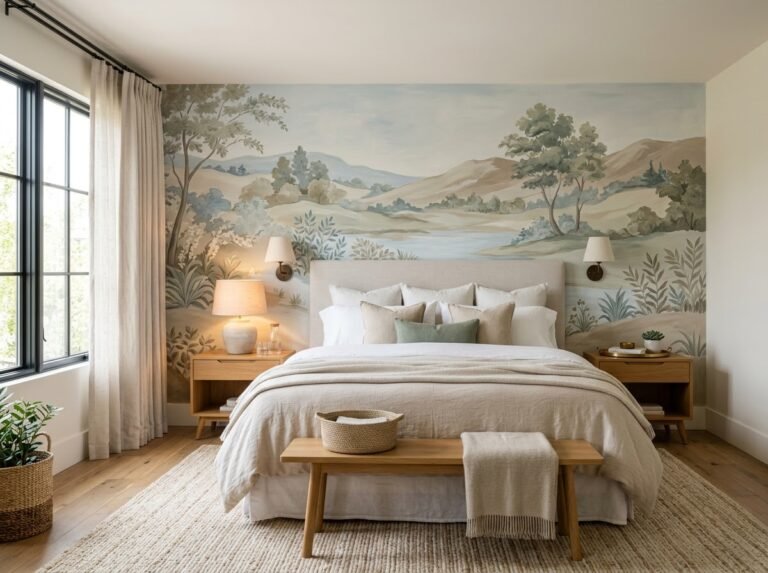
The bed itself is usually the natural choice: a textured headboard, one piece of oversized art above it, or a single patterned duvet can carry the whole room’s personality. Once that’s set, the rest of the room, walls, other textiles, smaller decor, can stay simple enough to support it instead of competing with it.
Practical Tip: A gallery wall isn’t off-limits, but treat it as the one focal point rather than an addition to an already-busy room.
Try a Daybed for a Flexible Room

In a bedroom that also needs to double as a guest space, home office corner, or reading nook, a daybed does something a standard bed frame can’t: it reads as seating during the day and sleeping space at night, without looking like a bed that’s just sitting there unused.
Positioned against a wall with a few cushions, a daybed can anchor a small sitting area in a room too tight for a separate chair. Many daybed frames also include a trundle or drawers underneath, which covers extra sleeping space or storage without adding a second piece of furniture.
Practical Tip: A daybed usually accommodates a twin or twin-XL mattress, so it’s not the right swap if the room needs to sleep two people every night.
Lay Out a Square Bedroom

Square rooms are the most forgiving shape to furnish, but that doesn’t mean any arrangement works. Center the bed on the wall facing the door if there’s room on both sides for a nightstand, this creates a symmetrical, calm layout and keeps a full walking path along the two side walls.
If the room is tight enough that centering the bed blocks the closet or a window, push it into a corner instead, headboard against one wall and one side against the adjacent wall. This sacrifices a nightstand on one side but frees up the rest of the room for a dresser or a small desk.
- Measure the longest uninterrupted wall and place the bed there first.
- Leave at least 24 inches of walking space on any side you can access.
- Put the dresser on the wall directly across from the bed so it doesn’t block the door swing.
- If a nightstand doesn’t fit on both sides, use one and a floating shelf on the other.
Lay Out a Narrow or Rectangular Bedroom
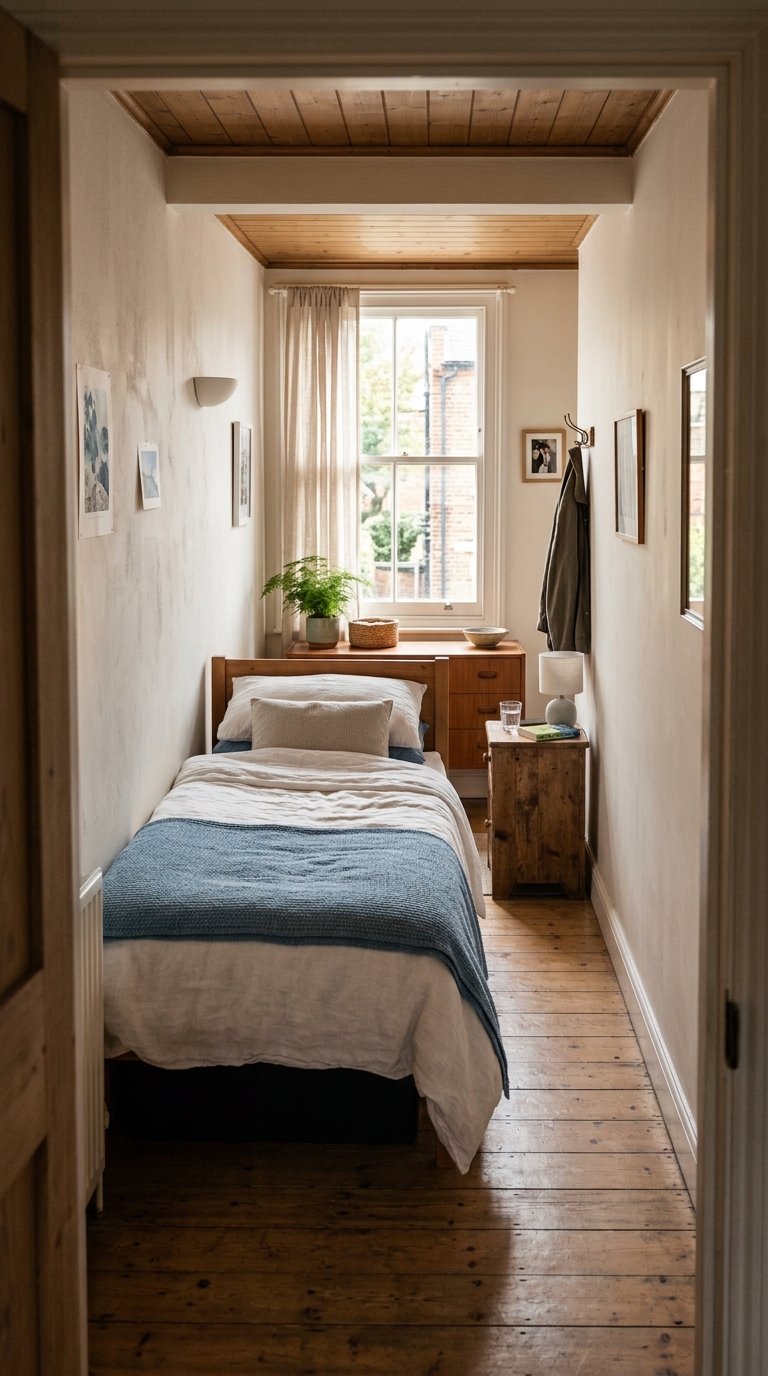
A narrow room punishes the wrong layout more than a square one does, because there’s rarely a second option if the first arrangement doesn’t work. Place the bed along the longest wall rather than the short one, pushing it against a short end wall usually blocks the only real walking path and makes the room feel like a hallway with a bed in it.
If the room is narrow enough that a bed centered on the long wall leaves no room to walk on one side, push it flush against that wall entirely and accept a single nightstand on the open side. A tall, narrow dresser at the foot of the bed works better than a wide one along a side wall, since it won’t compete with the walkway.
- Place the bed on the long wall, not the short one.
- Keep one full-length walking path clear, even if it means only one nightstand.
- Use the foot of the bed for a slim dresser rather than the side walls.
- Mirrors on the short end walls can visually widen the narrow dimension.
Lay Out an Attic or Sloped-Ceiling Bedroom

Sloped ceilings make furniture placement feel like a puzzle, but the low sections of the room aren’t actually wasted space, they’re just the wrong spot for anything you need to stand near. Put the bed under the lowest part of the slope, since you’re lying down there anyway and don’t need headroom, and reserve the tallest section of the room for anything you’ll be standing at, like a dresser or a desk.
Built-in or custom shelving that follows the slope of the ceiling makes use of an area that standard rectangular furniture can’t fit into cleanly. A low bench or storage bins tucked into the shortest, tightest corners work better than trying to force a tall piece of furniture in where it won’t fit anyway.
- Sleep in the low zone, stand in the tall zone.
- Use angled or custom shelving to follow the slope instead of fighting it.
- Save the tightest corners for low, flat storage rather than furniture with height.
Decorate Like a Renter

Renters often assume small-bedroom decorating means waiting until they own the place, but most of the highest-impact ideas here don’t require paint, drilling, or a landlord’s permission. Peel-and-stick wallpaper on a single wall delivers the same visual effect as a painted accent wall and comes off cleanly at move-out. Tension rods handle curtains at any height without a single screw.
Command hooks and strips hold floating shelves, mirrors, and even light artwork, as long as you check the weight rating before hanging anything heavier than a picture frame. Furniture-based ideas, the leggy bed frame, the tall dresser, the under-bed storage, work exactly the same whether you own the walls or not, since none of them touch the building itself.
Practical Tip: Skip anything that requires cutting into a wall, moving outlets, or built-in shelving that isn’t freestanding.
Small Bedroom Decorating Mistakes to Avoid
- Buying furniture sized for a bigger room because it was a good deal. A dresser that doesn’t fit the wall it’s meant for ends up blocking a walkway no matter how nice it looks in the showroom.
- Filling every shelf and surface completely. A shelf with nothing on it does more for the room than one crammed edge to edge.
- Hanging a gallery wall and calling it the only decor decision the room needs. Without a single anchor piece, a busy wall can make the whole room feel smaller, not more personal.
- Skipping the walkway measurement. A room can look great in a photo and still be unusable if there’s no clear path from the door to the bed.
- Choosing a dark accent wall in a room with little natural light, which can tip a cozy room into a genuinely gloomy one.
FAQs
How small does a bedroom have to be to count as a small bedroom?
There’s no official cutoff, but most of the ideas here are built for rooms under roughly 100 to 120 square feet, think a single window, one uninterrupted wall, and just enough floor space for a bed and one or two other pieces of furniture.
What is the best bed size for a small bedroom?
A full or queen bed generally fits a small bedroom without overwhelming it, as long as at least 24 inches of walking space stays clear on one side. A king bed can work in a square room over roughly 10 by 10 feet, but it usually forces a single nightstand instead of two.
Should you skip a nightstand entirely in a very small bedroom?
Not entirely, a floating shelf or a slim wall-mounted table does the same job in a fraction of the footprint. Skipping a surface next to the bed altogether tends to create more visual clutter, not less, since phones and glasses of water still need somewhere to land.
Do dark accent walls make a small bedroom feel smaller?
Not if the other three walls stay light and the room gets decent natural light during the day. A single dark wall behind the headboard reads as a backdrop rather than a boundary. A genuinely dim room with all four walls painted dark is a different story.
What’s the best way to fit a desk into a small bedroom?
A narrow floating desk, 12 to 16 inches deep, mounted against the wall at the foot of the bed usually fits without blocking the walkway. A fold-down desk works even better in a very tight room, since it disappears against the wall when it’s not in use.
How do you make a small bedroom feel cozy instead of cramped?
The difference usually comes down to what’s on the surfaces, not the size of the room. A cluttered dresser top and an overstuffed nightstand read as cramped, while the same furniture with a single focal point and a few empty inches of breathing room reads as cozy.
Conclusion
None of this works as a checklist to complete in one weekend. Start with whatever’s causing the most daily friction, a blocked walkway, a nightstand you’re tripping over, walls that make the room feel darker than it is, and treat the rest as options rather than requirements. A small bedroom doesn’t need every idea on this list to feel bigger and calmer; it usually needs two or three that solve its specific problems. Pick the ones that match your room’s shape and your budget, and let the rest wait.



2 Comments