
Small Bedroom Closet Organization Ideas: 17 Smart Ways to Fit More
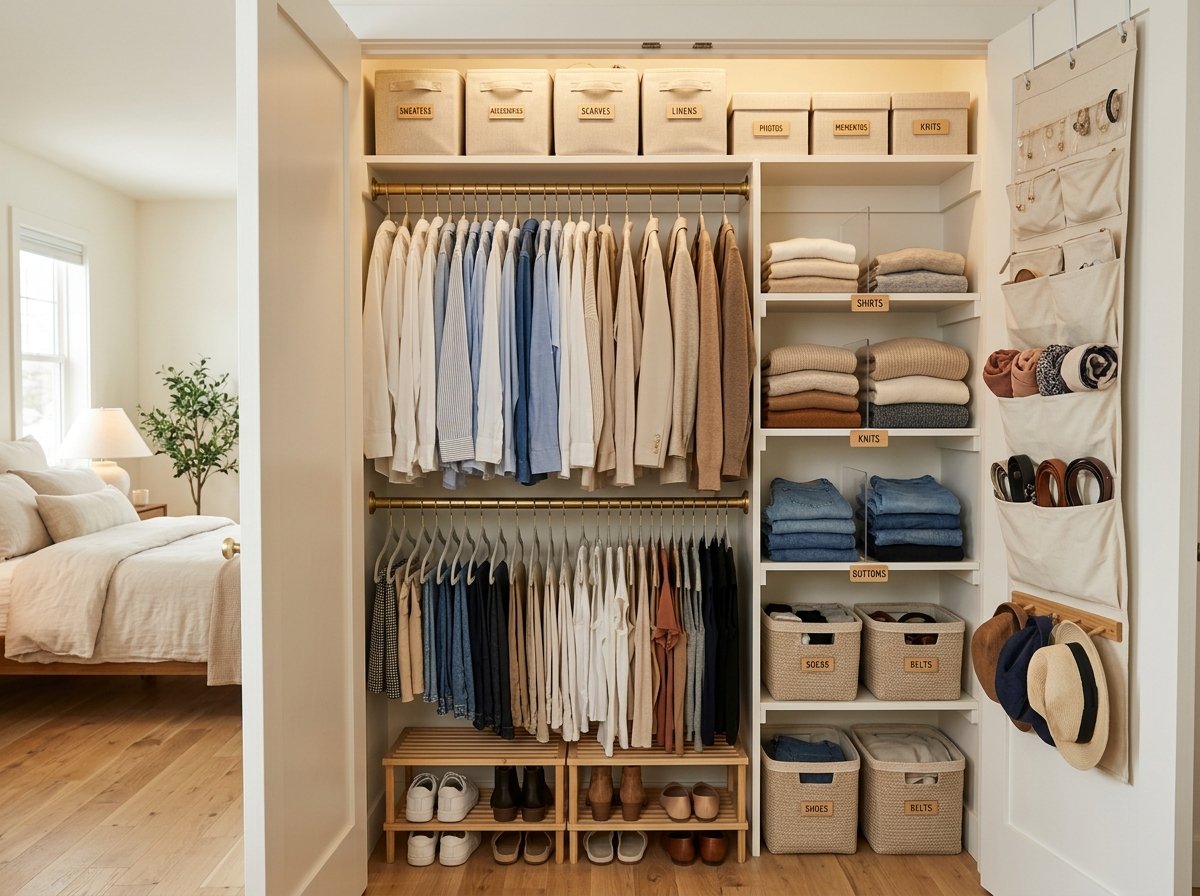
Small bedroom closet organization is mostly about using the space you already have more carefully. A closet that feels too small often wastes plenty of room. Bulky hangers eat up rod space, the area under short shirts sits empty, shoes spread across the floor, and the top shelf holds things you can’t reach.
This guide offers 17 distinct small closet ideas, grouped by where they go: the hanging rod, shelves, floor, door and walls, and top shelf. Each idea explains what it fixes, which closet it suits, and what to check before buying. Most are low-cost, and many need no drilling so that renters can use them too.
You don’t need to try all 17. Read through, spot the two or three that match your biggest frustrations, and start there.
Start Here: Measure and Edit Before You Buy Anything
The most common closet mistake happens at the store. People buy organizers first and discover later that the bin is two inches too wide or the shelf blocks the door. A short measuring session avoids that, and it also shows you which areas of your closet are being wasted.
Grab a tape measure and a notepad, then work through these steps:
- Measure the width, depth, and height. Include the space from the rod to the shelf above and from the rod to the floor.
- Note where the rod sits. Many single rods sit around 66 to 72 inches high, which leaves a large gap below short clothing.
- Empty everything onto the bed. Seeing it all at once makes it easier to judge what you own.
- Make four piles: keep, donate, sell, and store somewhere else (off-season items, keepsakes, rarely worn pieces).
- Sort the keep pile by how often you wear it. Daily items need the easiest spots. Occasional pieces can go higher, lower, or deeper.
Your closet type also changes which ideas work best. A shallow reach-in closet, often around 24 inches deep, suits slim hangers, shelf dividers, and over-the-door storage. A freestanding wardrobe can handle hanging drawers and inside-door hooks. If you have no closet at all, jump to the special situations section near the end.
1. Slim Matching Hangers
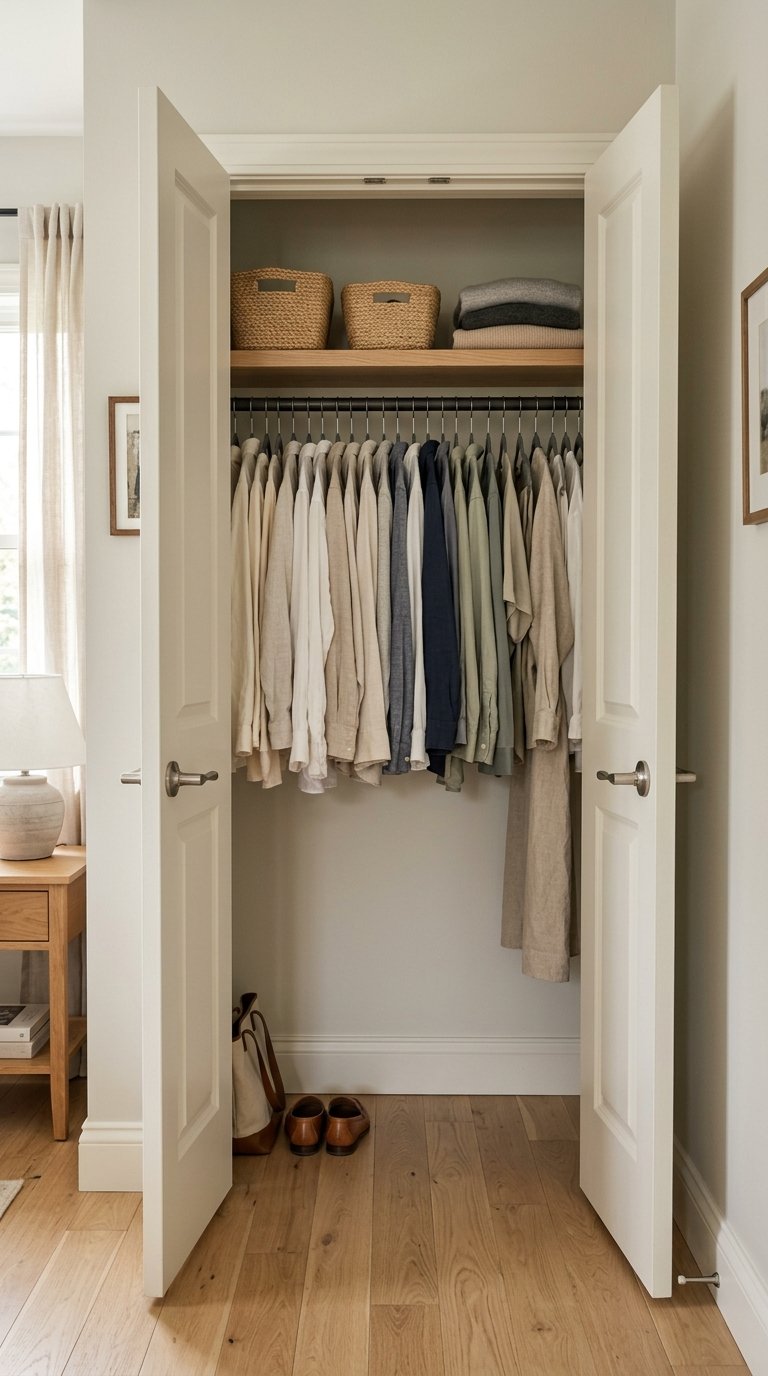
Hangers are the cheapest closet upgrade, and they often make the biggest immediate difference. Standard plastic and wooden hangers are thick, so a dozen of them can take up more rod space than the clothes themselves. Thin velvet or slim-profile hangers can fit noticeably more garments on the same rod, and the rod itself looks calmer when everything hangs at the same height.
The velvet surface also solves a smaller daily annoyance. Silky tops, tank straps, and wide-neck sweaters slide off smooth hangers and land on the floor. A grippy hanger holds them in place, so you spend less time picking things up and rehanging them.
Replace the whole set rather than a few at a time. Mixed hangers make even an organized rod look messy. Keep a handful of sturdier hangers for heavy coats and thick blazers, since very thin ones can bend under that weight.
2. Group Clothes by Category, Then by Length
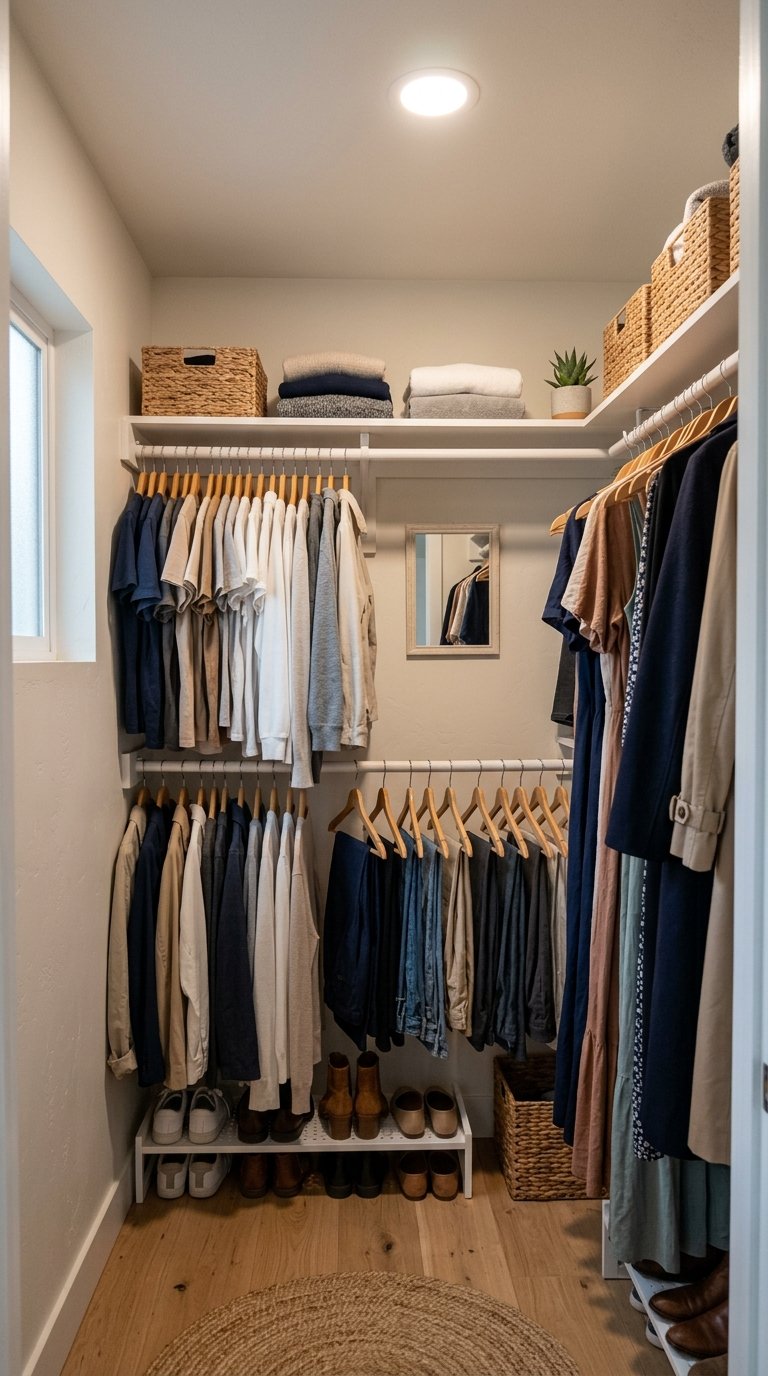
Before you add any new hardware, rearrange what’s already on the rod. Hang clothes in groups: shirts together, pants together, dresses together, jackets together. Inside each group, line them up from shortest to longest. This one habit makes the closet faster to use, and it quietly shows you where space is going unused.
A useful side effect appears right away. Short garments leave empty air underneath them, while long dresses and coats need full drop. Putting them on opposite ends of the rod creates one tall, clean section and one short section with a gap below. That gap is exactly what ideas like a second rod, a cube unit, or hanging drawers can fill.
If you like color order, add it as a second step inside each category. Color-sorting a whole small closet can backfire, because it scatters similar items across the rod. Category first, color second keeps the logic simple.
3. A Second Hanging Rod for Short Clothes
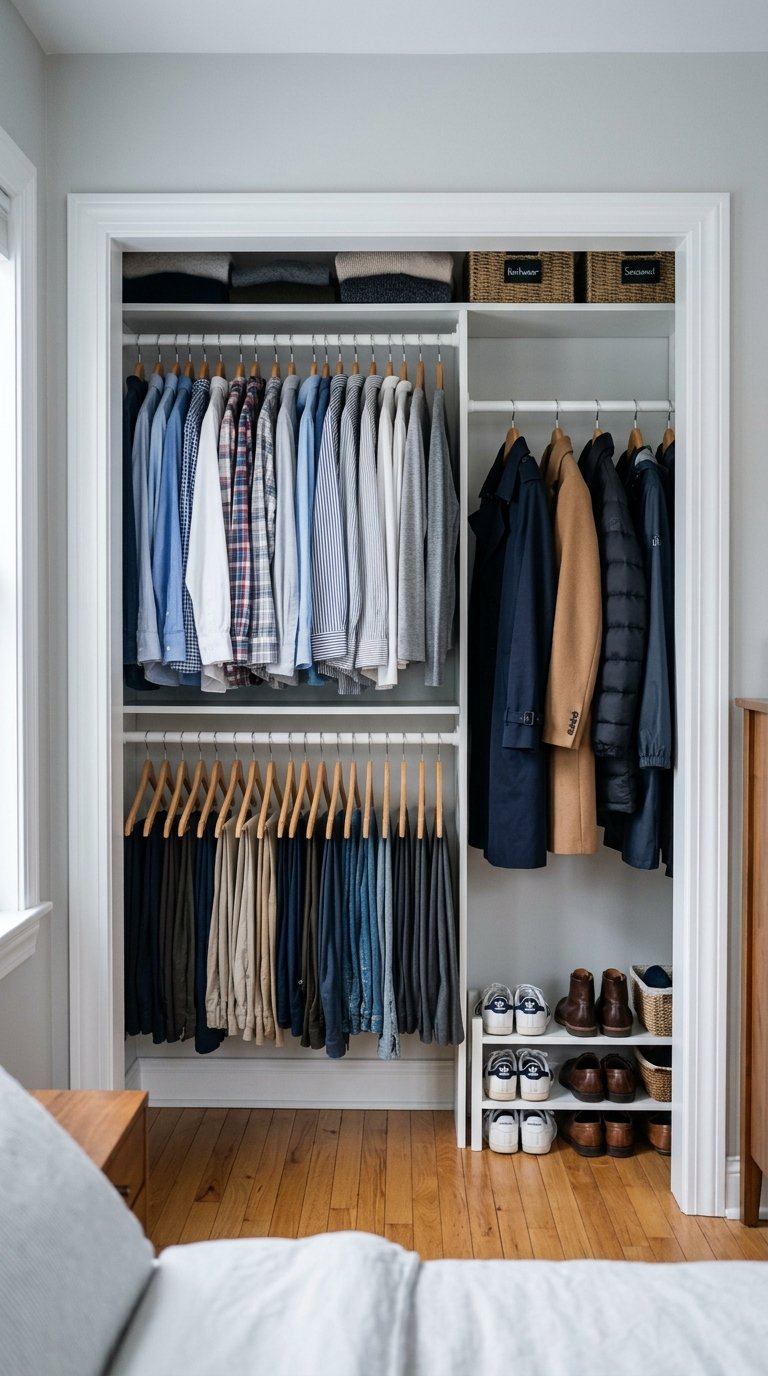
If your closet has one rod and a large space beneath your shirts, a second rod can nearly double your hanging capacity for short items. In a typical setup, the upper rod sits around 80 inches off the floor and the lower rod around 40 inches. Your exact numbers depend on your closet height, so measure your own clothes before buying anything.
A good rule of thumb is to check the drop of your most-worn pieces. Shirts and folded pants often need roughly 36 inches, while dresses and long coats need far more. Hang those on a separate single-rod section so they still reach the bottom without crumpling.
Renters can skip permanent installation. Hang-on double-rod add-ons attach to the existing rod and need no drilling. They’re slightly less stable than a fixed rod, so use them for lighter items rather than loaded winter coats.
A smart layout can make closet storage much easier to manage. These small bedroom layout ideas show how to position furniture while keeping doors, drawers, and walkways usable.
4. Tension Rods for Hidden Extra Storage
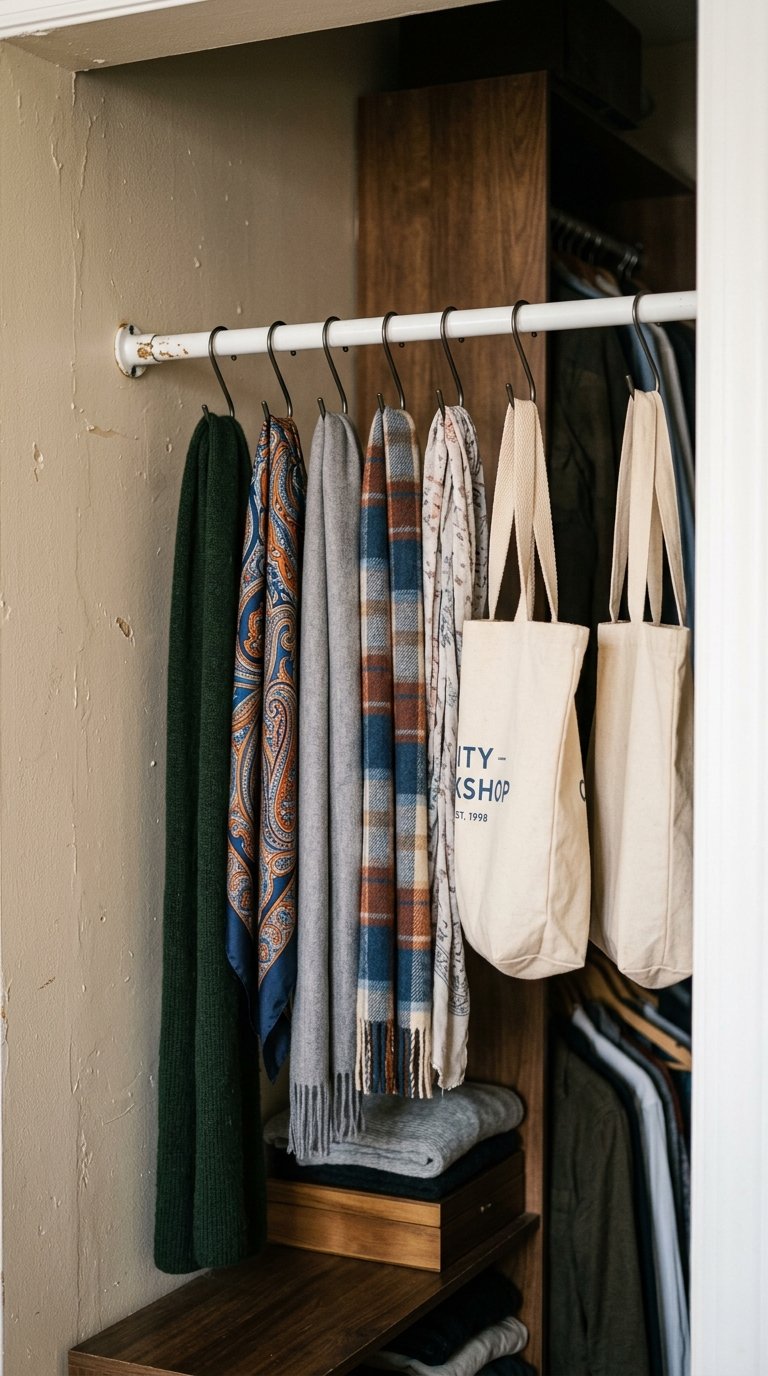
A tension rod stays in place by pressure alone, so it’s one of the quickest ways to add a storage level without a single screw. Wedge one between the closet’s side walls, or between a wall and a divider, and you’ve added a place to hang things. It takes under a minute, and it comes out cleanly when you move.
Pick a spot based on what you want to hang. A rod across a corner holds scarves or belts. One tucked under a shelf can carry a few lightweight bags on S-hooks. A short one running front to back along a side wall can hold slim items like ties or leggings on clip hangers.
Weight is the thing to watch. A tension rod grips the walls but can slip if you load it heavily or if the wall surface is smooth and glossy. Stick to light items, and test the rod by pressing down on it before you rely on it.
5. File Folding for Drawers, Bins, and Shelves
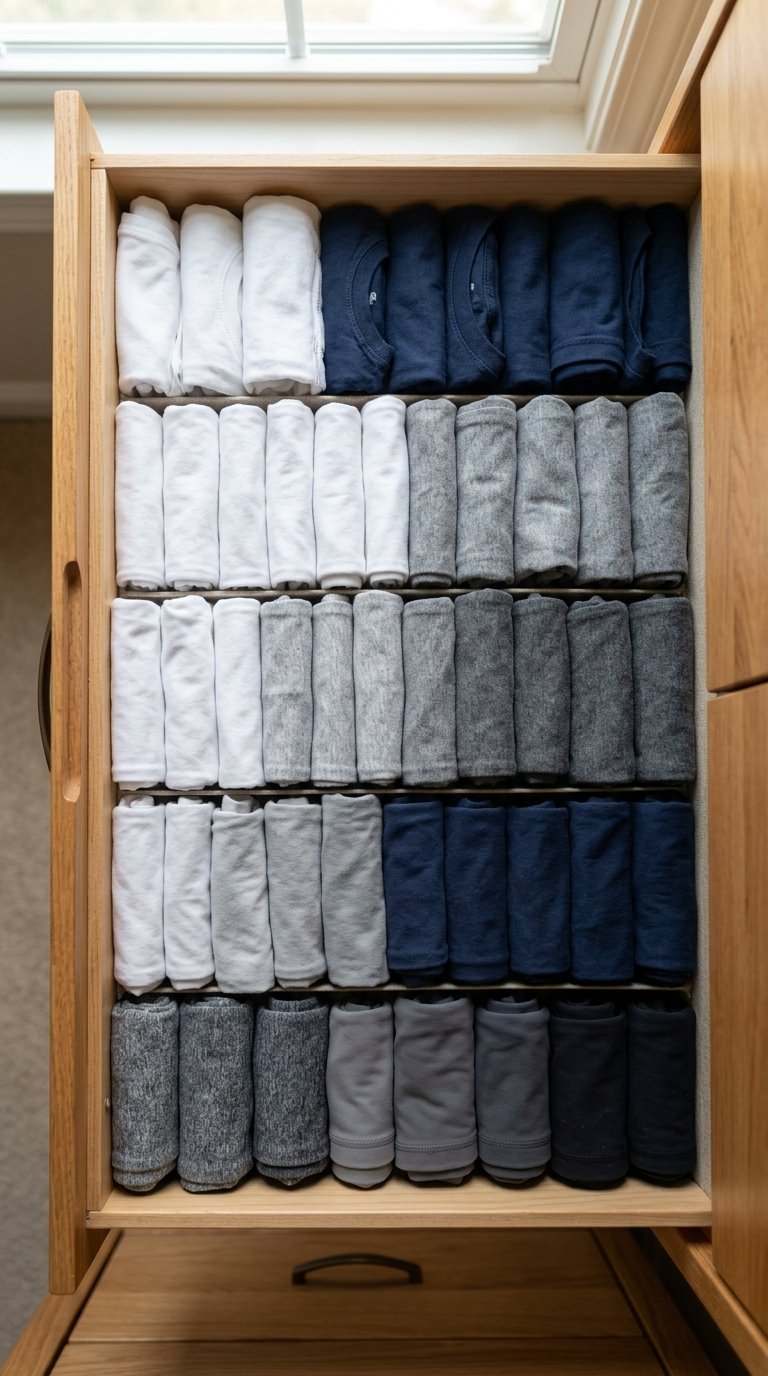
Stacked clothes hide whatever sits at the bottom. You pull out one T-shirt, and the pile collapses, so you end up refolding half the stack. File folding fixes this by standing each folded item upright, like files in a drawer, so every piece is visible from above.
This works for T-shirts, leggings, jeans, and soft knits. Fold the garment into a small rectangle, then fold it once more so it can stand on its own edge. Arrange them in rows with the folded edge facing up. You can see everything at once, and removing one piece leaves the rest standing.
It also helps to decide what to hang and what to fold. Wrinkle-prone items belong on hangers. Stretchy or bulky ones do better folded.
6. Shelf Dividers That Keep Stacks Upright
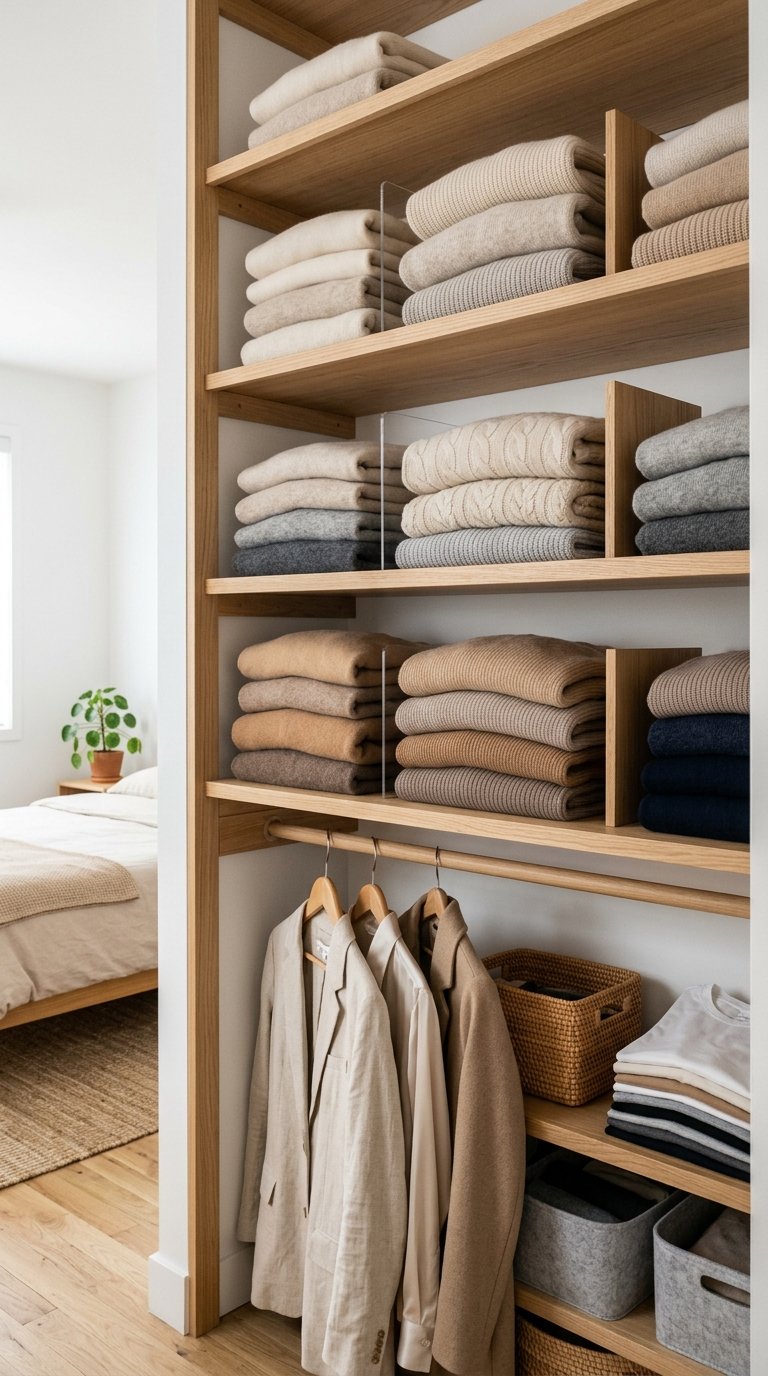
Open closet shelves cause a familiar problem. A stack of sweaters leans, slides sideways, and merges with the stack next to it. Shelf dividers are simple vertical panels that hold each stack in its own section, so one pile doesn’t collapse into another.
The material changes how the shelf looks. Clear acrylic stays almost invisible and suits white or light shelving. Wire dividers cost less and add some airflow, which helps for knitwear. Wood or laminate looks more built-in, and it pairs well with wooden closet systems.
Choose a height that matches your typical stack. If you usually store six folded sweaters, a divider that’s a few inches shorter than that stack works fine. Slide-on styles need no tools, and you can shift them around as your wardrobe changes through the year.
7. Hanging Fabric Drawers Instead of a Dresser
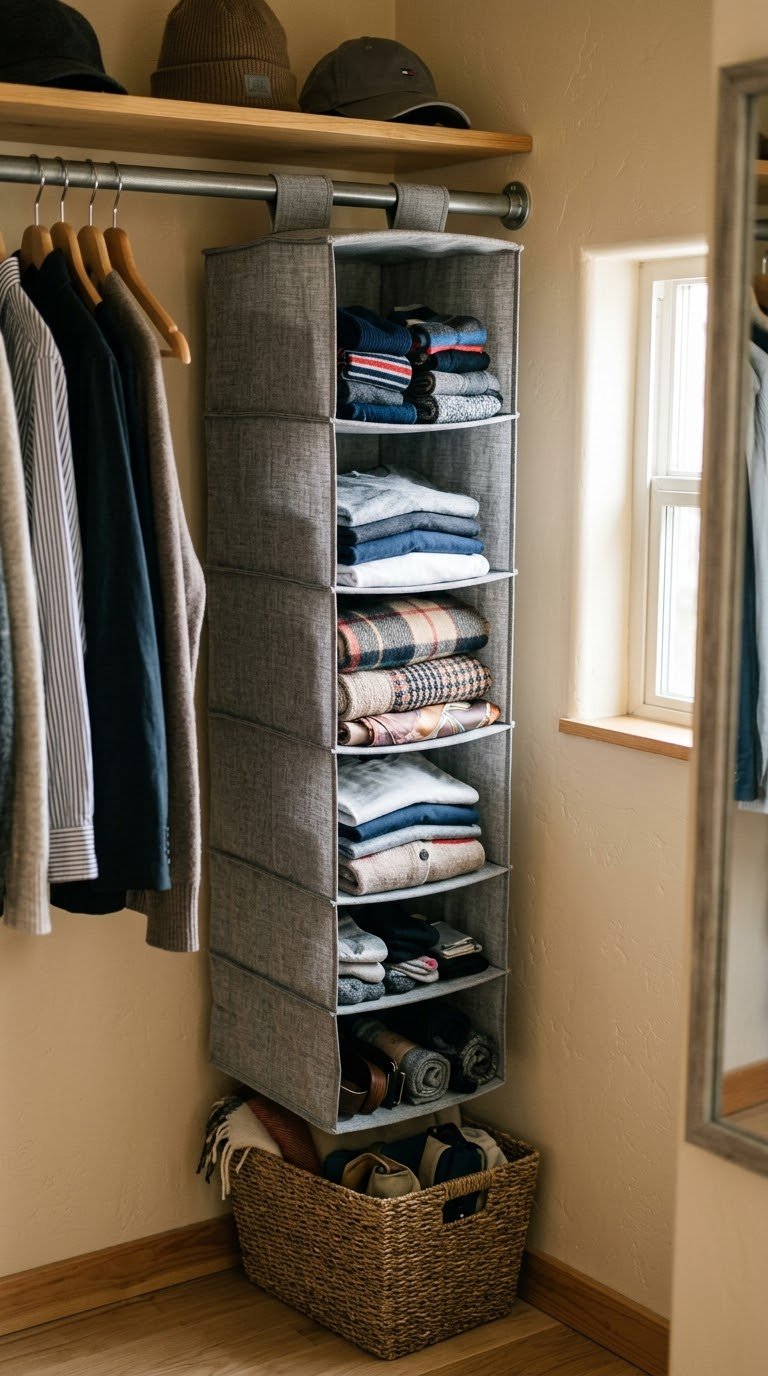
Many small bedrooms can’t fit a dresser at all. Hanging fabric drawers, or a hanging shelf organizer with several cubbies, bring that extra storage into the closet itself. They hang from the rod and give you compartments for socks, T-shirts, scarves, or underwear.
These organizers are best for lightweight, softly folded items. Socks, tees, and scarves are ideal. Jeans and thick sweaters are too heavy, and they’ll make the fabric sag and pull on the rod.
Look for a version with a stiff insert in each shelf, since that stops the sagging. Place it at the end of the rod nearest the door, so the compartments are easy to open. Because it hangs, you can move it, resize your layout, and take it with you when you leave.
8. Use the Empty Space Under Short Clothes
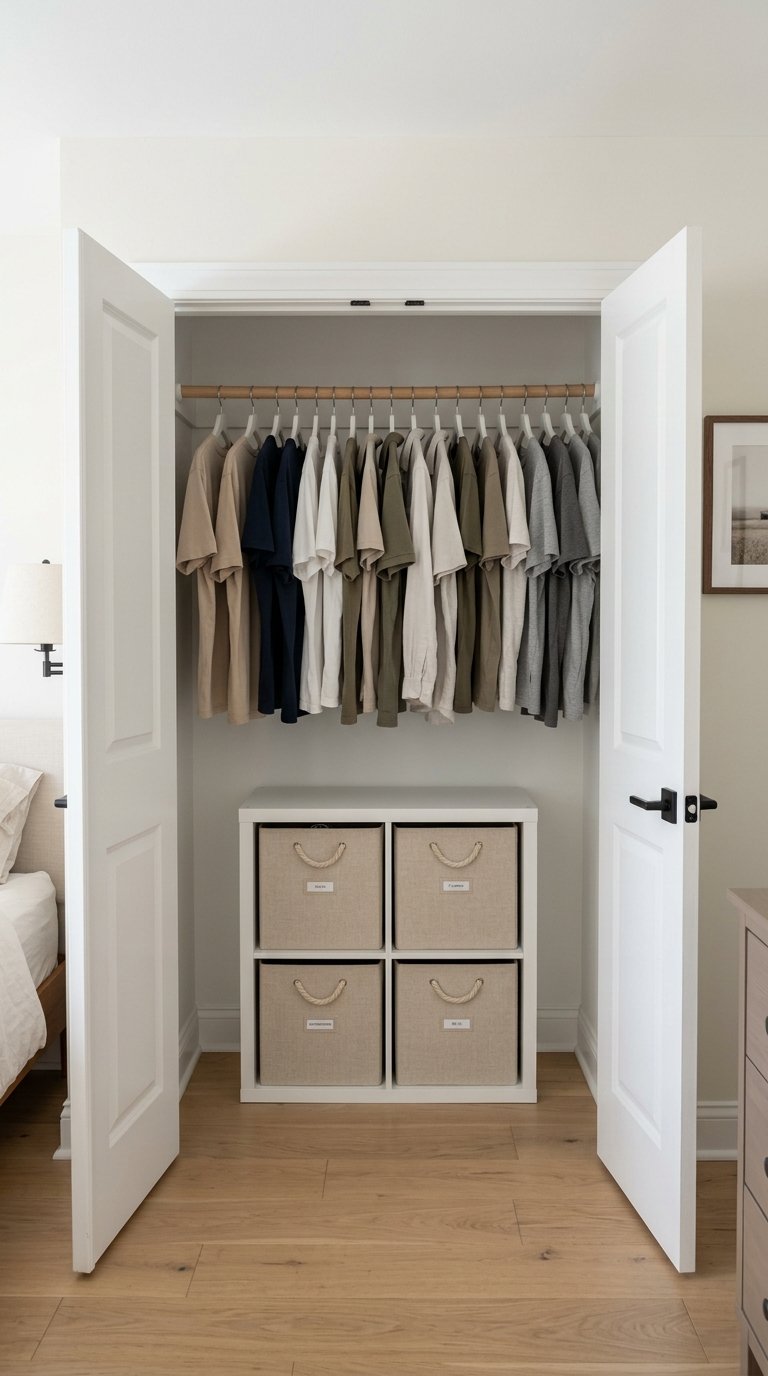
Look at the gap beneath a row of shirts or folded pants. That tall, empty block of space often goes unused, even though it’s close to the floor and easy to reach. A small dresser, a low chest, or a cube shelf with fabric bins can fit right in there.
Measure before you shop. Take the height from the floor to the bottom edge of the shortest hanging garment, then subtract a couple of inches for clearance. Also check the depth, because the unit shouldn’t stick out far enough to block the doors. A two-by-two cube unit or a narrow three-drawer chest tends to suit most closets.
If the closet has corners that go unused, a corner shelf can work in the same way. L-shaped or triangular shelves tuck into the corner and hold folded clothes or baskets without blocking the main rod.
9. Shoe Storage That Doesn’t Swallow the Floor
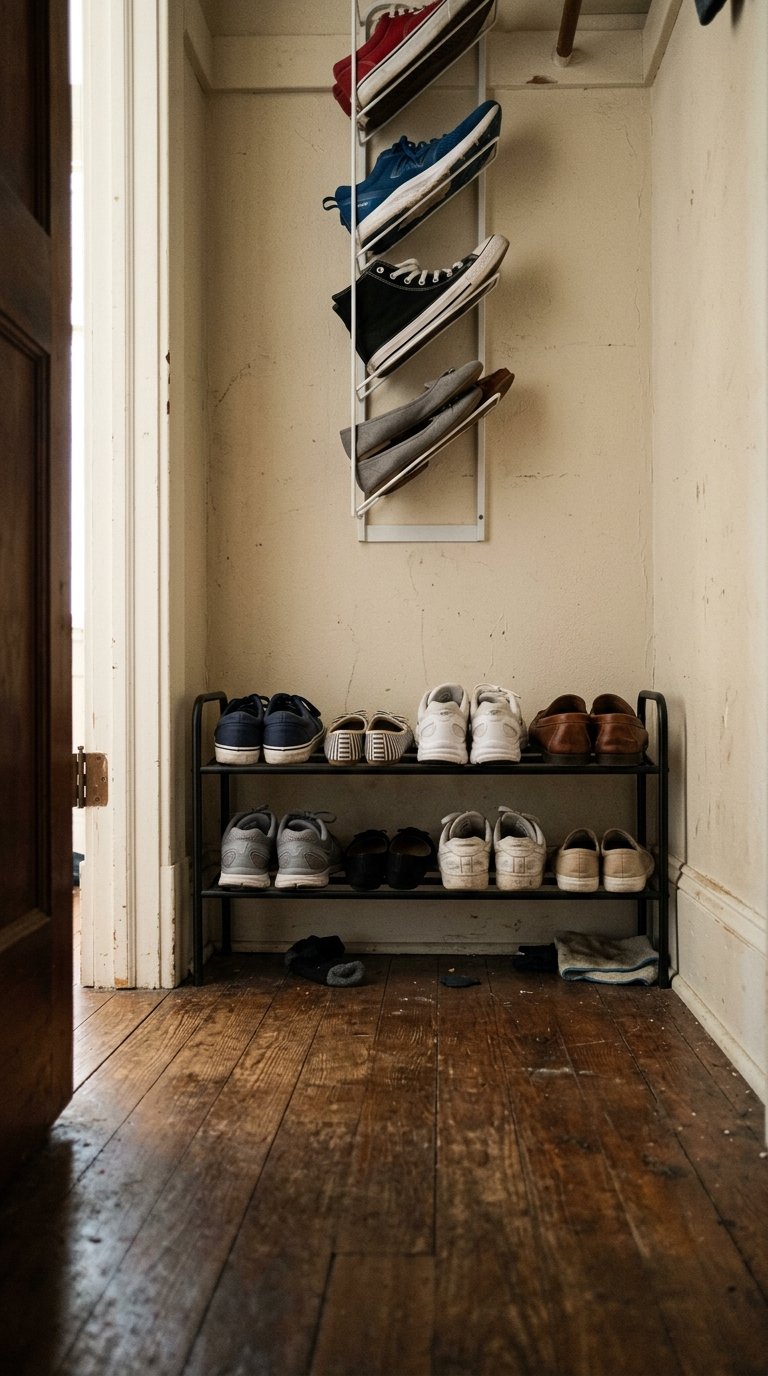
Shoes are one of the biggest floor hogs in a small closet. A loose pile looks messy, scuffs the pairs at the bottom, and covers floor space you could use for bins. A simple rack gives each pair a spot and lets you see what you own.
Several shapes work. Angled racks hold shoes at a slant, so more pairs fit in less depth. Stackable shelves let you build upward in a narrow footprint. Over-the-door pocket organizers move flats, sandals, and sneakers off the floor entirely, which is handy if the floor is already crowded.
Be realistic about how many pairs you wear. Keep your daily and seasonal pairs in the closet, and move the rest to an under-bed box or a hallway rack. Boots are the one exception, since they’re tall and awkward. Store them standing with boot shapers, or lay them on their side in a separate bin.
10. Floor Bins Sorted by How Often You Use Things
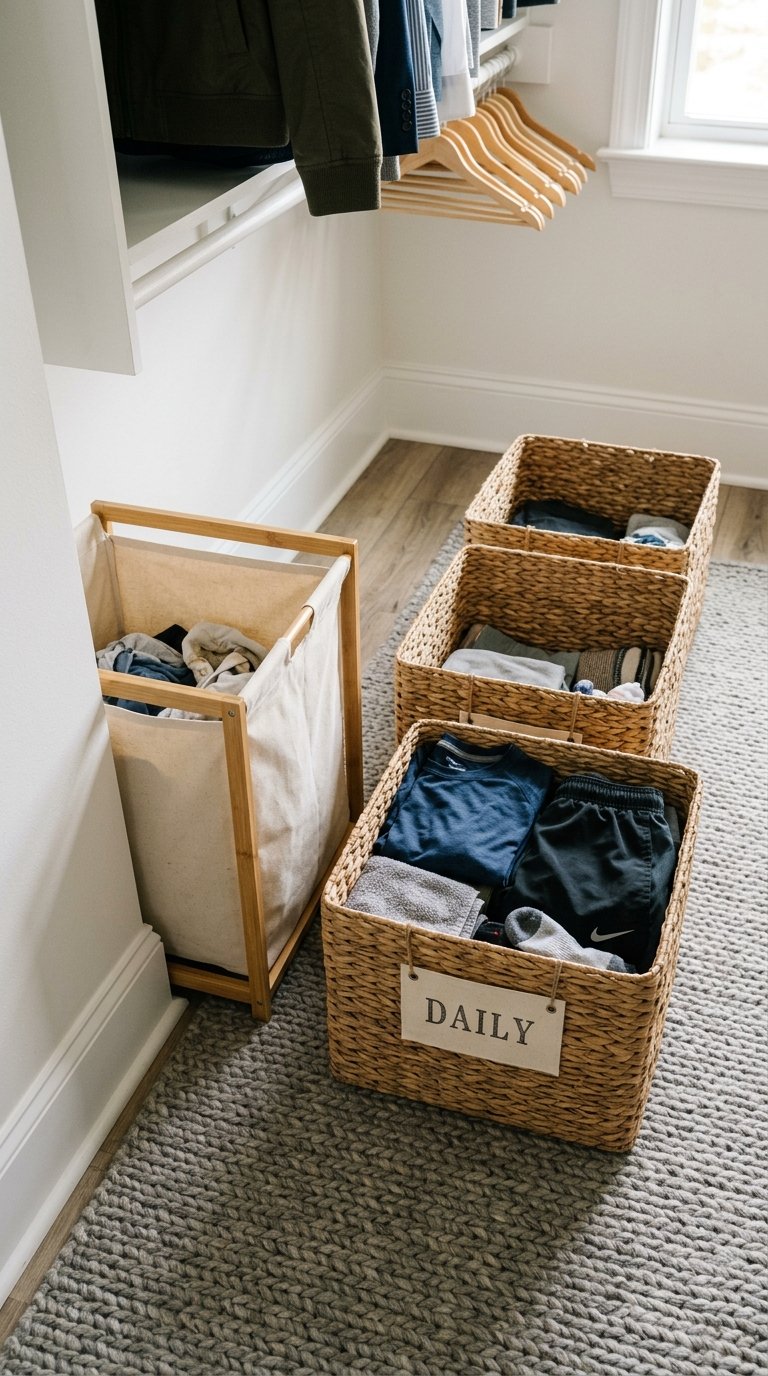
The closet floor isn’t just for shoes. Placed with some thought, a few bins turn that dead zone into useful storage. The key is to sort by frequency. Keep things you grab often, like gym clothes or a laundry bag, in the front and easy to reach. Items you only need now and then, like spare bedding or luggage, can sit toward the back.
Choose shallow bins with a handle or a pull-out style. Deep bins hide the items at the bottom, and you end up emptying the whole thing to find one object. A low bin that slides forward lets you see its contents from above.
A narrow slide-out hamper along one wall is worth considering too. It keeps dirty laundry off the bedroom floor and out of sight, and it takes up very little room. Check that it clears your shoes and doesn’t block the door.
11. An Over-the-Door Organizer for Accessories
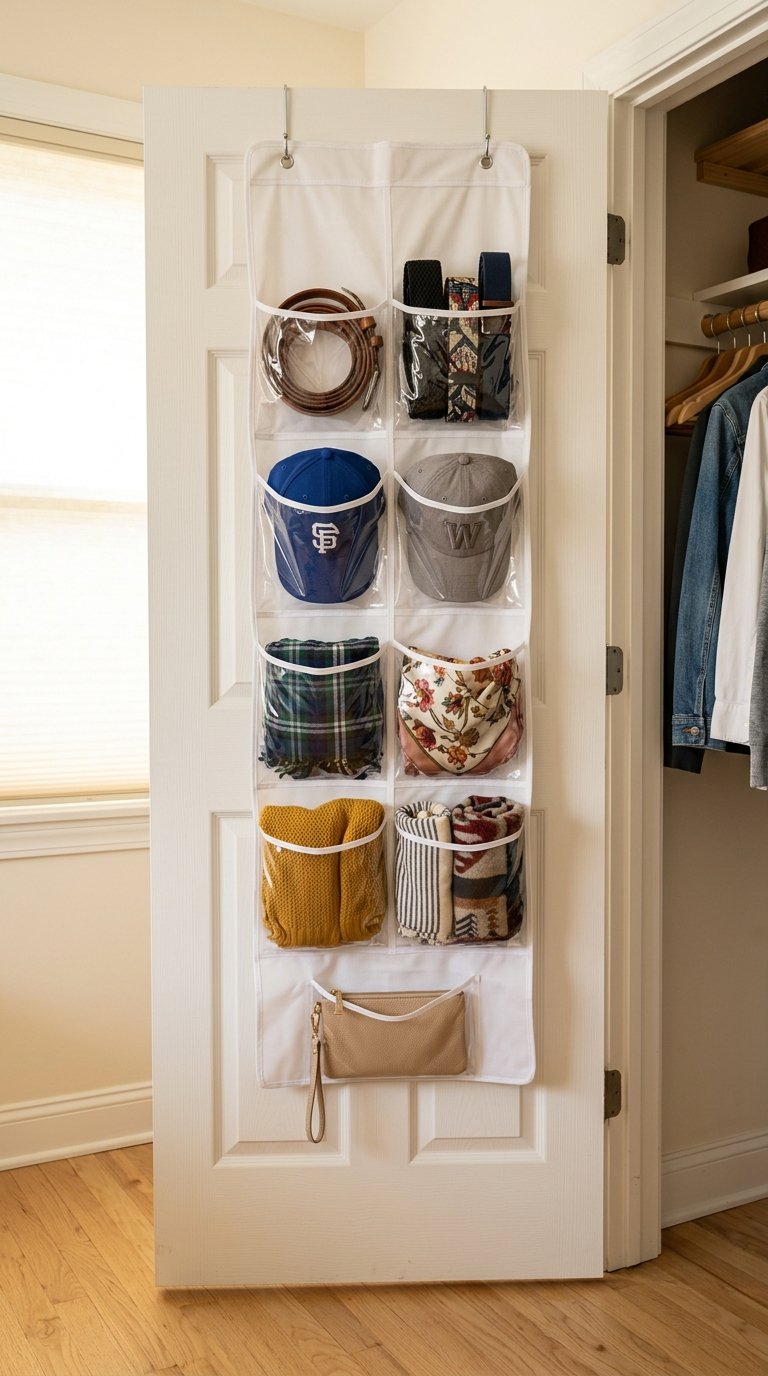
The back of the closet door is one of the best unused spots in the bedroom. An over-the-door organizer with clear pockets holds belts, scarves, hats, small bags, or hair accessories, and the clear fronts let you spot what you need without digging.
Before you buy, check the clearance. The door needs to close with the organizer on it, and the pockets shouldn’t rub against clothes on the rod. A slim version works best in a shallow closet. Also check the top hooks against the door thickness so they sit flat.
It’s a good fit for renters, since it hangs over the door with no drilling. Fill the pockets with items you use weekly, and keep heavy things like boots out. Too much weight can pull the door off its track or cause it to sag over time.
12. Wall Hooks and a Small Accessories Station
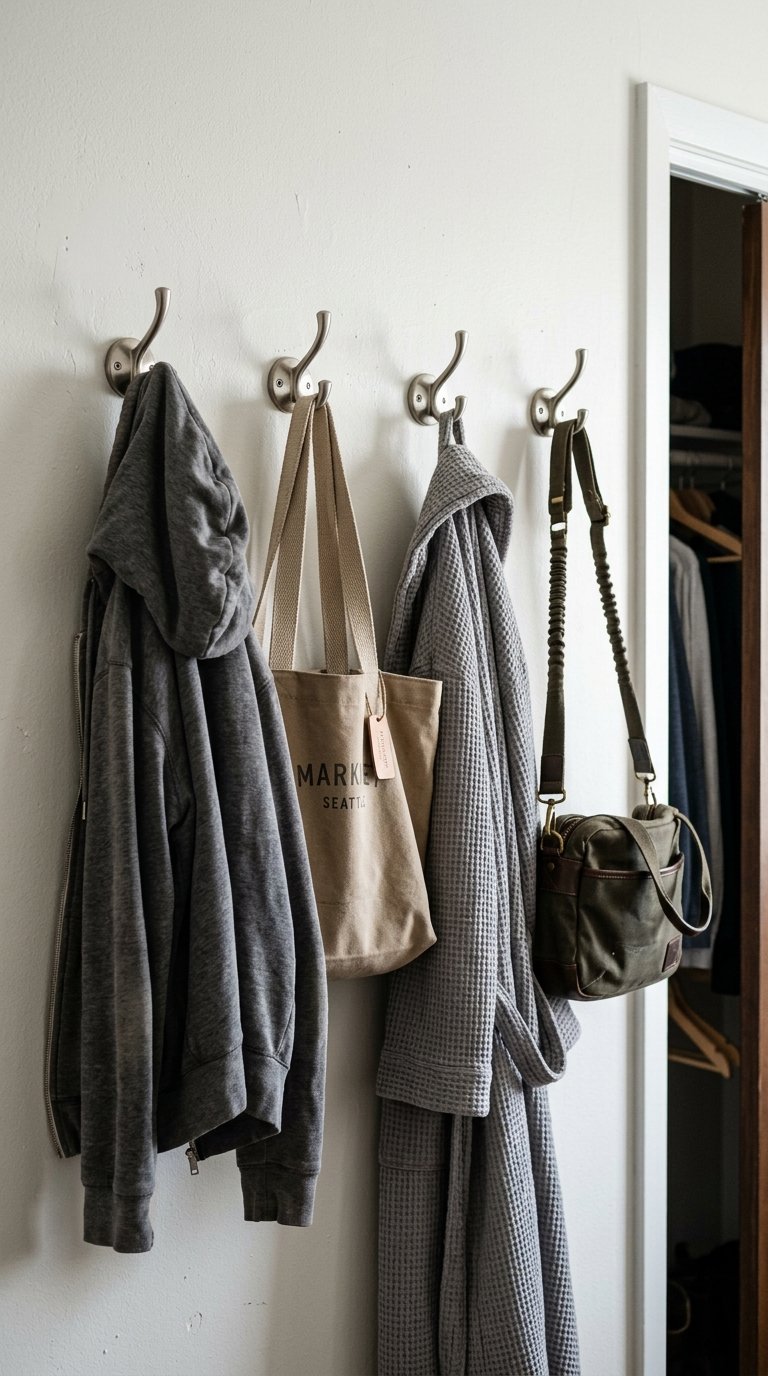
The side walls of a closet usually hold nothing at all, yet a few well-placed hooks can handle the things you grab daily: a hoodie, a robe, a tote, or tomorrow’s outfit. Adhesive hooks suit rented homes, while screw-in hooks hold more weight if you own the place.
If you have jewelry or small accessories, a slim pegboard or a few small hooks on a free stretch of wall keeps them visible and untangled. Seeing your necklaces and earrings tends to mean you wear them more, and it prevents the lost-earring problem that comes with boxes and drawers.
Limit yourself to three or four hooks. More than that, and the wall becomes a place to dump things, which defeats the purpose. Keep it for items you reach for every day, and let everything else live in a bin or on the rod.
13. Replace a Swing Door with a Curtain or Sliding Panel
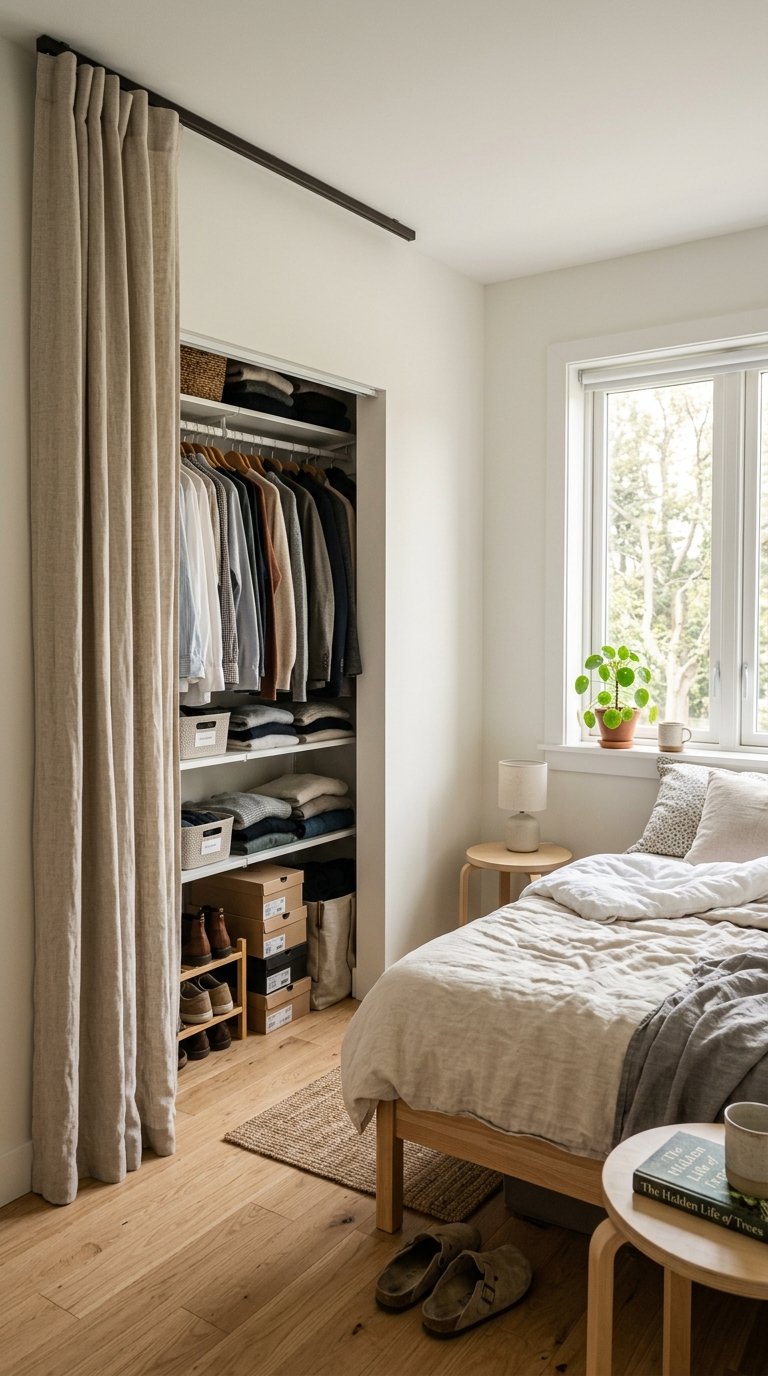
A swing-out closet door needs about as much floor space as the door is wide. In a small bedroom, that can mean a dresser can’t sit where you’d like, or you can’t open the closet when the bed is pulled out. Removing it, or swapping it for something that doesn’t swing, gives that space back.
There are a few options. A curtain on a tension or ceiling-mounted rod is the lightest and cheapest change. Sliding panels or bifold doors stay on a track and take up almost no floor space, but they cost more and may need installation. Taking the door off entirely creates an open closet, which works if you’re happy to keep it tidy.
For a curtain, hang the rod a few inches above the door frame and use fabric that reaches the floor without dragging. Linen or cotton blends look relaxed and soften a room. Keep in mind that curtains don’t hide a messy closet as well as a solid door, and they collect dust faster.
For a shared bedroom, every inch of closet and floor space matters. These small bedroom ideas for two kids offer additional ways to organize a tight room without overcrowding it.
14. Seasonal Rotation with Labeled Storage
A closet holding every season’s clothes year-ound will always feel full. Winter coats and chunky knits take up a lot of room in July, and sundresses do the same in January. Moving out-of-season pieces somewhere else is one of the easiest ways to free space without buying any new hardware.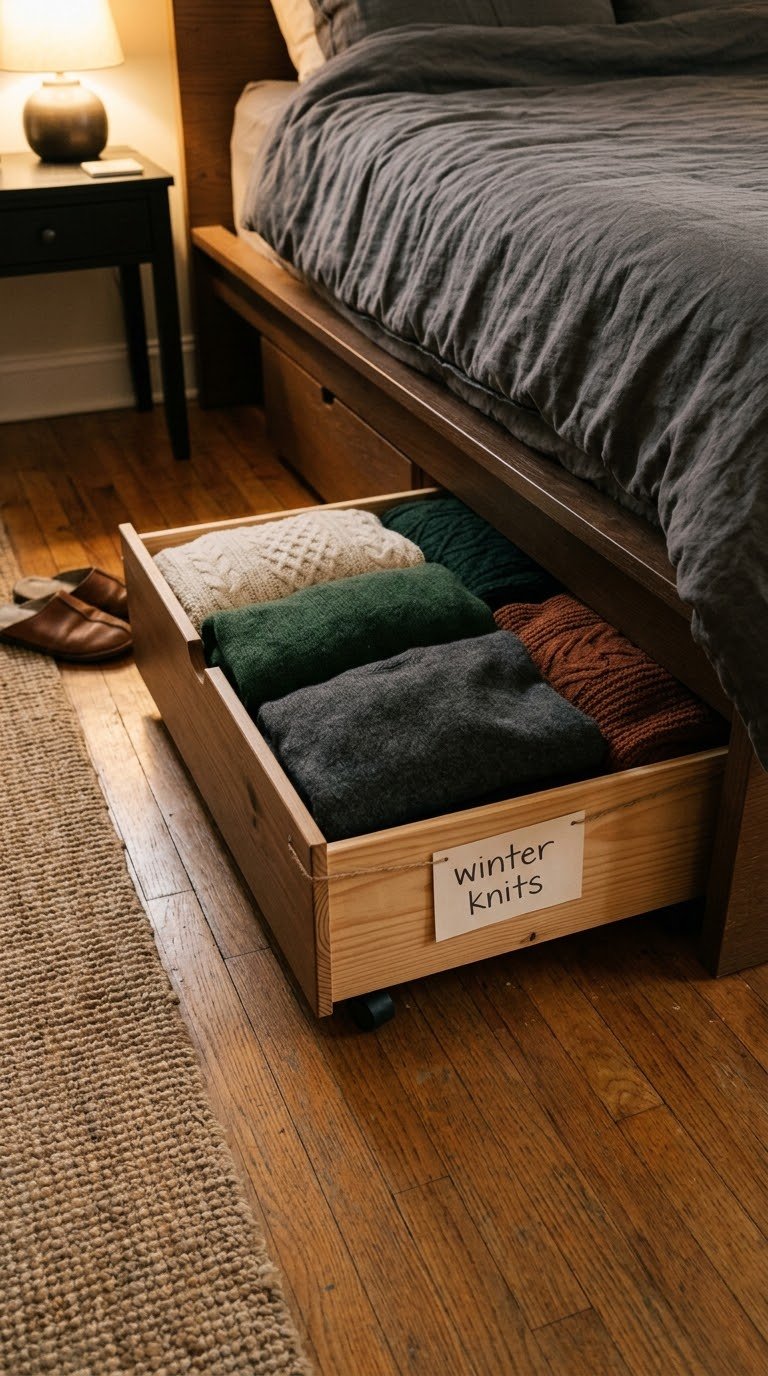
Under-bed boxes, a high shelf in another room, or a lidded bin in a hall closet all work. Wash or clean items before storing them, and keep delicate fabrics folded loosely. Vacuum bags save space, but they can flatten delicate fibers, so use them for sturdy items like sweaters and bedding.
Label each container with the contents (“winter knits,” “summer dresses”) on the front. Do the swap twice a year, and take that moment to donate anything you didn’t wear. It takes under an hour, and it keeps the closet from drifting back to overflowing.
15. Use the Top Shelf for Things You Rarely Need
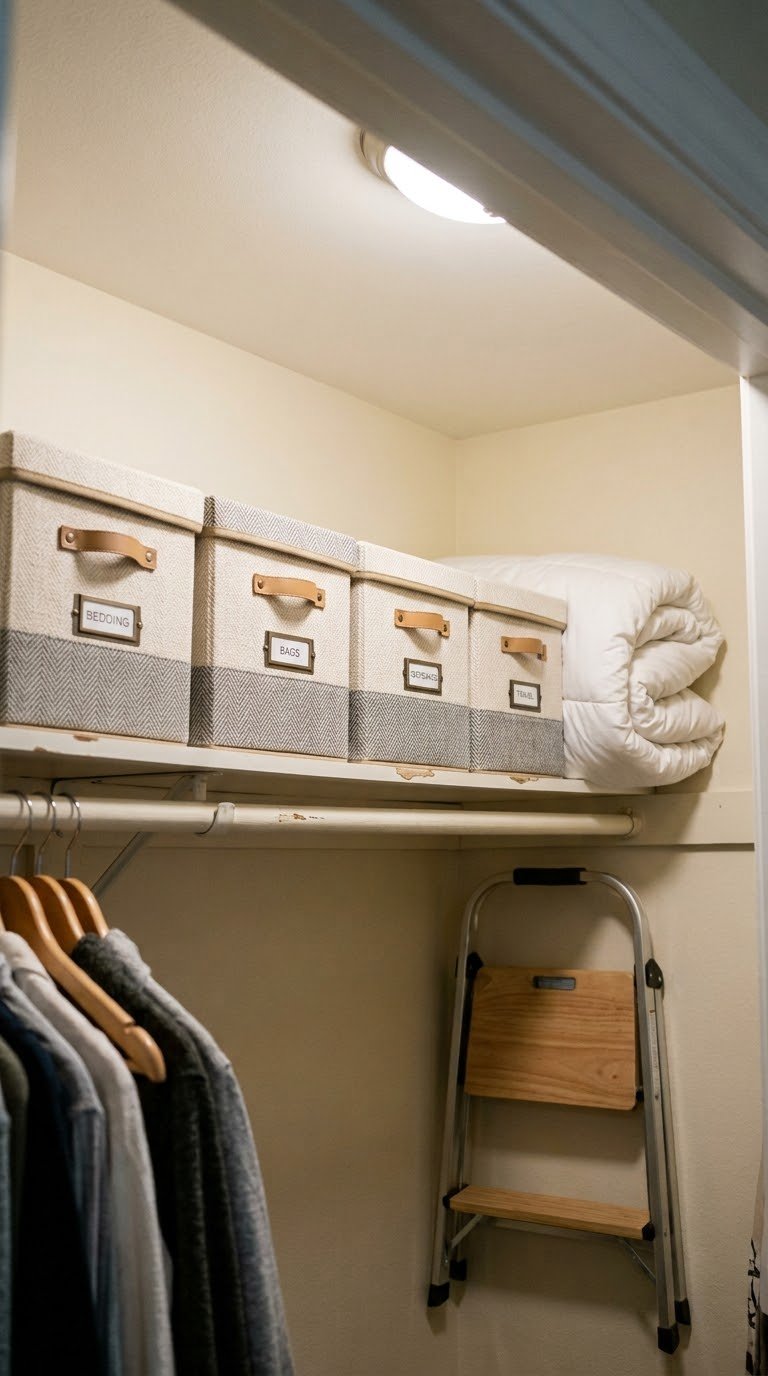
The top shelf is hard to reach, so it suits items you don’t touch often: spare bedding, luggage, special-occasion bags, and keepsakes. Treat it as a storage area for the least-used things, not a spot for your daily clothes.
Lidded boxes keep dust off and give the shelf a tidy, uniform look. Put a label on the front of each so you don’t have to pull everything down to find the right one. Keep heavier boxes toward the front edge only if you can lift them safely, and otherwise store them lower.
In a tall closet, a pull-down rod can bring high clothing down to your level with a handle. It suits seasonal jackets or special outfits. A small folding step stool stored nearby is also worth having. It makes the top shelf reachable without climbing onto a chair.
16. Stick-On LED Lighting for a Dark Closet
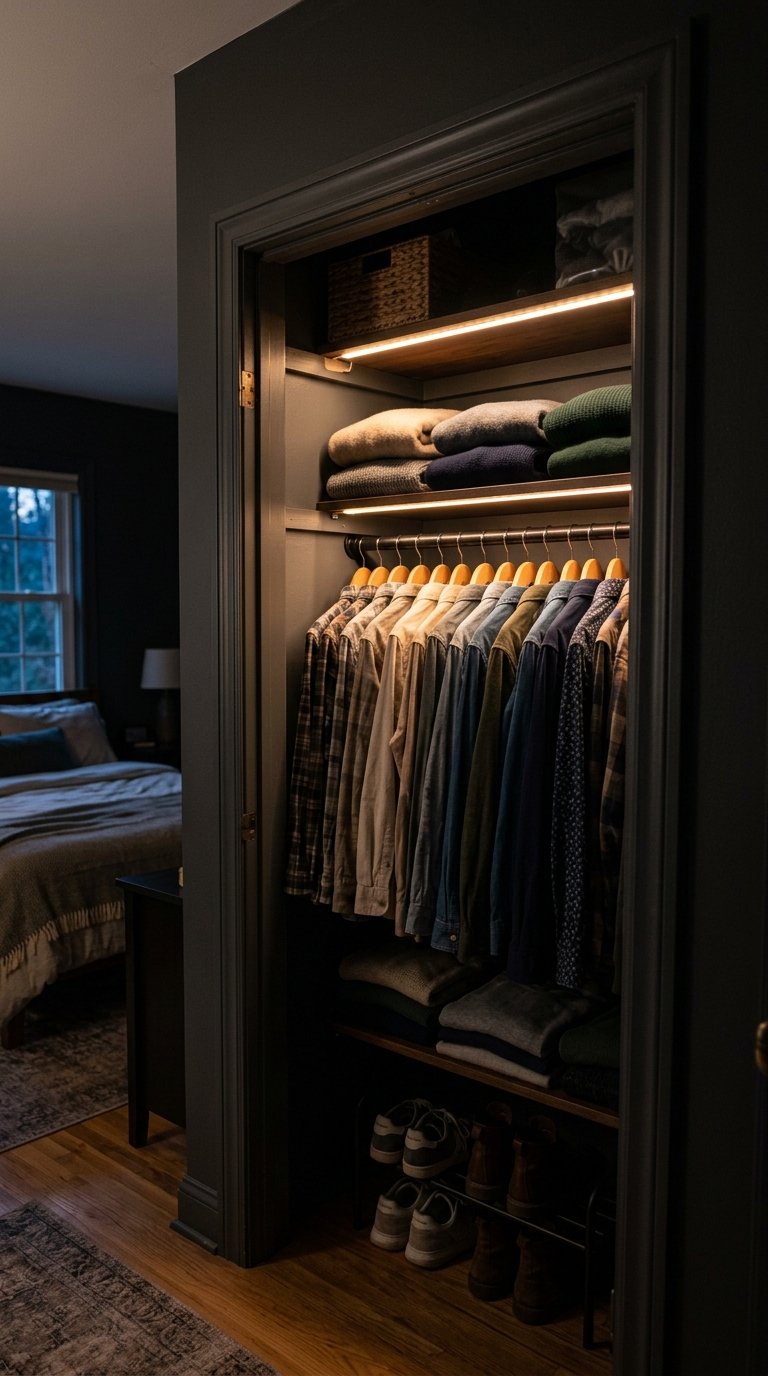
A dim closet is harder to use. You can’t see where things are, colors look off, and you end up buying a duplicate of something that was hidden at the back. Good lighting makes the space feel larger and helps you dress faster.
Battery-powered LED strips and puck lights stick on with adhesive, so there’s no wiring and no electrician. Mount them under a shelf, along the door frame, or on the underside of the top rod area. Motion-sensor versions switch on when you open the door and turn off when you close it, which is useful when your arms are full.
Pay attention to the color of the light. Warm white shows fabric colors more accurately than cool blue-white, so a navy sweater looks navy instead of black. If the closet has no outlet nearby, choose rechargeable lights and keep a cable handy for topping up.
17. Matching Bins and Clear Labels
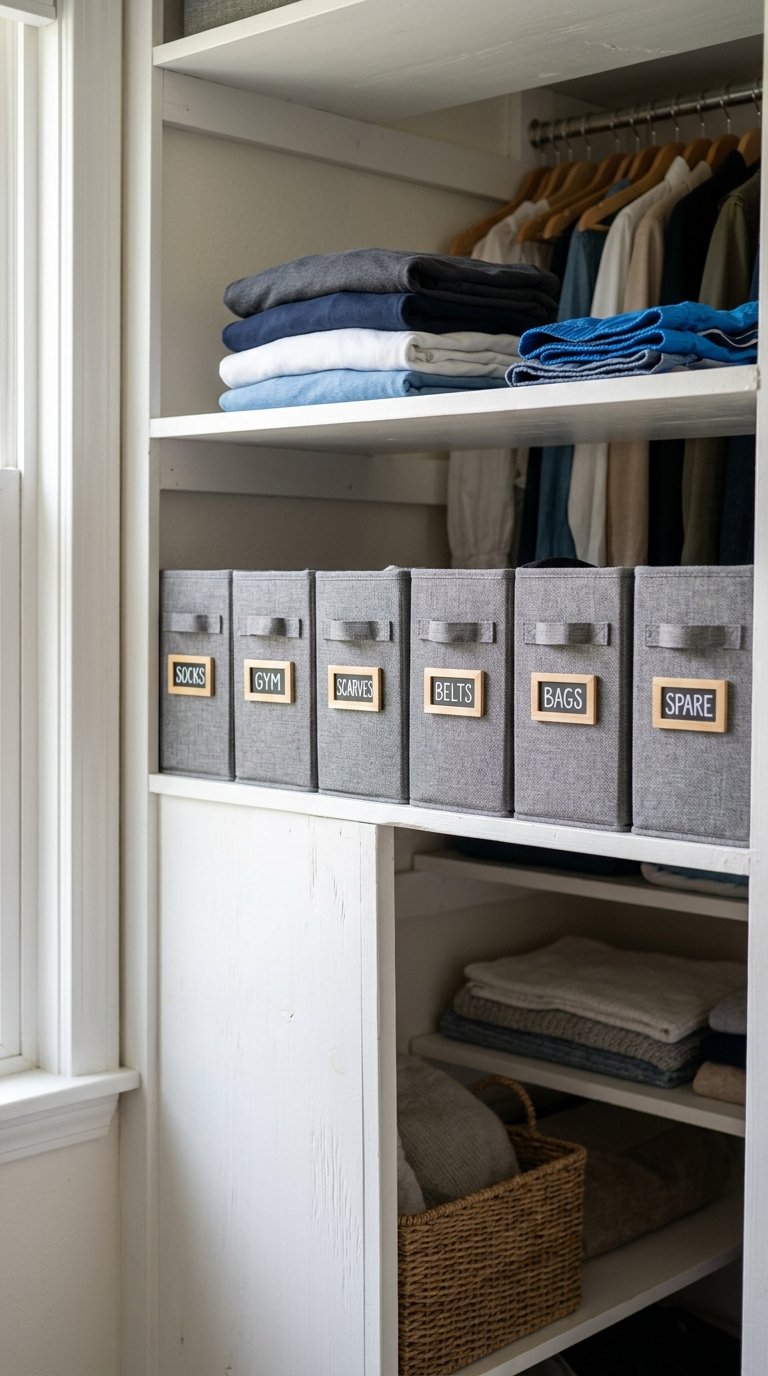
Even a well-organized closet can look chaotic when the containers don’t match. A cardboard box, a plastic tub, and two different baskets next to each other create visual noise, and a small space feels fuller as a result. Using one or two bin styles in related colors calms the whole closet.
Material matters. Woven baskets bring warmth and texture. Fabric bins are light and soft, and they suit folded clothes. Clear plastic bins show what’s inside, which works for socks and gym gear. Pick based on what you’re storing, then stay consistent across shelves.
Labels turn a neat closet into one that stays neat, especially if you share the space. Be specific, such as “belts and ties” instead of “misc.” A label holder on the front of each bin lets you change contents later without redoing everything.
Once your closet is organized, keeping the rest of the room visually open can make a big difference. Try these ways to make a tiny bedroom feel bigger without adding more furniture.
Special Situations
If You Don’t Have a Closet at All
A freestanding clothes rail with a shelf above and a shoe rack below works as a mini closet. Place it along the longest free wall, away from the door swing, and keep the shelf for folded items. A simple fabric cover or a curtain panel hides the contents and softens the look in the room.
If You Share the Closet
Split the rod and shelves into two clear halves and give each person their own bins. Equal sections prevent arguments, and labels help everyone put things back. If one person has longer clothes, give them the taller end of the rod.
Renter-Friendly Checklist
- Slim hangers
- Over-the-door organizers
- Tension rods
- Adhesive hooks and stick-on LED lights
- Hang-on double rods
- Freestanding cube units and hanging drawers
Small Closet Mistakes to Avoid
Most closet problems come from a few repeated habits. Fixing them often matters more than adding new products.
- Buying before measuring. Organizers that don’t fit end up in a donation bag or back in the box.
- Overstuffing the rod. If hangers are pressed tight, clothes wrinkle and you can’t see what’s there. Edit the closet instead of squeezing.
- Leaving dead zones. The space above the rod and below short clothes is the easiest to fix.
- Mixing storage styles. Too many different baskets and boxes make the closet look busier than it is.
- Skipping the light. A dark closet hides items and feels smaller than it is.
Keep It Organized with a Five-Minute Weekly Reset
Once a week, hang up anything sitting on a chair, return stray items to their bins, and check that nothing has spilled onto the floor. It takes about five minutes, and it stops small messes from becoming a full closet overhaul.
Twice a year, tie a quick edit to your seasonal swap. Pull out what you haven’t worn, donate what no longer fits, and adjust your dividers or bins to match the new season.
FAQs
How do I organize a small bedroom closet?
Start by measuring the space and editing your clothes down to what you actually wear. Then group items by category, switch to slim hangers, and fill unused areas with a second rod, shelf dividers, or a cube unit. Give accessories a home on the door or side wall.
How can I fit more clothes in a small closet?
Slim hangers, a double rod for short items, and folding bulky pieces into bins make the biggest difference. Moving off-season clothes to under-bed storage clears even more room.
Should I hang or fold clothes in a small closet?
Hang things that wrinkle, like dresses, blouses, and blazers. Fold stretchy or bulky items like sweaters, T-shirts, and leggings. File folding keeps folded clothes visible and easy to pull out.
How do I organize a small closet with no shelves?
Use a cube unit on the floor, hanging fabric drawers on the rod, a tension rod for bonus hanging space, and an over-the-door organizer. Floor bins can hold the rest.
How do I organize a small closet on a budget?
Slim hangers, tension rods, adhesive hooks, shelf dividers, and over-the-door organizers cost little and make a visible difference. Start with one or two, then add more as you see what helps.
What can I do if I rent and can’t drill?
Tension rods, over-the-door organizers, hang-on double rods, adhesive hooks, stick-on LED lights, and freestanding cube units all install without tools or damage.
Where should shoes go if the closet floor is too small?
Keep only your daily pairs on a stackable or angled rack. Store the rest in under-bed boxes, an over-the-door pocket organizer, or a rack in another part of the home.
How do I organize a small closet shared by two people?
Divide the rod and shelves evenly, give each person their own bins, and label each section. Matching hangers within each half keep it visually tidy.
How often should I reset a small closet?
A five-minute tidy each week keeps things from piling up. A deeper edit twice a year, matched to your seasonal swap, is enough for most closets.
What should go at eye level?
Your most-worn items. Keep daily clothes at eye level, occasional pieces higher or lower, and rarely used things on the top shelf.
Conclusion
You don’t need all 17 ideas, and trying to do everything at once usually backfires. Begin with the measuring and editing step, since it shows you what the closet really needs. After that, pick the one area that frustrates you most, whether that’s the packed rod, the shoe pile, or the unreachable top shelf, and fix that first.
Small changes add up quickly in a closet this size. One weekend of work plus a short weekly reset is often enough to keep it working for months.




One Comment