
18 Small Bedroom Ideas for Boys That Save Floor Space and Grow With Him
Small bedroom ideas for boys all start with the same problem: the bed, the desk, the LEGO builds, and the soccer gear are fighting over one patch of floor. The fix is rarely more furniture. It’s smarter furniture, plus a clear plan for where everything lives.
This guide gathers 18 small boys’ bedroom ideas, from loft beds and trundles to zoned pegboards, wall shelving, and a gaming corner with hidden cables. Each idea comes with realistic sizes, an honest trade-off, and a note on what to change as he gets older, so the room still works from age five to fourteen. Start with the measuring and safety checks below, because they decide which beds will fit.
Measure, Plan and Check Safety First
Ten minutes with a tape measure will save you from returning a bed. Measure the room’s length and width, the ceiling height, the window and door swings, and the longest uninterrupted wall. Then sketch the bed on that wall first, since the bed is the biggest floor decision in the room.
Standard mattress sizes are a useful starting point: a twin is about 38 × 75 inches, a twin XL about 38 × 8,0 and a full about 54 × 75 inches. Frames add several inches on every side, so measure the actual product, not the mattress.
Before choosing the right bed or storage solution, it also helps to look at practical small bedroom layout ideas that show how to position furniture without blocking walkways. A smart layout can make even a very tight room easier to use, especially when you need space for a bed, desk, storage, and everyday movement.
Safety checklist before you buy
- Confirm the bed’s minimum ceiling height with the manufacturer, not a blog or a listing photo.
- Check for guardrails on all open sides of any raised sleeping surface.
- Follow the manufacturer’s age guidance. US safety guidance generally advises against upper bunks for children under six.
- Anchor tall bookcases, dressers, and wall units to the studs.
- Keep fans, light fixtures, and sprinkler heads clear of a raised bed.
1. Loft Bed With a Desk or Lounge Underneath
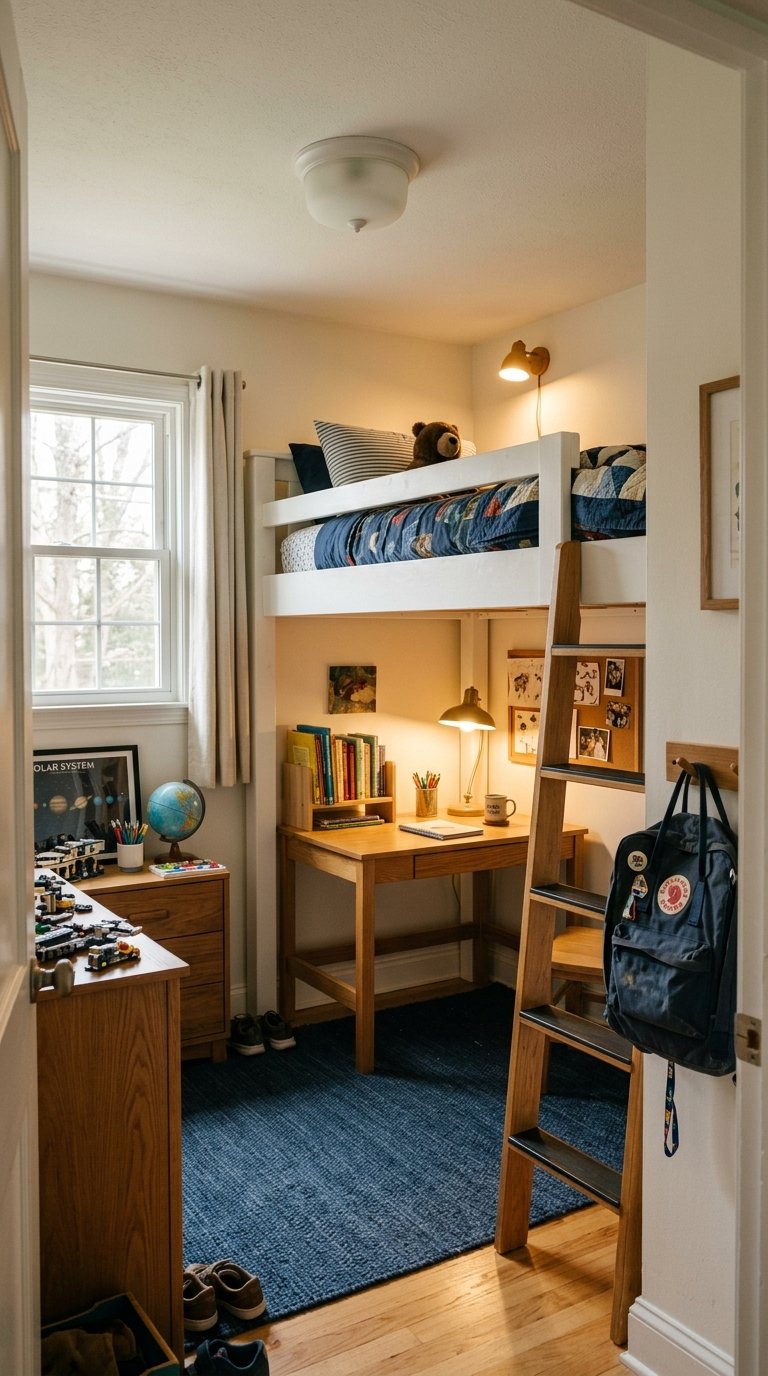
A loft bed lifts the mattress high enough to reclaim the floor below it. Picture a white or oak frame in the corner, a ladder on the short end, and a desk with a shelf tucked underneath. In a room that’s 9 × 10 feet, that swap can be the difference between having a workspace and not having one.
The ceiling is the deciding factor. He needs to sit up on the mattress without his head hitting the ceiling, and the fan or light fixture needs to be nowhere near. Put the ladder on the side away from the door, and add a clip-on reading light so the space under the bed doesn’t feel like a cave.
Best for: Ages 7 and up in rooms with standard or taller ceilings.
Trade-off: Making the bed is awkward, and headroom above the mattress is tight.
When he’s older: Swap the desk for a beanbag and a small TV, or move to a longer loft if he grows past the mattress.
2. Cabin Bed With Storage Stairs

Cabin beds (also called mid-sleepers) sit around chest height, so they work where a full loft would hit the ceiling. The staircase is the smart part: each step is a drawer or cubby, so the way up doubles as a dresser.
That makes it a good choice for younger boys and for rooms with lower ceilings. There’s still usable space under the mattress for a play mat, a toy bin, or a small beanbag. Measure the stair footprint before buying, since some stair units add 20 inches or more of depth to the room.
Best for: Ages 4–9, lower ceilings, kids who aren’t ready for a full-height loft.
Trade-off: Less space underneath than a loft, and the stairs take up floor space.
When he’s older: Turn the under-bed area into a reading nook or drop a desk in once the toy phase passes.
3. A Trundle for Sleepovers

Instead of leaving a spare bed permanently unfolded, tuck one under the main bed. A trundle rolls out on casters when a friend stays over and disappears the next morning. It’s often the most useful bed for a single boy who has regular sleepovers.
Check the pull-out clearance before you commit. You’ll need roughly the width of the trundle in free floor space on the side it rolls out. A room where the bed is against a wall with no free side won’t work. Look for a low-profile trundle if you want to avoid raising the main bed too high.
Best for: Single boys with regular sleepovers, rooms where a second bed would eat the floor.
Trade-off: The trundle mattress is usually thinner, and you’ll need clear floor space when it’s open.
When he’s older: It’s a spare bed for cousins or a teen’s friends, and a handy extra drawer if the mattress isn’t needed.
4. Murphy Bed With a Desk for Older Boys

A Murphy bed folds up into the wall, and some models add a desk on the front panel or a matching cabinet beside it. During the day, the room reads as a study; at night, the bed comes down. For a teen who needs a real workspace in a very small room, it’s the strongest floor-space play.
It costs more than a standard bed and usually needs secure wall mounting, so it isn’t a good fit for every rental. The fold-down routine also matters. If he won’t put the bed up in the morning, the whole idea stops working.
Best for: Teens in rooms under about 9 × 9 feet who need a daytime workspace.
Trade-off: Higher cost, installation, and a daily habit.
When he’s older: It scales well into college or a guest-room role.
5. Platform Bed With Drawers or Rolling Bins
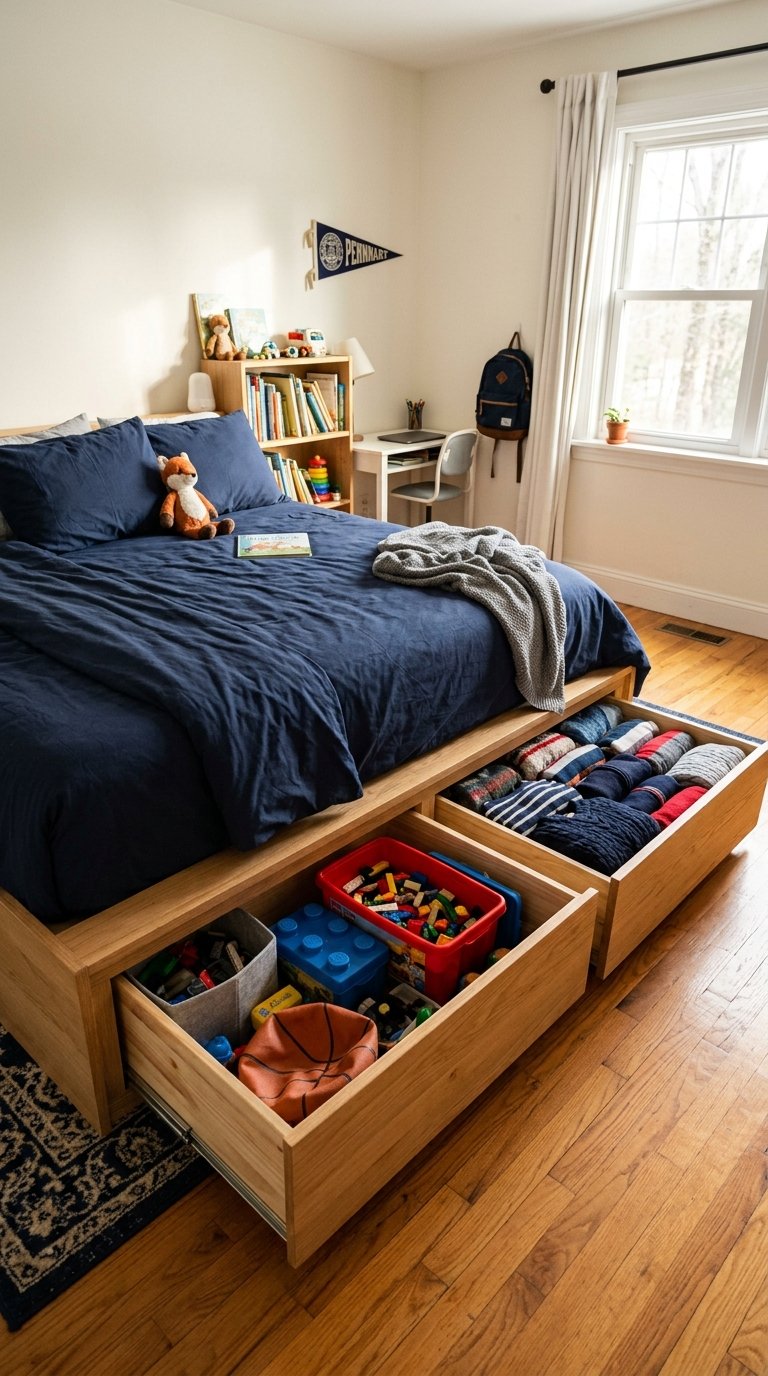
A platform bed with two or three deep drawers replaces a dresser, freeing up a whole wall. It also stores what a small room is short on: bulky items like winter clothes, spare bedding, sports gear, and out-of-season toys.
Sort what goes in by how often you reach for it. Put daily items in easy-reach drawers, and store occasional items in the back. If you’d rather not buy a new frame, low rolling bins under a standard bed do a similar job. Measure the gap between the floor and the bed rails first, since many frames leave less than 6 inches.
Best for: Ages 5–12, any room where a dresser won’t fit.
Trade-off: Drawers need clearance to open, and heavy frames are hard to move.
When he’s older: Swap toys for clothes and shoes as he outgrows them.
6. A Storage Headboard That Replaces the Nightstand
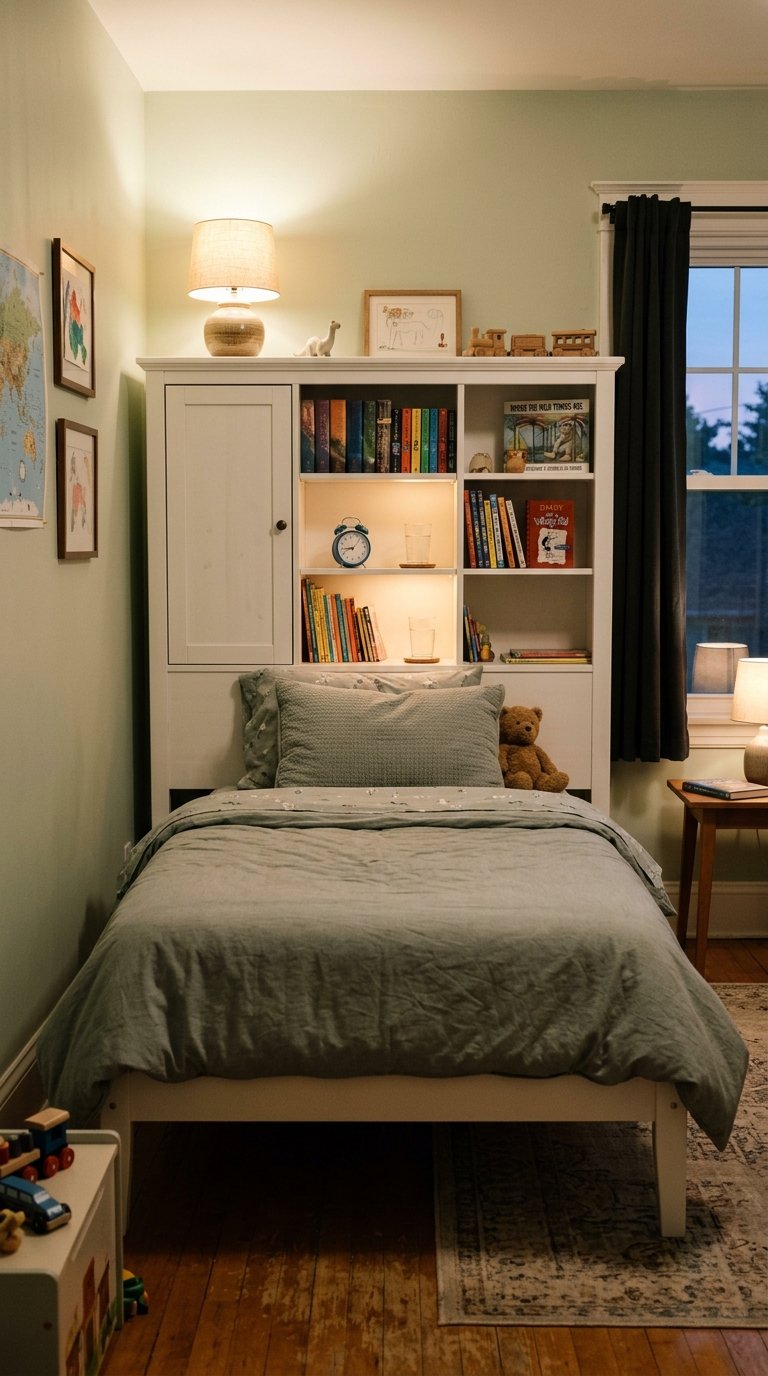
Nightstands take floor space. A headboard with built-in shelves or a bookcase headboard puts books, a lamp, a water glass, and a charging spot right where he needs them, and it clears the floor on both sides of the bed.
Keep the shelf depth shallow, around 6–10 inches, so the headboard doesn’t push the bed too far into the room. Avoid loading it with tall or heavy objects, and skip open shelves above pillow height for anything he could knock onto his head. A closed cabinet section at one end hides the mess.
Best for: Ages 6–14, rooms too narrow for a nightstand.
Trade-off: It can look cluttered if every shelf is filled.
When he’s older: Add a charging strip and swap kids’ books for a speaker and headphones.
7. Tiered Wall Shelving, Sorted by Reach Height

Floor space runs out fast, but wall space rarely does. The trick is arranging shelves by how he uses them. Daily items like books and headphones sit at his reach height, occasional stuff goes on the middle tier, and display pieces go up high where they’re out of the way.
Anchor every shelf into studs or with proper anchors, and keep the heaviest items low. In a narrow room, a run of shelves along one wall reads cleaner than shelves scattered across three. Painting the shelves the same color as the wall makes the whole thing recede.
Best for: Ages 6 and up, rooms where floor storage isn’t an option.
Trade-off: Open shelves need regular tidying to avoid looking messy.
When he’s older: Move the lowest shelf up and swap kids’ books for trophies and hobby gear.
8. A Zoned Pegboard Wall
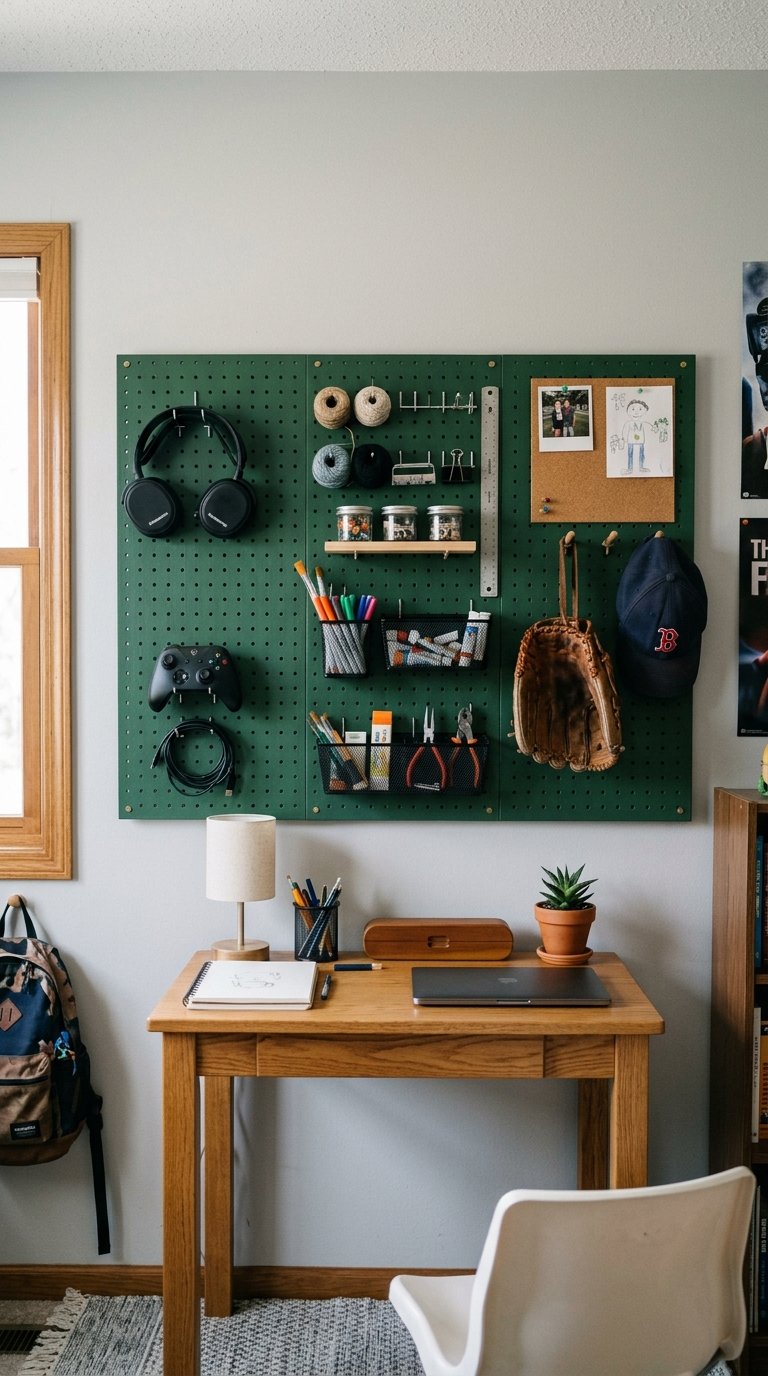
A pegboard turns one blank wall into a flexible storage system. The difference between a good one and a cluttered one is zoning. Give each area a single job: one section for headphones and controllers, another for craft or LEGO tools, another for sports gear like a helmet and a glove.
Paint the board the wall color or a deep tone like forest green so it looks intentional. Use hooks, small baskets,s and shelves that lift off easily, and leave some pegs empty so it can change as his hobbies do.
Best for: Ages 8–14, kids with several different hobbies.
Trade-off: It takes a bit of planning, and a crowded pegboard looks busy.
When he’s older: Rearrange the zones, or add a monitor shelf and cable hooks.
9. Display Ledges for LEGO and Collections

Finished LEGO builds take up floor space and get knocked over. Picture ledges solve both. Mount two or three narrow shelves along a wall at different heights, and let the builds sit there like a small museum. It also lets him show them off instead of hiding them in bins.
Choose ledges deep enough for a base plate, about 4–6 inches for most sets, and mount them above bed height so nothing falls onto pillows. Dust is the trade-off. Open display collects it, so wipe them occasionally or keep especially detailed sets behind clear covers. A shallow drawer nearby holds the loose bricks.
Best for: Ages 7–14, kids with builds, models, or collections.
Trade-off: Dusting, and builds are less protected than in a closed case.
When he’s older: Switch to trophies, model kits,s or framed prints.
10. A Closet Reset and Back-of-Door Storage

Most small-room closets are wasted. A kid-height double rod, with a low bar for him and a higher one for out-of-season clothes, immediately doubles usable hanging space. Add a shoe shelf and a few stackable bins on the floor.
The back of the door is unused too. An over-the-door organizer holds shoes, caps, gloves, e,s or small toys, and it needs no drilling, so it’s renter-friendly. Just check the door’s clearance so it still closes.
Best for: Any age, rooms where a dresser won’t fit.
Trade-off: A door organizer can make the door heavy.
When he’s older: Raise the low rod and swap pockets for jackets and bags.
11. A Fold-Down or Floating Desk

If the room can’t handle a full desk, a wall-mounted one is the answer. A fold-down desk sits flat against the wall when he’s done, then drops down for homework. A floating desk stays put but has no legs, so the floor underneath stays open.
Aim for a depth of about 18–24 inches, which is enough for a laptop and notebook. Anchor it into studs, since it carries his weight when he leans on it. Add a pinboard or a shelf above for supplies so nothing lives on the desktop.
Best for: Ages 8–14 in rooms too tight for a standard desk.
Trade-off: Less surface than a full desk, and it needs solid wall mounting.
When he’s older: Upgrade to a deeper floating desk or add a monitor arm.
12. A Gaming Corner With Hidden Cables
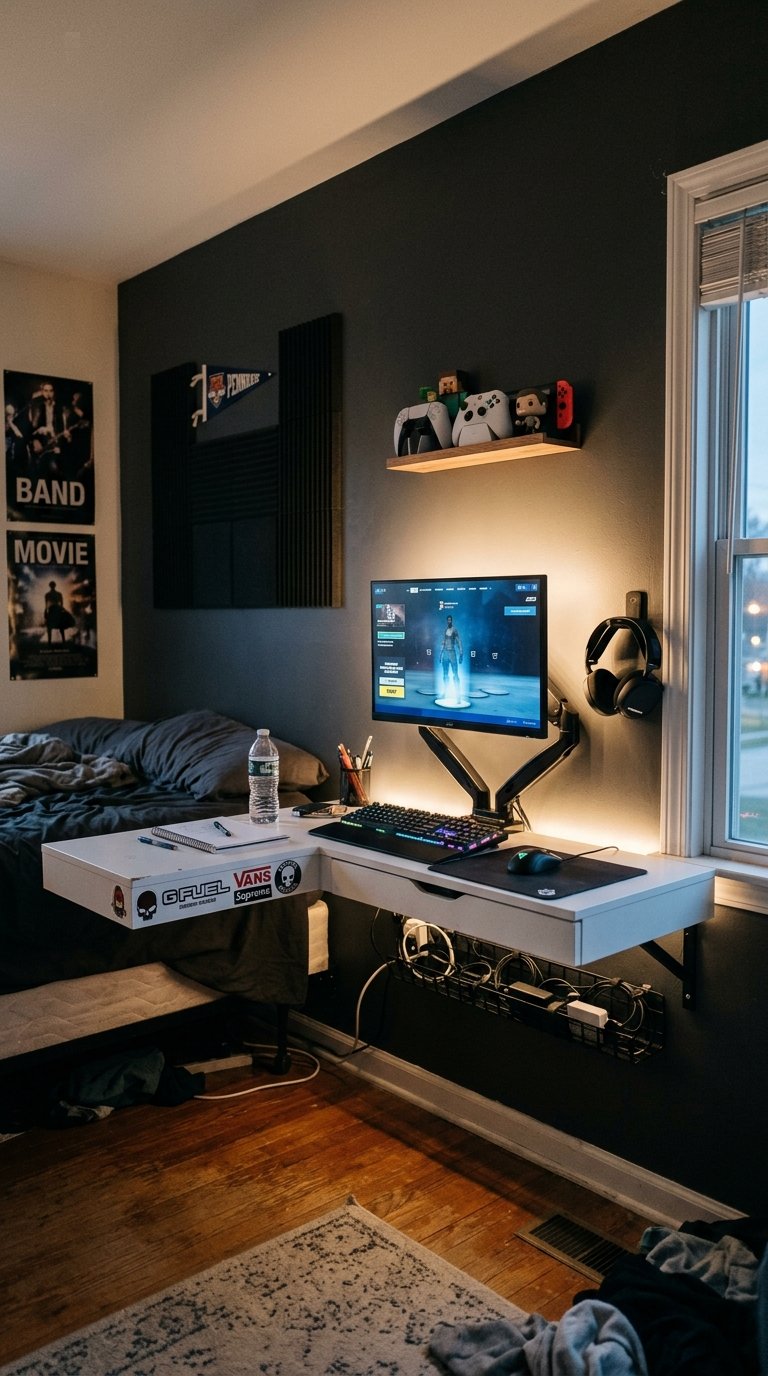
For a teen with a console or PC, an L-shaped floating desk in the corner uses space that’s often dead. Put the monitor on an arm to free the desktop, and run cables through a tray or sleeve under the desk so nothing dangles.
Add a hook for the headset and a small shelf for controllers. Keep the power strip mounted to the desk edge, out of reach of the floor. A dark wall behind the screen reduces glare, and it keeps the gaming zone visually separate from the sleep area.
Best for: Ages 11 and up, corner spaces.
Trade-off: Gaming gear draws heat and adds cable clutter if not managed.
When he’s older: Swap the console for a work setup without changing the desk.
13. Sports Gear Storage That Doesn’t Take Over

Balls, bats, helmets,e etc ., and cleats spread fast. Give each a dedicated spot: a wall rack for bats and sticks, a ball net or basket in a corner, and a ventilated shoe shelf so cleats can dry.
Keep the gear near the door so it doesn’t travel across the room. Hooks at his height make putting away easy, which is the only reason any storage works. If space is really tight, use a vertical stack of open crates on the wall.
Best for: Ages 6–14, kids in team sports.
Trade-off: Gear can smell, so ventilation matters.
When he’s older: Rotate the equipment as his sport changes.
14. A Window Seat With Drawers
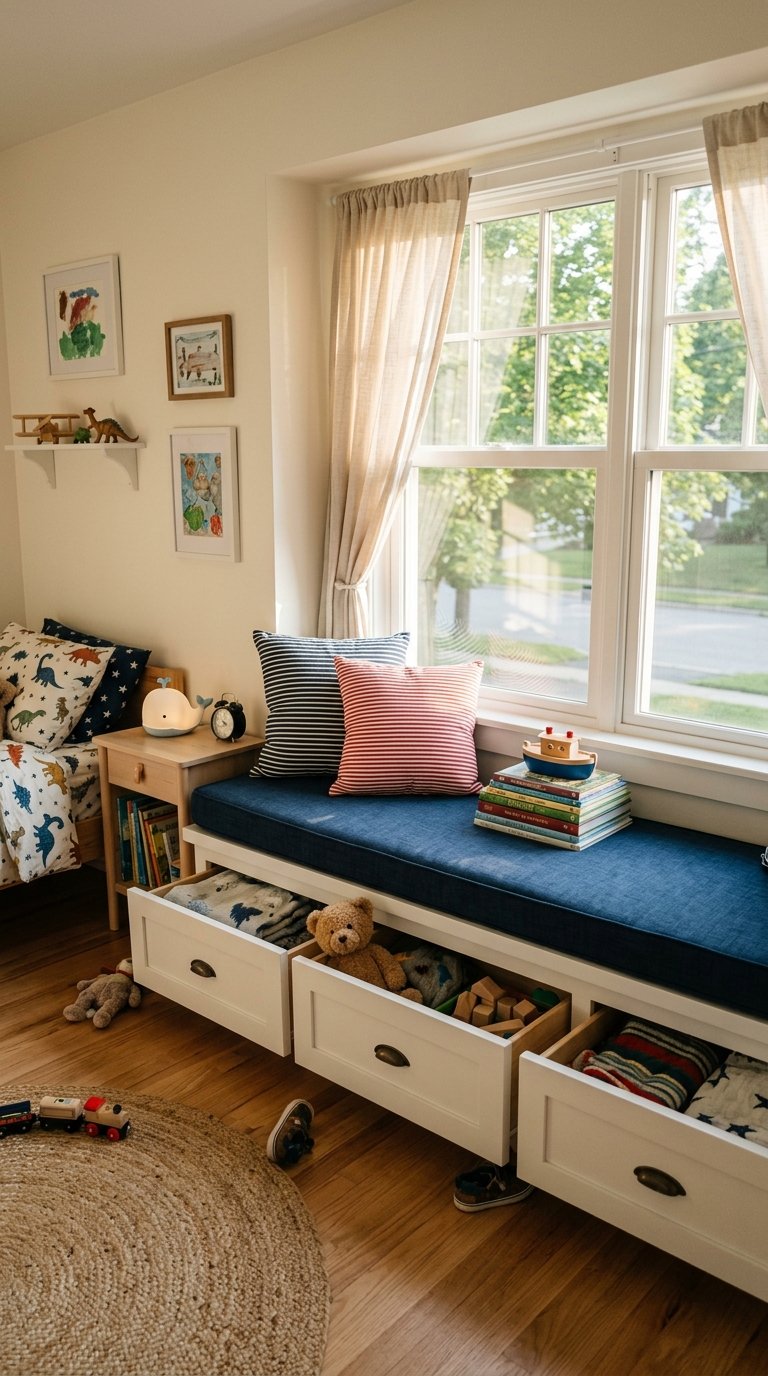
The window wall is prime real estate. A built-in bench with drawers underneath gives him a reading spot in daylight and a place to stash stuff. Cushions make it comfortable, and a couple of pillows make it a lounge.
If built-ins aren’t an option, a storage bench cut to fit the window width does a similar job. Keep the drawers on the room side so the window remains clear. Check that curtains or blinds don’t clash with the seat height.
Best for: Ages 5–12, rooms with a deep sill or free window wall.
Trade-off: It’s a project unless you buy a ready-made bench.
When he’s older: It becomes a hangout spot for friends.
15. Keep the Floor Clear for Play

Sometimes the best storage strategy is a rule: the floor stays open. Boys need space to build, r ll,cars, and wrestle a pile of pillows. Designate one zone with a rug as the play area, and everything else stays off it.
Rotate toys so only a handful are out at a time, and use lidded bins that slide under the bed. A round rug looks lighter than a rectangular one in a small room. A quick tidy before bed keeps the rule real.
Best for: Ages 4–9.
Trade-off: It takes habit, not just furniture.
When he’s older: The play zone becomes a hangout or workout space.
16. Color: Deep Behind the Bed, Light Everywhere Else

Dark walls don’t automatically shrink a room, but unbalanced ones can. A deep navy, forest green, or charcoal behind the bed anchors the space, while lighter walls and a white ceiling keep the rest feeling open.
Match trim to the light color and keep the floor lighter than the accent wall. In a room with little natural light, choose a warm deep tone like a muted green instead of a cold blue. Test paint samples in the room, since light changes everything.
If you’re also trying to make a small space feel more open, these small bedroom ideas can help you use color, mirrors, lighting, and furniture placement to create a room that feels bigger without adding more square footage. They’re especially useful when you’re working with limited floor space.
Best for: Any age, rooms with at least one window.
Trade-off: Dark paint shows scuffs and can feel heavy in a very dim room.
When he’s older: Repaint the accent wall, and the rest stays.
17. Themes Through Swappable Layers

Space, sports,t s and music themes are popular, but painting a wall or buying a themed bed locks you in. Put the theme in layers instead: bedding, a print or two, a pillow, maybe a peel-and-stick decal. The base stays neutral.
Skip novelty beds like race-car frames. They cost more, eat space, and get outgrown fast. Racing stripes on the bedding or a framed print look without the commitment.
Best for: Ages 4–12, any room
18. Lighting, Mirrors and Ambient Glow

Layered light makes a small room feel bigger. Combine a ceiling fixture with a bedside lamp or plug-in wall sconce, and add LED strips behind a headboard or under a shelf for soft glow.
A mirror can help, but place it opposite a window to bounce daylight, and use shatter-resistant or securely anchored glass. Mount it at a height that won’t catch a thrown ball. Clip lights on a loft or desk give focused light where he needs it.
Best for: Any age, especially dim rooms.
Trade-off: Too many cords and lights create clutter.
When he’s older: Add dimmers and color-changing strips.
FAQS
What bed works best in a small boy’s bedroom?
A loft bed is best if the ceiling is tall enough, since it frees the floor for a desk. A cabin bed suits lower ceilings, a trundle suits sleepovers, and a platform bed with drawers suits storage-heavy rooms. Match the bed to the biggest problem you’re solving.
Are loft beds safe, and what ceiling height do they need?
Loft beds are generally safe when they match the child’s age, have guardrails, and are used within the manufacturer’s limits. Ceiling height requirements vary by product, so check the manufacturer’s stated minimum and make sure he can sit up without touching the ceiling.
How do you fit a desk and a bed in a tinyboy’ss room?
Stack them with a loft bed, or replace the desk with a fold-down or floating one that leaves the floor open. A corner desk also uses dead space. Measure the walkway so you don’t block the door.
How can I store LEGO without it taking over the floor?
Use picture ledges for finished builds and a shallow drawer or under-bed bin for loose bricks. Sort by set or color, and keep the display above bed height.
What colors work in a small boy’s room?
Light walls with one deep accent wall behind the bed work well. Navy, forest green,een and charcoal add depth without shrinking the room if the ceiling and trim stay light.
How do you set up a gaming corner in a small bedroom?
Use an L-shaped floating desk in a corner, mount the monitor on an arm, and route cables through a tray. Add hooks for headphones and a wall power strip so nothing hangs.
How do you design a boy’s room so he won’t outgrow it?
Start with a neutral base and put themes in bedding and art. Choose furniture that changes roles, like a loft that converts from a play zone to a desk, and revisit the room every couple of years.
What can renters do to add storage without drilling?
Use over-the-door organizers, freestanding shelves, storage benches, and rolling bins. Peel-and-stick decor and adhesive hooks handle lighter items.
Where should sports gear go in a small room?
Keep it near the door on wall hooks, a rack, and a ventilated shoe shelf. That keeps gear off the floor and stops smells from spreading to the bed.
How do you fit a sleepover bed in a small room?
A trundle is the simplest fix. Alternatively, keep a floor mattress or air bed in a closet and clear the play zone when needed.
Conclusion
Designing a small boy’s bedroom doesn’t mean you have to sacrifice comfort, storage, or style. The right small boys’ bedroom ideas can help you make better use of every inch, whether you choose a loft bed with a desk, a storage bed, wall shelves, a gaming corner, or simple under-bed storage. Start by measuring the room, keeping walkways clear, and choosing furniture that solves your biggest space problem.
As he grows, his bedroom can grow with him too. Keep the main pieces practical and neutral, then update bedding, wall art, storage, and hobby areas as his interests change. With smart small bedroom storage ideas for boys, flexible furniture, and a little planning, even a tiny room can feel organized, comfortable, and ready for everything from homework and playtime to sleepovers and gaming.