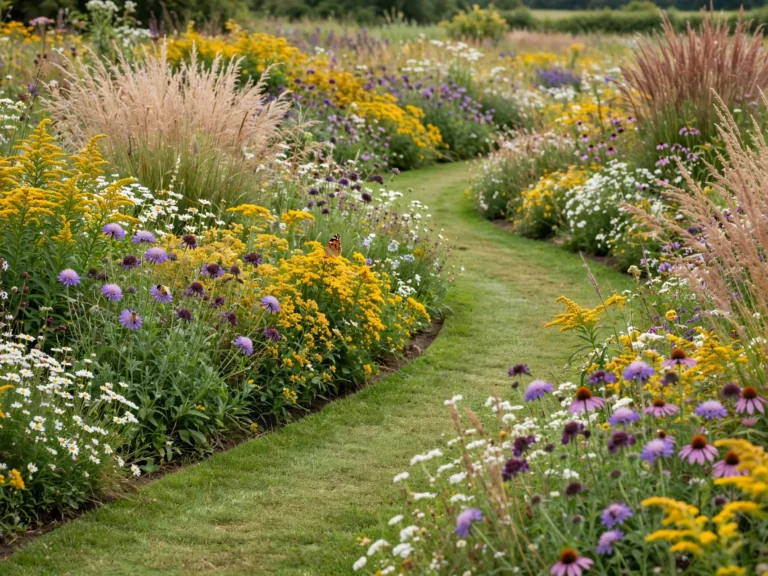

12 Indoor Vertical Herb Garden Ideas for Small Kitchens
An indoor vertical herb garden lets you grow basil, mint, parsley, and more on a wall, ladder,r or tower instead of on a crowded counter. If your windowsill only fits two pots, going vertical can give you ten or twelve plants in the footprint of a cutting board, with fresh leaves a step away from the stove.
Below are 12 vertical herb garden ideas for small kitchens, apartments, and rentals. Each one lists the best herbs for that setup, how much light it needs, a rough cost, and the one mistake most people make with it. Costs are approximate US ranges and vary by store and region.
1. A Wood Slat Wall Grid for Your Herbs
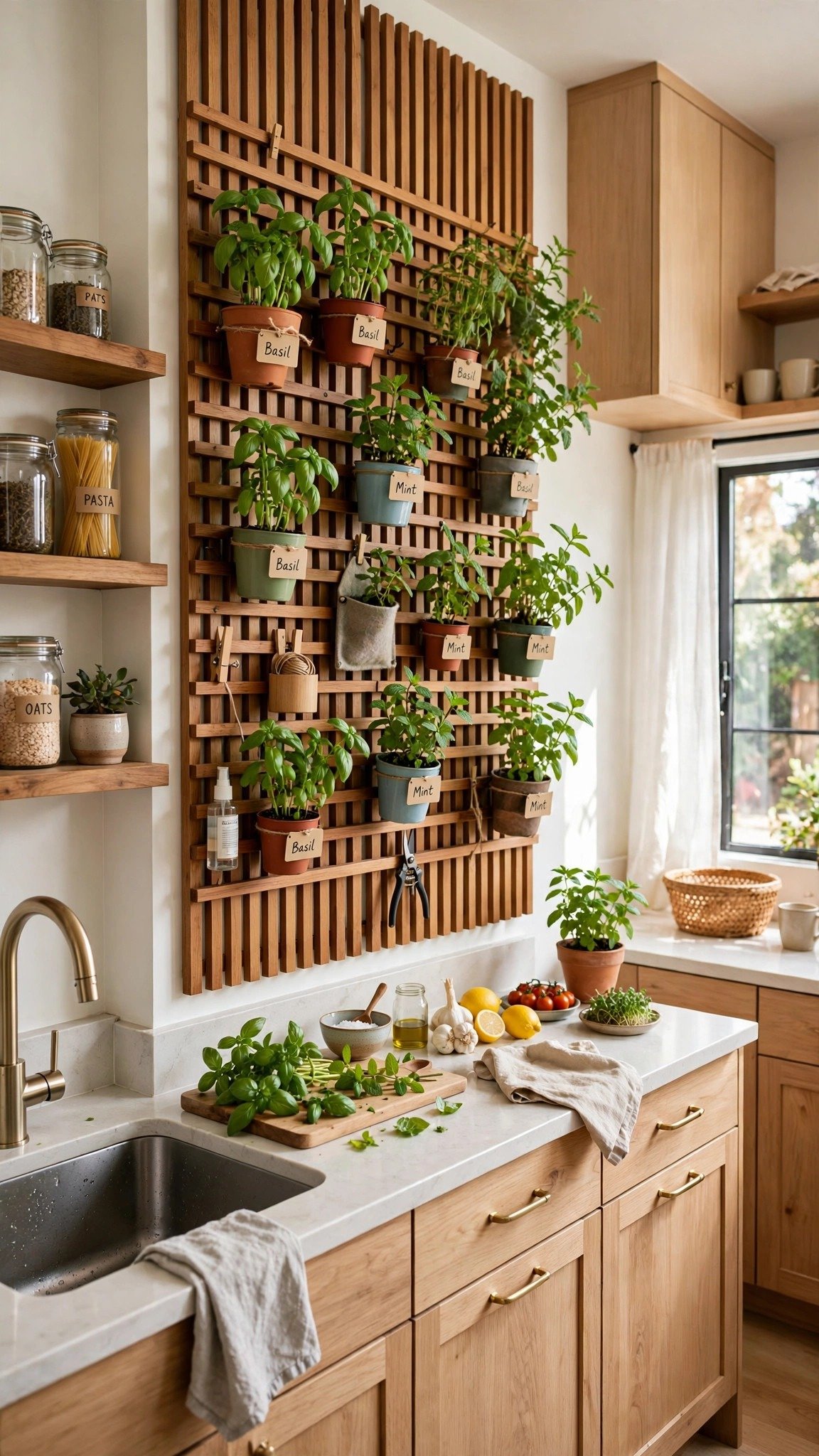
A slat wall is a row of horizontal wooden strips with small pots hooked or clipped along them. It suits people who know they will want more plants later, since adding a pot just means adding a clip. The wood also warms up a white or tiled kitchen.
- Best herbs: basil, parsley, chives
- Light: four to six hours of bright light; add a clip-on grow light if the wall is dim
- Care tip: water when the top inch of soil feels dry, and keep mint out of this setup unless it has its own pot, because its roots spread quickly
- Watch out for: screwing slats straight into drywall. Use wall anchors or find a stud, since wet pots add real weight.
What you need: wooden slats or a ready-made slat panel, small pots with hooks or clips, potting mix, screws and wall anchors.
2. A Window Frame With Hanging Macramé Planters

Hang macrame planters from an old wooden window frame, and your herbs sit in the best light the room has. It also gives a kitchen a relaxed, boho feel for very little money, especially if you already own a frame.
- Best herbs: basil, rosemary, thyme
- Light: direct sun, which this spot provides
- Care tip: hanging pots dry out faster than shelf pots, so check the soil every two to three days
- Watch out for: blocking the entire window. Stagger the heights and keep taller plants at the sides.
What you need: an old window frame, macramé hangers, small pots with drainage and saucers, potting mix, strong ceiling or wall hooks.
3. A Stainless Steel Pocket Planter on the Backsplash
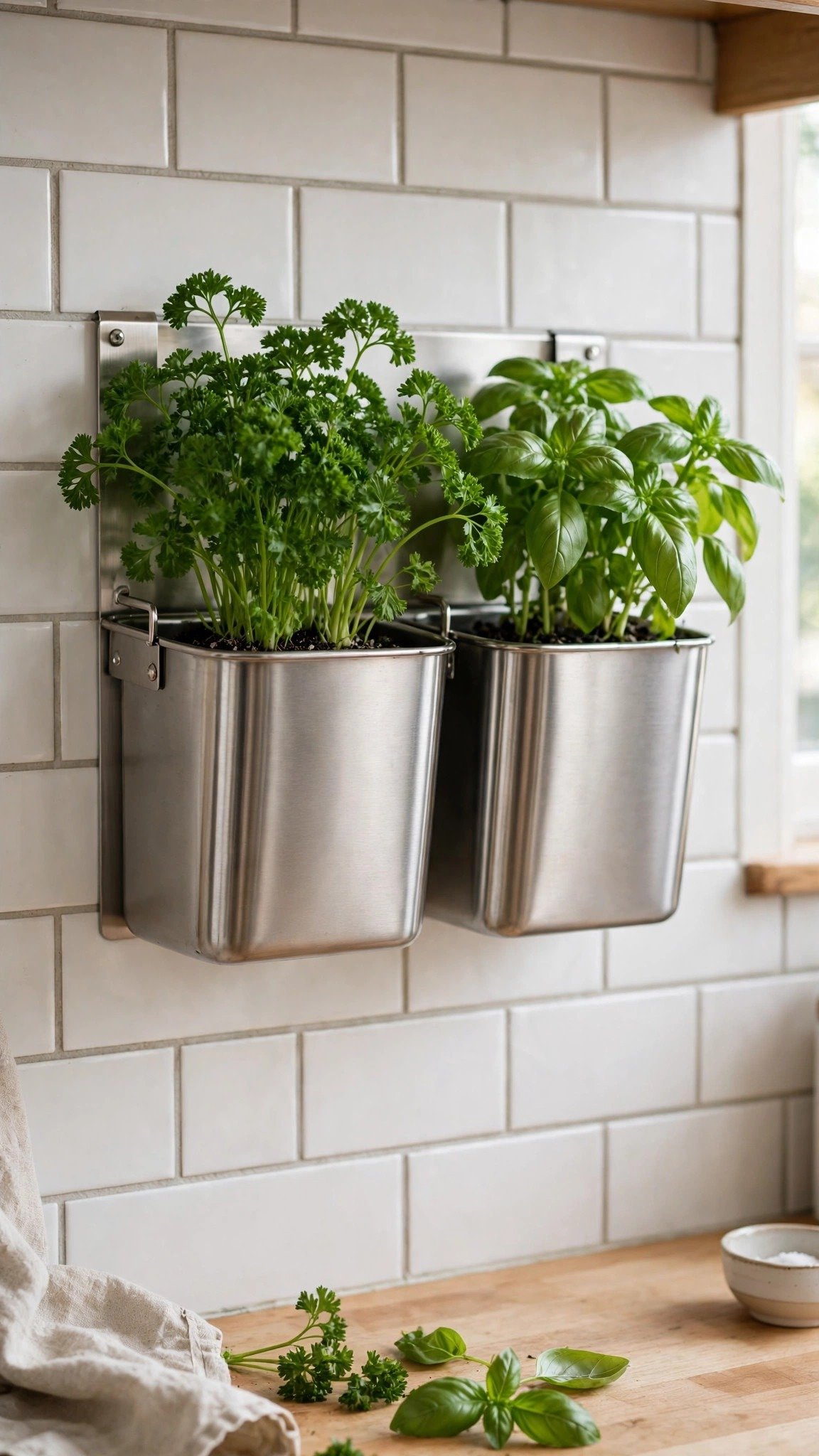
A stainless steel pocket planter turns the backsplash behind your stove or sink into a herb garden. A slim steel rail or panel holds fabric or metal pockets, and each pocket holds one small herb plant. The steel matches modern kitchens, wipes clean in seconds, and keeps the herbs at arm’s reach while you cook — snip parsley straight into the pan without taking a step.
Parsley, chives, and cilantro do well in pockets because they like steady moisture and do not need deep soil. The backsplash can get warm near the stove, so pick a spot that does not sit directly above a hot burner, and water pockets a little more often than pots, since they dry out fast. A small drip tray or a waterproof backing behind the pockets protects the wall from splashes. This is a mid-range idea, and it suits a modern kitchen best.
- Best herbs: parsley, chives, oregano
- Light: a bright spot, but not directly over a burner
- Care tip: pockets hold little soil and dry quickly, so water slightly more often than you would for pots
- Watch out for: heat. Cilantro bolts (flowers and turns bitter) in warm spots, so keep it on the coolest part of the wall and replant it every month or so.
What you need: a steel rail or pocket panel, pocket inserts, a waterproof backing or drip tray, potting mix, mounting screws.
4. Mason Jars on a Wooden Board
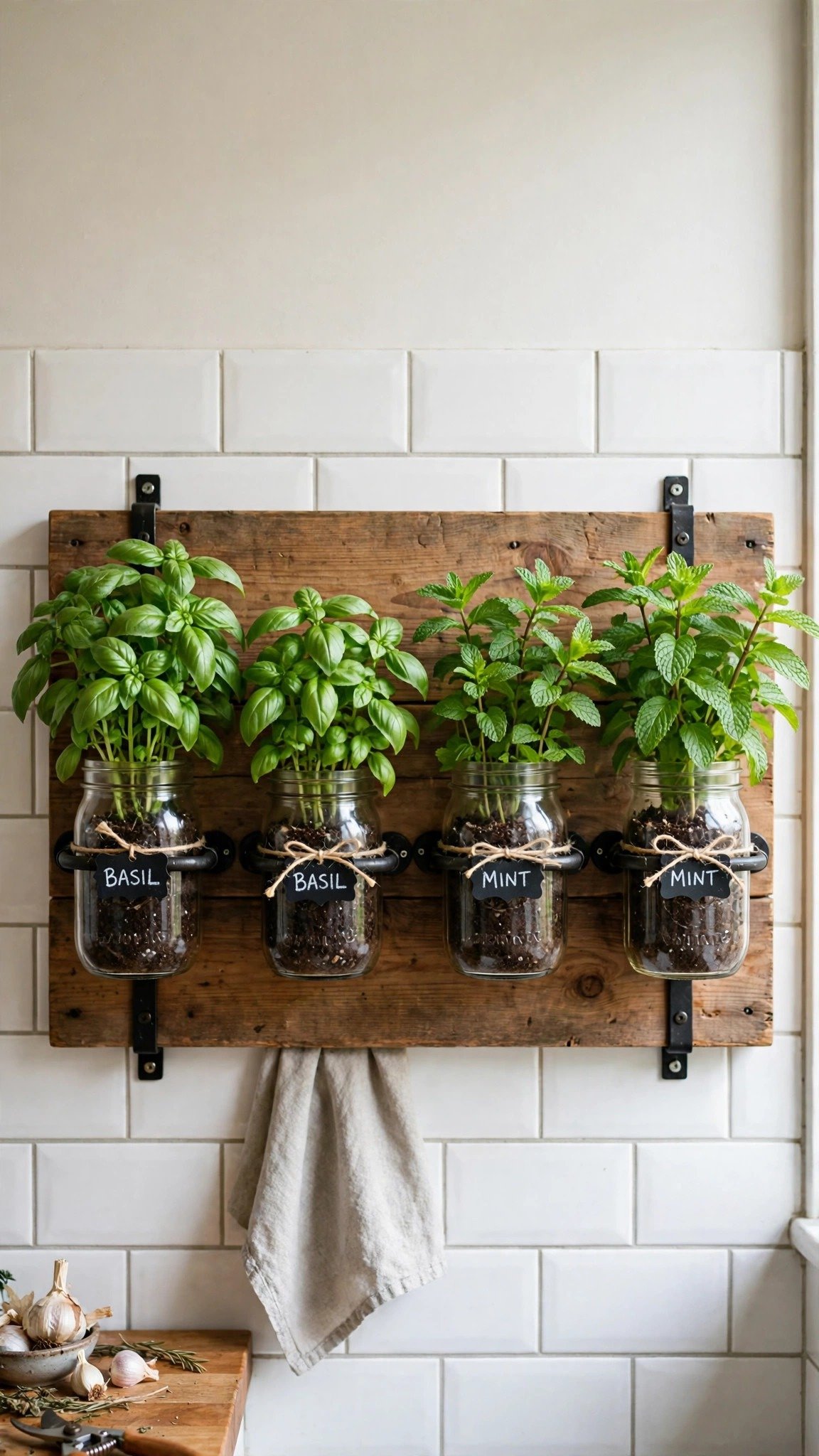
Mason jars on a wooden board are the classic DIY herb garden, and they still work beautifully. A stained or painted board mounts on the wall, and glass mason jars clamp to it in a neat row. You can see the soil and the roots through the glass, which makes watering easy to judge, and the jars look charming in a farmhouse or rustic kitchen.
Basil and mint are the best herbs for jars because they grow fast and forgive a missed watering. Drill a drainage hole in each jar lid or add a layer of small stones at the bottom so the roots never sit in water — jars have no drainage, and soggy roots kill herbs fast. Hang the board where it gets at least four hours of light, and label each jar so guests know what is what. This is a low-cost idea and a great first vertical garden.
- Best herbs: mint, chives, parsley (basil works if you are careful with water)
- Light: at least four hours of bright light
- Care tip: jars have no drainage holes, so plant each herb in a small plastic nursery pot and set it inside the jar, tipping out any pooled water after watering. Drilling glass needs a diamond bit and patience, so the nursery-pot trick is safer.
- Watch out for: soggy roots. This is the number one reason jar herbs die.
What you need: a wooden board, mason jars with clamps, small nursery pots, potting mix, wall anchors, labels.
5. A Freestanding Tiered Plant Ladder

A freestanding tiered plant ladder holds a dozen herbs on a footprint no bigger than a chair. The ladder leans against a wall or stands on its own, and each step holds a row of pots. The top step gets the most light, the bottom step the least, so you can place sun-lovers up high and shade-tolerant herbs down low. It looks like furniture, not a garden system, so it fits a living room or dining area as well as a kitchen.
Put basil, rosemary, and thyme on the top steps, and parsley, chives, and mint on the lower ones. A ladder is easy to move, which matters in winter — slide it closer to the window when the days get short. Water from the top down and catch drips on a tray, because water runs down the steps. This is a low-cost to mid-range idea, and it is the best choice if you rent, because it needs no holes in the wall.
- Best herbs: rosemary, thyme, and basil on the top rungs; parsley, chives, and mint below
- Light: place it beside your brightest window
- Care tip: slide it closer to the glass in winter when daylight shortens
- Watch out for: drips. Water runs down every tier, so put a tray on the floor and water from the top down.
- What you need: a wooden tiered plant ladder or leaning shelf, terracotta or plastic pots, potting mix, a drip tray, basil, rosemary, thyme, parsley, chives, and mint plants.
6. A Smart Hydroponic Wall Tower With LED Lights
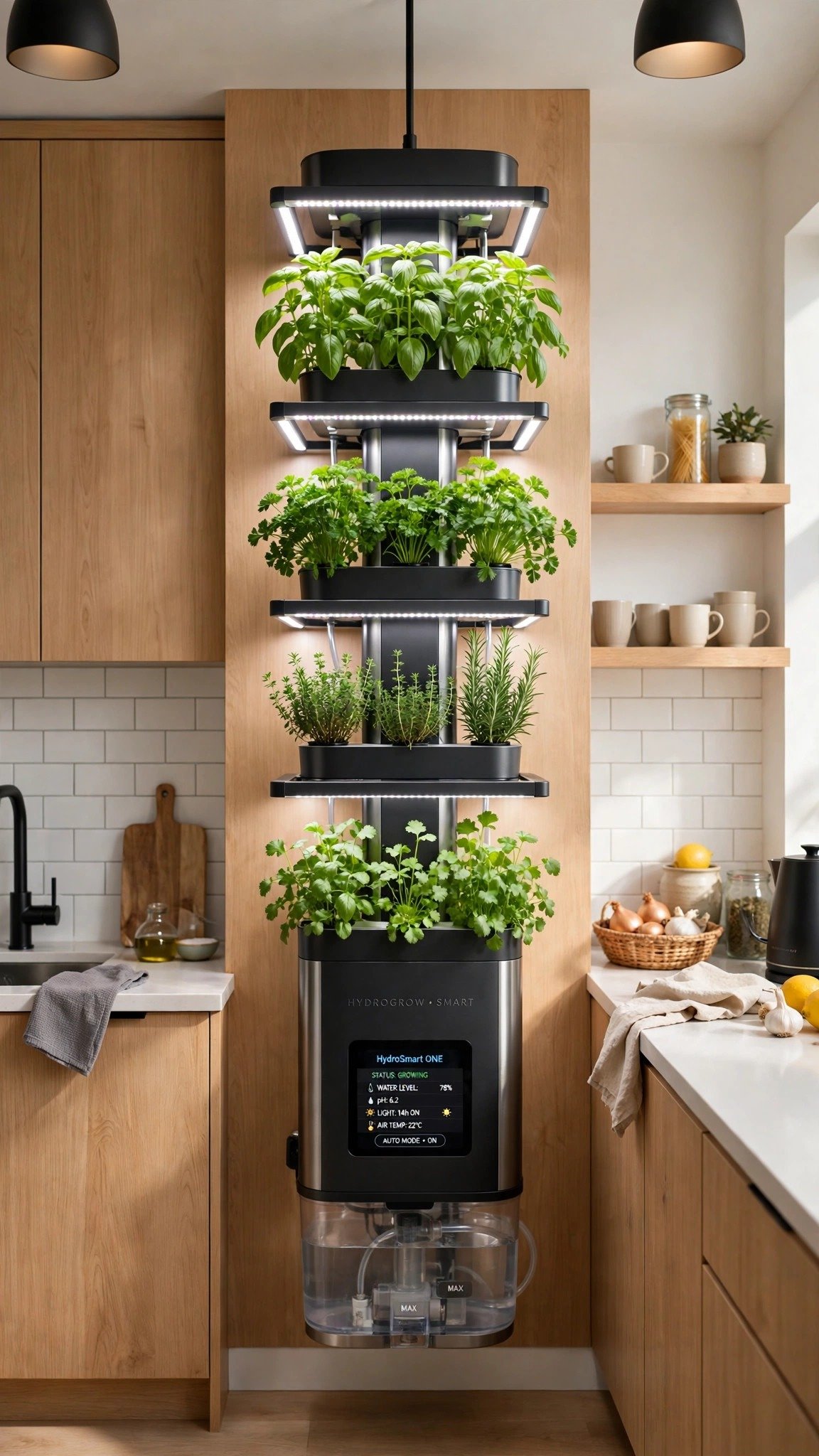
A smart hydroponic wall tower grows herbs in water instead of soil, with LED lights built in. The tower mounts on the wall or stands in a corner, and a small pump moves water and nutrients past the roots on a timer. You do not water at all — you just top up the tank every week or two — and the LED lights mean the herbs grow even in a kitchen with no sunny window.
Basil grows fastest in a hydroponic tower, and lettuce, parsley, and cilantro do well too. Mint can take over a shared water system, so give it its own pod or skip it here. The tower costs more than a jar board, so it is a bigger investment, but it pays back in fresh herbs all year, even in winter, with almost no daily work. Wipe the lights and check the water level once a week, and harvest often so the plants stay bushy.
- Best herbs: basil, parsley, cilantro, lettuce
- Light: supplied by the tower, usually on a timer
- Care tip: harvest often so plants stay bushy, and wipe the lights and check the water level weekly
- Watch out for: mint. It can overrun a shared reservoir, so give it a separate pod or grow it elsewhere.
The upfront cost is higher than any DIY option, but you get fresh herbs through winter with very little daily work.
- What you need: a hydroponic wall tower kit with LED lights and pump, seed pods or net pots, nutrient solution, basil, parsley, and cilantro seeds or seedlings, a power outlet nearby.
7. Magnetic Herb Pots on a Metal Board
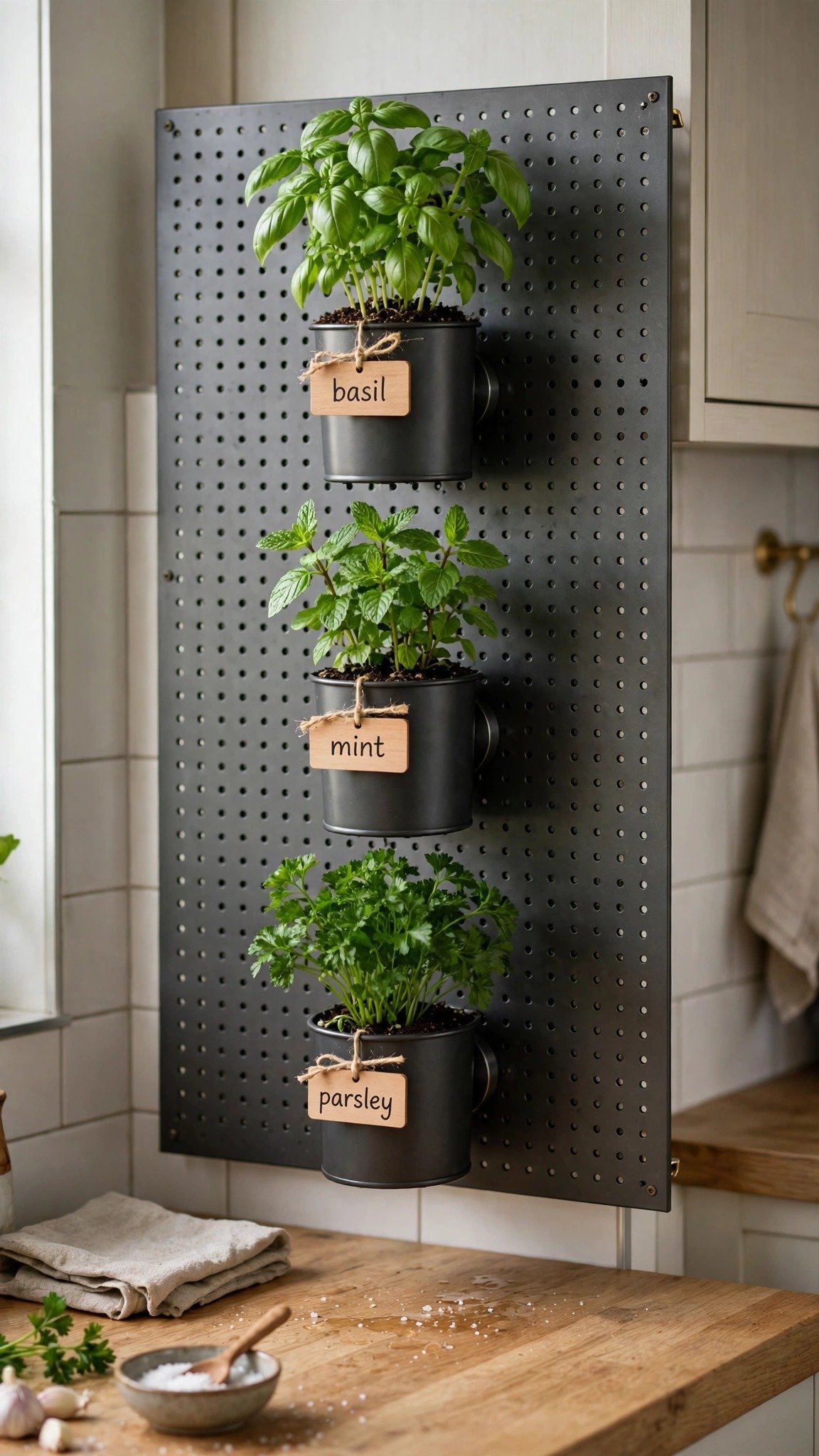
Magnetic herb pots on a metal board are the neatest small-space herb garden you can make. A steel board mounts on the wall, and small pots with strong magnets snap onto it anywhere you like. Move a pot in seconds when a plant needs more light, or pull one off the board and carry it to the stove while you cook. The board looks clean and modern, and the pots sit flat, so nothing dangles or swings.
This setup suits small herbs like thyme, oregano, and chives, because the pots are usually small and shallow. Use a strong magnet and a light pot — a heavy terracotta pot can slide down the board. Water gently so the soil does not wash out, and give the board a bright spot, because small pots dry out fast in warm kitchens. This is a low-cost to mid-range idea, and it is perfect for a renter who wants no drilling beyond two screws for the board.
- Best herbs: thyme, oregano, chives
- Light: a bright wall
- Care tip: water gently so soil doesn’t wash out, and expect small pots to dry quickly in warm kitchens
- Watch out for: weight. Use strong magnets with light plastic or tin pots; heavy terracotta can slide down the board.
- What you need: a steel or magnetic board, small magnetic pots, potting mix, thyme, oregano, and chives plants, mounting screws, plant labels.
8. A Hanging Terracotta Rail by the Window
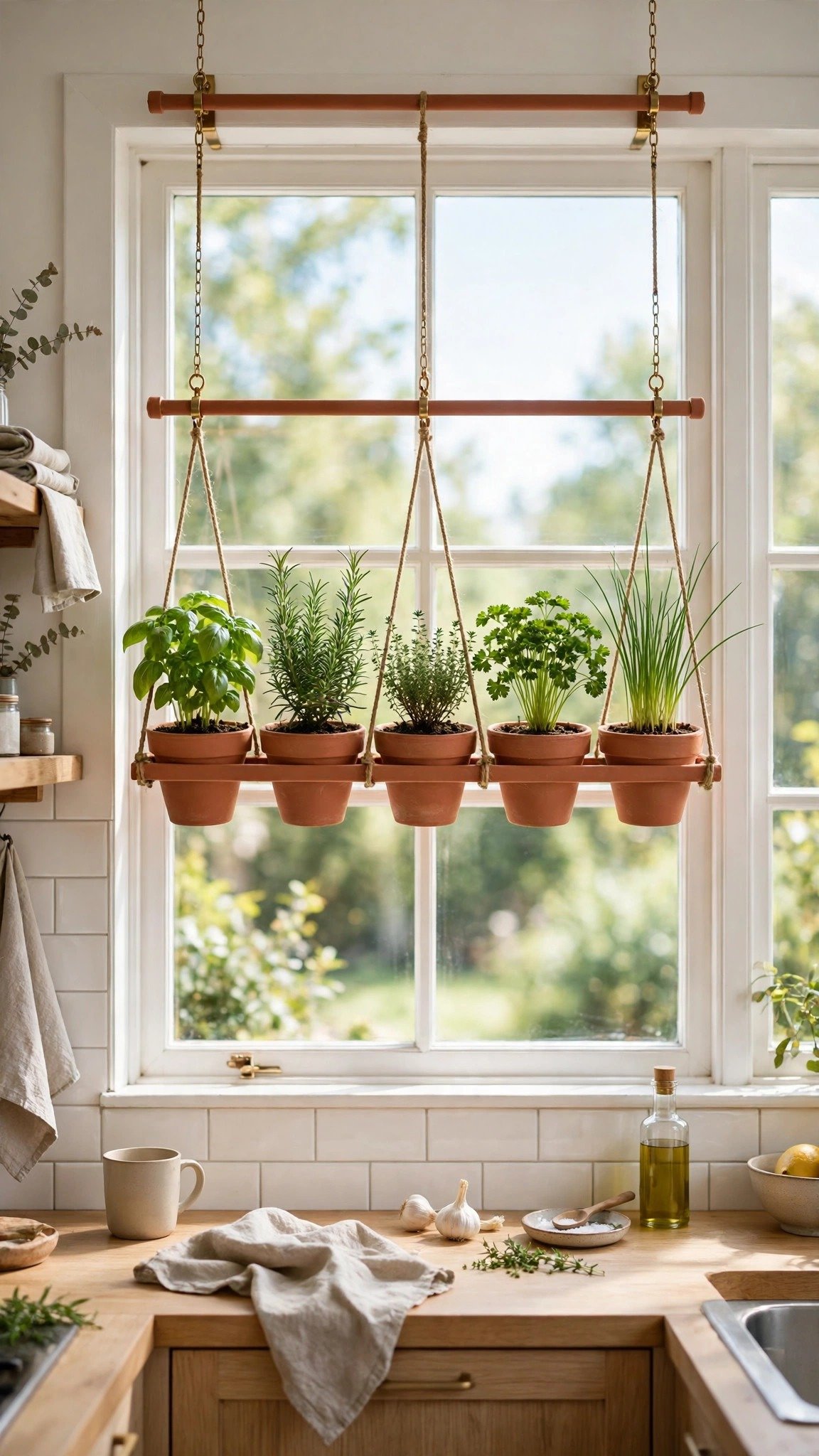
A hanging terracotta rail puts classic clay pots on a simple metal rail by the window. The rail mounts under a shelf or across a window frame, and terracotta pots hang from it on hooks. Terracotta breathes, so the soil dries evenly and the roots stay healthy, and the warm orange clay looks lovely against green leaves and white walls.
Rosemary and thyme love terracotta because they hate wet feet, and the clay helps the soil dry between waterings. Hang the rail where the pots get morning sun, and leave a little space between pots so air moves around the leaves. Terracotta is heavier than plastic, so fix the rail into a stud or use strong wall anchors. This is a low-cost idea, and it suits a sunny kitchen window best.
What you need: a metal rail with hooks, small terracotta pots, potting mix, rosemary and thyme plants, wall anchors or screws into a stud.
9. A Pegboard Herb Station You Can Rearrange

A pegboard herb station is the most flexible herb garden on this list. A pegboard panel mounts on the wall, and pots, hooks, and small shelves clip into its holes wherever you want them. Move a pot to a sunnier spot, add a shelf for scissors and twine, or hang a small watering can right beside the plants. When a plant outgrows its pot, unhook it and swap in a bigger one without touching the wall.
Basil, parsley, and mint all grow well on a pegboard, because you can give each plant the light it needs by moving it. Paint the board to match your kitchen, or leave the wood natural for a warm workshop look. Keep a small pair of scissors on a hook so you snip herbs often — regular cutting keeps plants bushy instead of tall and leggy. This is a low-cost idea, and it is the best choice if you like to change things around.
- Best herbs: basil, parsley, mint (in its own pot)
- Light: bright wall; move plants as the seasons change
- Care tip: keep scissors on a hook and cut often. Regular harvesting keeps herbs bushy instead of tall and leggy.
- Watch out for: overloading one hook. Spread the weight across several holes.
What you need: a pegboard panel, pegboard hooks and small shelves, hanging pots, potting mix, basil, parsley, and mint plants, mounting screws, small scissors.
10. A Copper Pipe Ladder Frame for Herbs
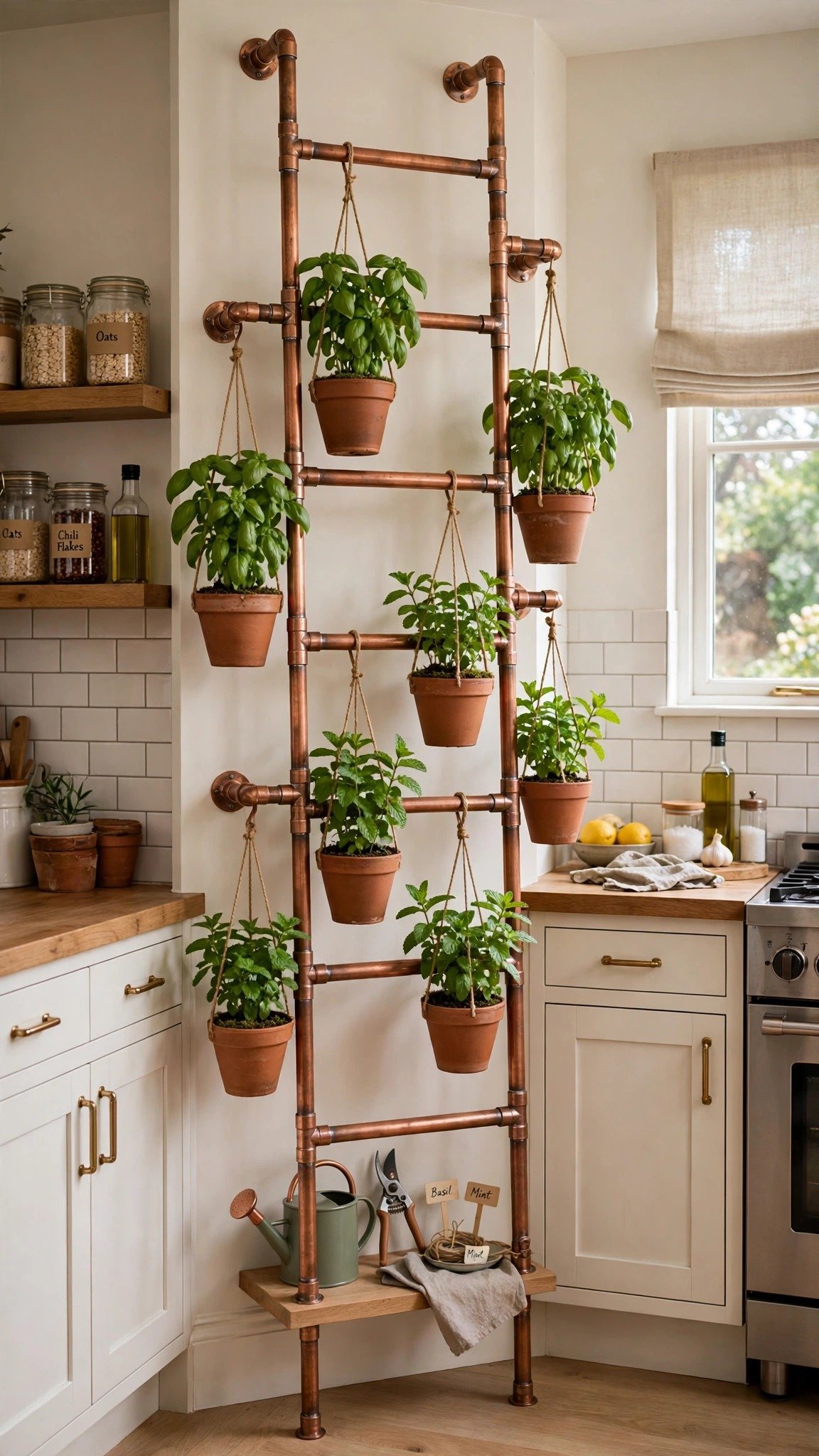
A copper pipe ladder frame turns plumbing pipe into a beautiful herb garden. Copper pipes form a ladder shape on the wall, and small pots hang from the rungs on hooks or rings. The warm copper glows in kitchen light and suits a modern or industrial kitchen, and the open frame keeps the wall visible behind the plants, so the garden never feels heavy.
Basil and mint grow fast on a copper frame, and trailing herbs like creeping thyme look lovely spilling over the rungs. Copper is light and easy to cut, but the joints must be tight — a wobbly frame drops pots. Fix the frame into studs or use strong anchors, and hang the pots with rings that fit the pipe snugly. This is a mid-range idea, and it works best on a wall that gets at least four hours of bright light.
- Best herbs: basil, mint, creeping thyme
- Light: at least four hours of bright light
- Care tip: use rings that fit the pipe snugly so pots don’t slide
- Watch out for: loose joints. A wobbly frame drops pots, so fix it into studs or strong anchors.
What you need: copper pipes and elbow joints, pipe rings or hooks, small pots, potting mix, basil, mint, and creeping thyme plants, wall anchors, a pipe cutter.
11. A Recessed Nook Garden With Built-In Lights

A recessed nook garden turns a shallow niche in the wall into a glowing herb garden. The nook holds two or three shelves, and a slim LED strip under each shelf lights the plants below. The herbs grow in soft light even in a dark hallway or a kitchen with no window, and the nook looks like a piece of built-in art when the lights are on at night.
Parsley, chives, and basil do well in a lit nook because the LED strips give steady, even light for twelve to fourteen hours a day on a timer. Keep the nook away from steam — not right above the stove — and water with a small can, because a recessed shelf is hard to reach with a big jug. This is a bigger investment, since it needs a carpenter or a handy builder to cut the nook, but it is the most polished herb garden on this list.
- Best herbs: parsley, chives, basil
- Light: LED strips on a timer for 12 to 14 hours a day
- Care tip: use a small watering can, since reaching into a nook with a big jug gets messy
- Watch out for: steam and splashes. Keep it away from the stove and use grow-spectrum bulbs rather than ordinary warm-white strips.
What you need: a recessed wall nook or a shallow built-in shelf unit, LED strip lights with a timer, small pots, potting mix, parsley, chives, and basil plants, a small watering can.
12. A Stackable Planter Tower for Small Spaces
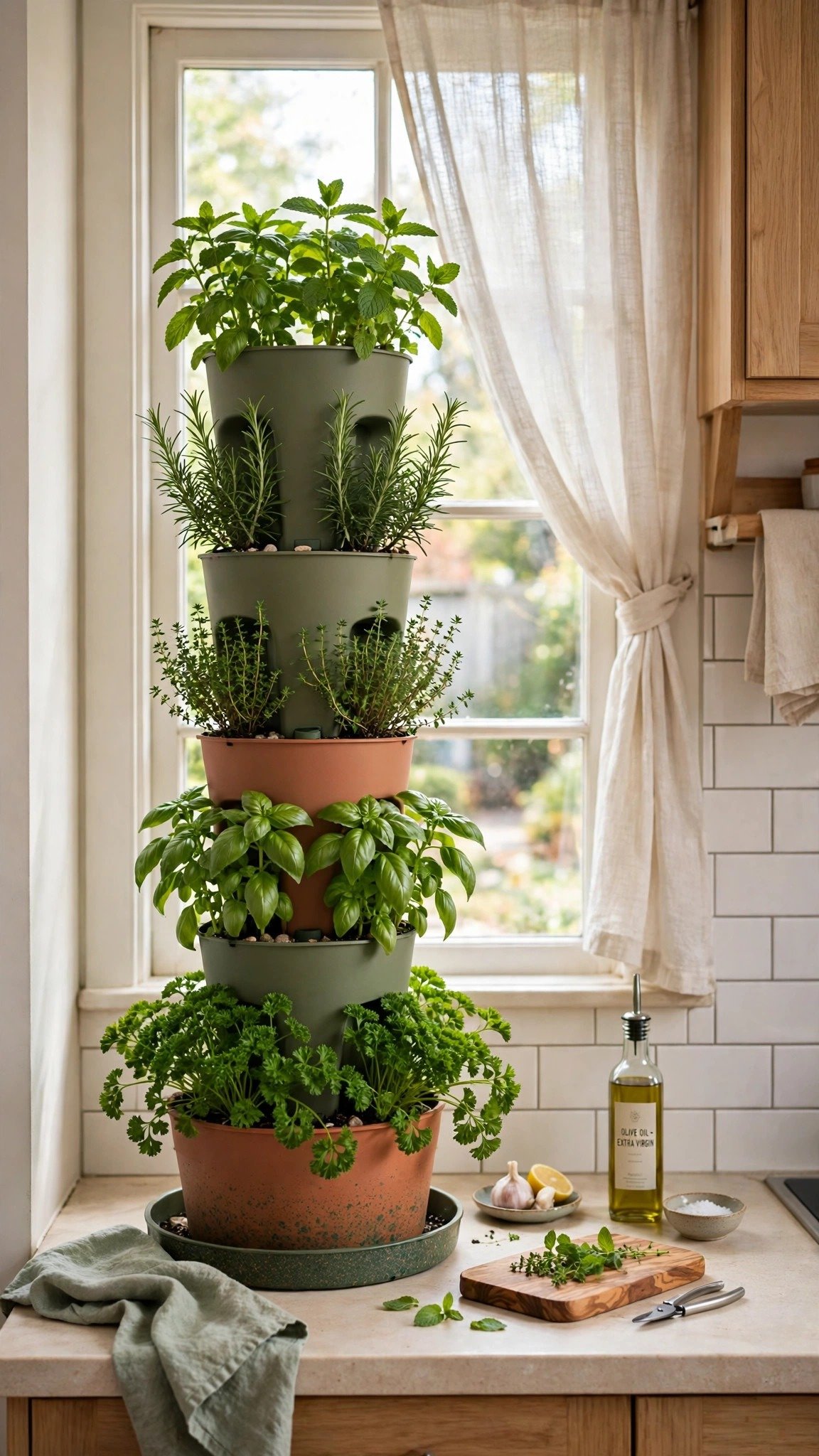
A stackable planter tower grows a dozen herbs on a single square foot of counter or floor. Round or square planters stack into a tower, and each level has pockets around its sides for plants. Water from the top, and it trickles down through every level, so one watering feeds the whole tower. The tower fits a balcony door, a kitchen corner, or even a sunny living room.
Put basil and parsley on the top levels where the light is strongest, and mint and chives lower down. Mint needs its own pocket, never shared with another herb, because its roots spread fast. A tower is easy to turn, so rotate it every few days, and every plant gets its share of sun. This is a low-cost to mid-range idea, and it is the best choice if you want the most herbs in the least space.
- Best herbs: basil and parsley up top, chives lower down, mint in its own pocket
- Light: a sunny corner or window; rotate the tower every few days so every side gets sun
- Care tip: top levels dry faster than lower ones, so check more than one level before watering again
- Watch out for: compacted soil in the lowest pockets. Use a light, well-draining mix.
What you need: a stackable planter tower kit, potting mix, basil, parsley, mint, and chives plants, a drip tray, a sunny corner or window.
Which Indoor Vertical Herb Garden Fits Your Home?
The right vertical herb garden depends on your light, your wall, and how much work you want to do. A sunny kitchen suits a window frame, a terracotta rail, or a wood slat grid — the sun does the work, and you just water. A dark kitchen needs a hydroponic tower or a recessed nook with LED lights, because no plant grows without light.
Renters should pick a freestanding ladder or a stackable tower, since neither needs holes in the wall. Homeowners can mount a pegboard, a slat grid, or a copper frame and leave it up for years. If you cook every day, a ladder or a tower holds the most herbs. If you cook once or twice a week, a jar board or a magnetic board with four or five plants is plenty.
FAQS
What herbs grow best in a vertical garden indoors?
Basil, parsley, mint, chives, thyme, and oregano grow best in a vertical garden indoors. They stay small, grow fast, and forgive a missed watering. Basil is the easiest to start with, and mint should always get its own pot.
How much light do indoor vertical herb gardens need?
Indoor vertical herb gardens need four to six hours of bright light a day. A sunny window or a bright kitchen wall works well. If your kitchen is dark, use an LED grow light for twelve to fourteen hours a day on a timer.
How do you water a vertical herb garden?
Water each pot when the top inch of soil feels dry, usually every two to three days. Water slowly so the soil soaks it up, and let extra water drain away. Hydroponic towers need no watering — just top up the tank every week or two.
Can you grow herbs indoors without soil?
Yes, you can grow herbs indoors without soil using a hydroponic system. The roots sit in water with nutrients, and a pump keeps the water moving. Basil, parsley, and cilantro grow very well this way, and the plants need almost no daily care.
What is the easiest vertical herb garden for beginners?
A mason jar board or a pegboard station is the easiest vertical herb garden for beginners. Both are cheap, simple to build, and easy to move. Start with basil, parsley, and mint, and add more plants once you see how they grow.
How do you keep herbs from drying out on a wall?
Check the soil every two or three days and water when the top inch feels dry. Small wall pots dry fast, so group plants together to hold humidity, and keep them away from hot stoves and heating vents. A small spray bottle helps on dry days.
Which herbs should not grow together?
Mint should not grow with other herbs because it spreads fast and takes over. Rosemary and thyme like dry soil, while basil and parsley like more water, so keep dry-lovers and water-lovers in separate pots. Give each herb its own pot when you are not sure.
Conclusion
An indoor vertical herb garden does not need a big kitchen or a green thumb. It needs a bright wall, a simple system, and three herbs you actually cook with. Start small, water on a routine, and snip often — the plants will reward you with fresh flavor every day.
The best vertical herb garden is the one that fits your home and your habits. Pick one idea from this list, hang it this weekend, and let your kitchen wall slowly turn into a garden that feeds you all year.