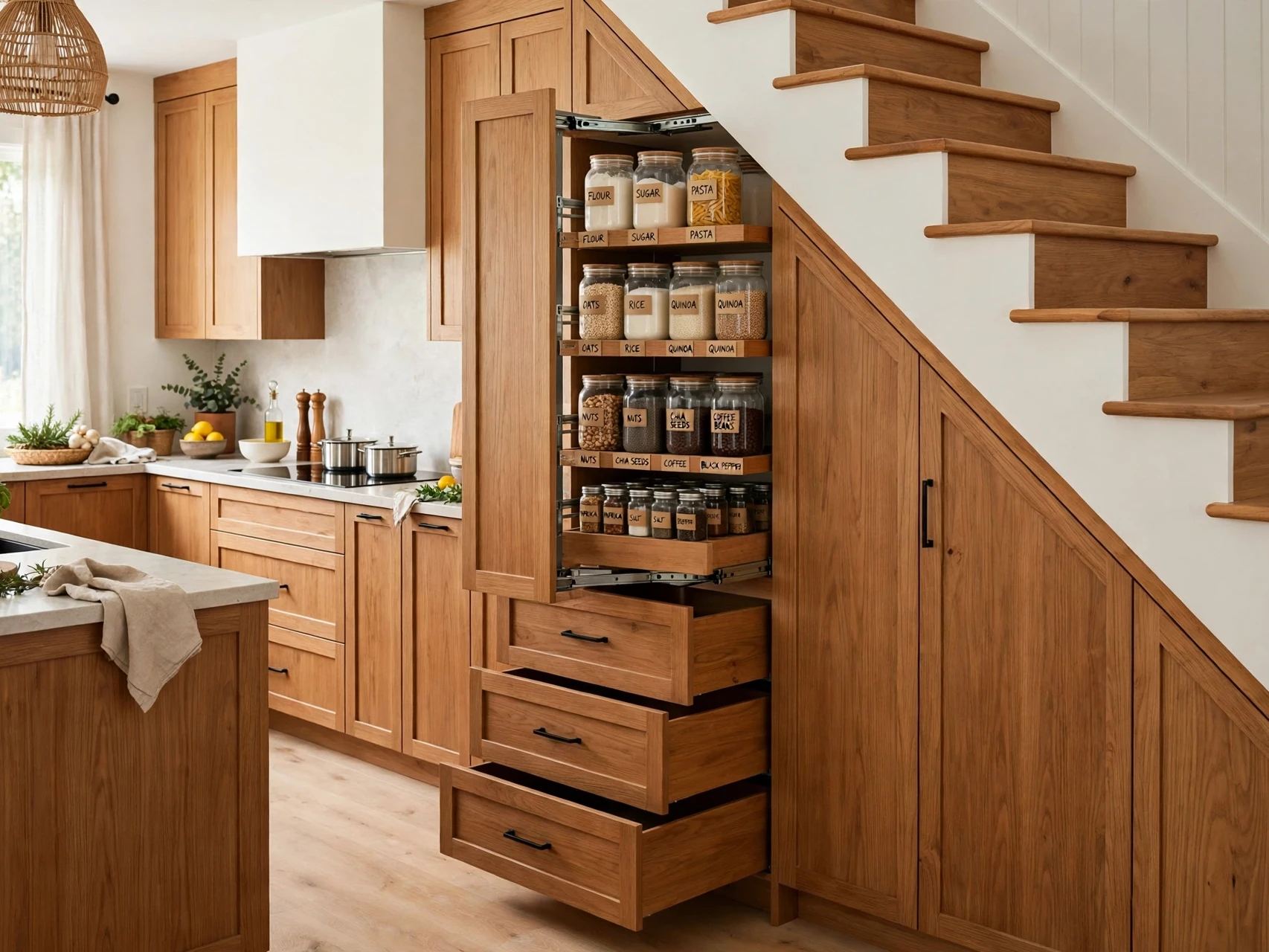
21 Kitchen Cabinet Under Stairs Ideas
Most kitchens have a dead corner that nobody talks about: the triangle of space under the stairs. It collects a vacuum cleaner, a bag of bags, and whatever did not fit anywhere else. Yet that same sloping space sits right where a kitchen needs storage most, close to the counters, the cooker, and the table.
A cabinet built into that slope changes how the whole kitchen feels. Counters clear up because the pots, the baking trays, and the recycling finally have a home that is not the worktop. You stop stacking things in front of other things, and you stop losing the spice jar you know you bought last week.
Use this list by starting with the problem that annoys you most, not by the prettiest picture. If your counters are covered in appliances, start with the appliance garage. If you have no pantry at all, start with the tall pull-out. Measure the slope first, then pick the cabinet that fits what you actually own.
1. Tall Pull-Out Pantry for the Full Height
The tallest part of the slope, where the stairs are highest, is the natural home for a full-height pull-out pantry. It slides out in one smooth movement, so you can see every shelf at once instead of reaching into a dark cupboard and guessing. Cans, jars, pasta, and baking supplies stand in rows, and nothing hides behind anything else.
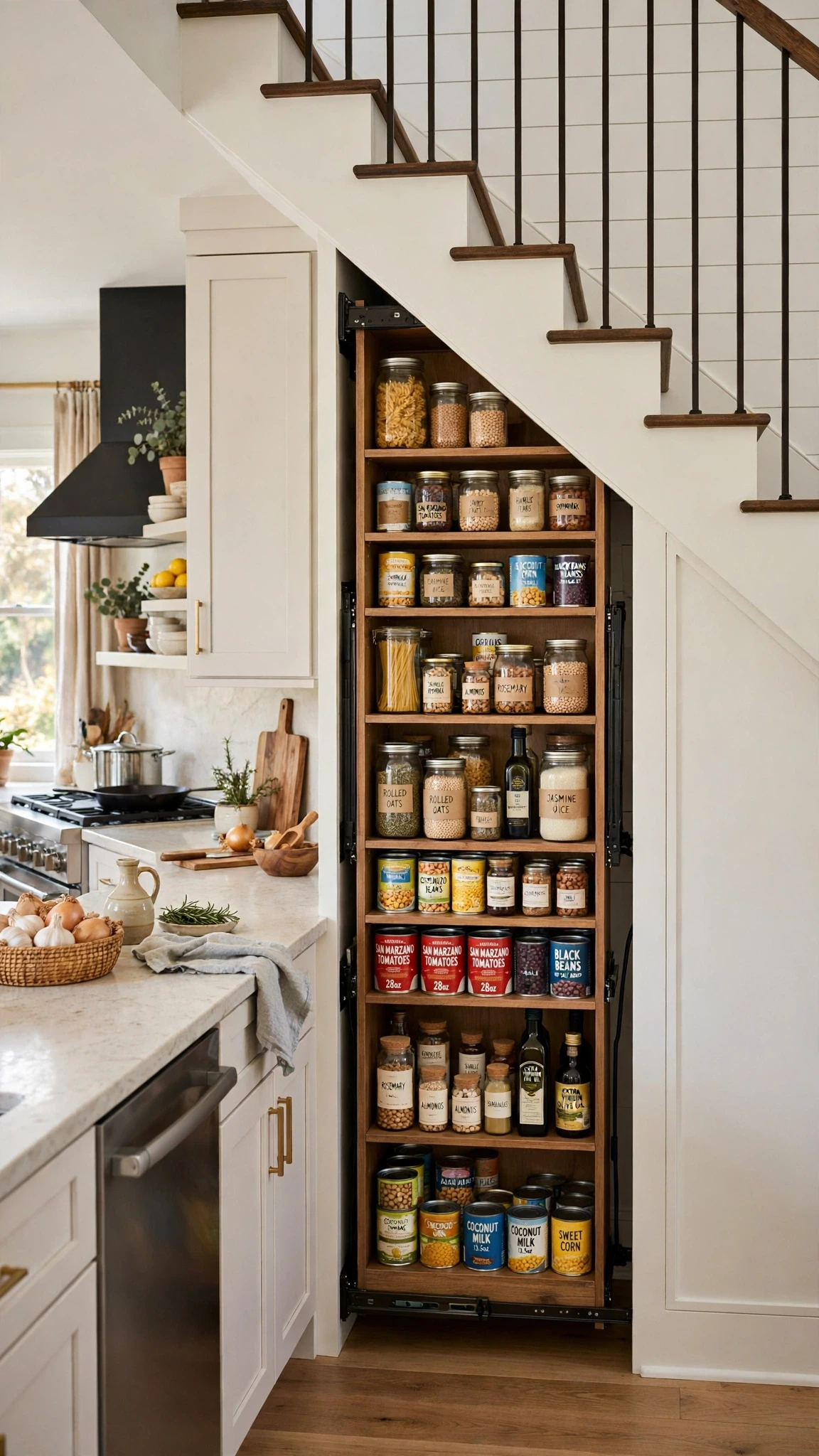
This works best when you sort by use rather than by size. Put the everyday things at hand height, the heavy bags of flour low down, and the rarely used gadgets up high. Adjustable shelves matter here, because a pantry that cannot change with your shopping will feel wrong within a year.
2. Deep Drawers for Pots and Pans
Deep drawers under the middle of the slope are made for the heavy things that usually live in a jumbled cupboard. Pots stack neatly in one drawer, lids stand upright in another, and you pull the whole drawer out to see everything instead of crouching and lifting a stack to reach the pan at the bottom.
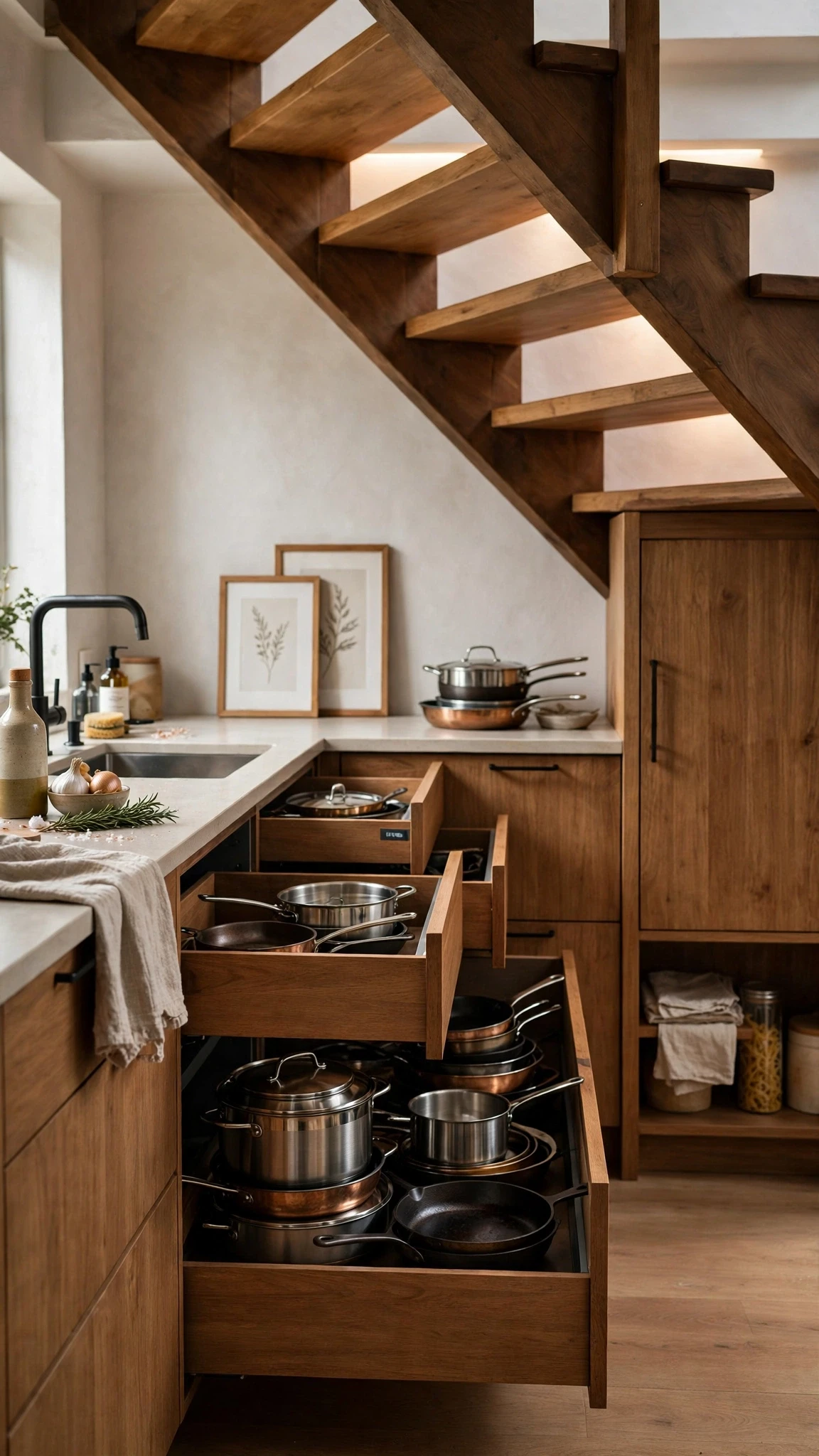
Choose full-extension slides if you can, because a drawer that only opens halfway wastes the deepest, most useful part of the slope. A simple peg board or a couple of dividers keeps the pans from sliding around, and it stops the loud clatter every time someone opens the drawer in a hurry.
3. Slim Spice Pull-Out for the Narrow End
At the low end of the slope, where the ceiling drops too low for a normal cupboard, a slim pull-out is the answer. It is only wide enough for two or three rows of jars, but that is exactly what spices need. Each jar faces forward, labelled, and you can find the cumin without pulling out twelve other jars first.

This little unit also keeps spices away from the heat of the cooker, which helps them stay fresh longer. If you cook with a lot of small bottles, oils and vinegars can live on the bottom row, and the whole pull-out can sit right beside the prep area where you actually reach for it.
4. Corner Turntable for the Awkward Angle

The corner where the stairs turn is the hardest spot in the whole kitchen, and a turntable is the simplest fix for it. A round shelf spins, bringing the back of the corner to the front, so the blender attachments and the spare baking dishes stop disappearing into the dark. You spin, you grab, you spin it back.
One turntable is enough, and it is worth spending on good bearings here. A wobbly turntable that sticks halfway round is worse than no turntable at all, and it will put you off using the corner entirely. Keep the heaviest items low on the turntable so it spins smoothly even when it is full.
5. Open Shelves for Everyday Dishes
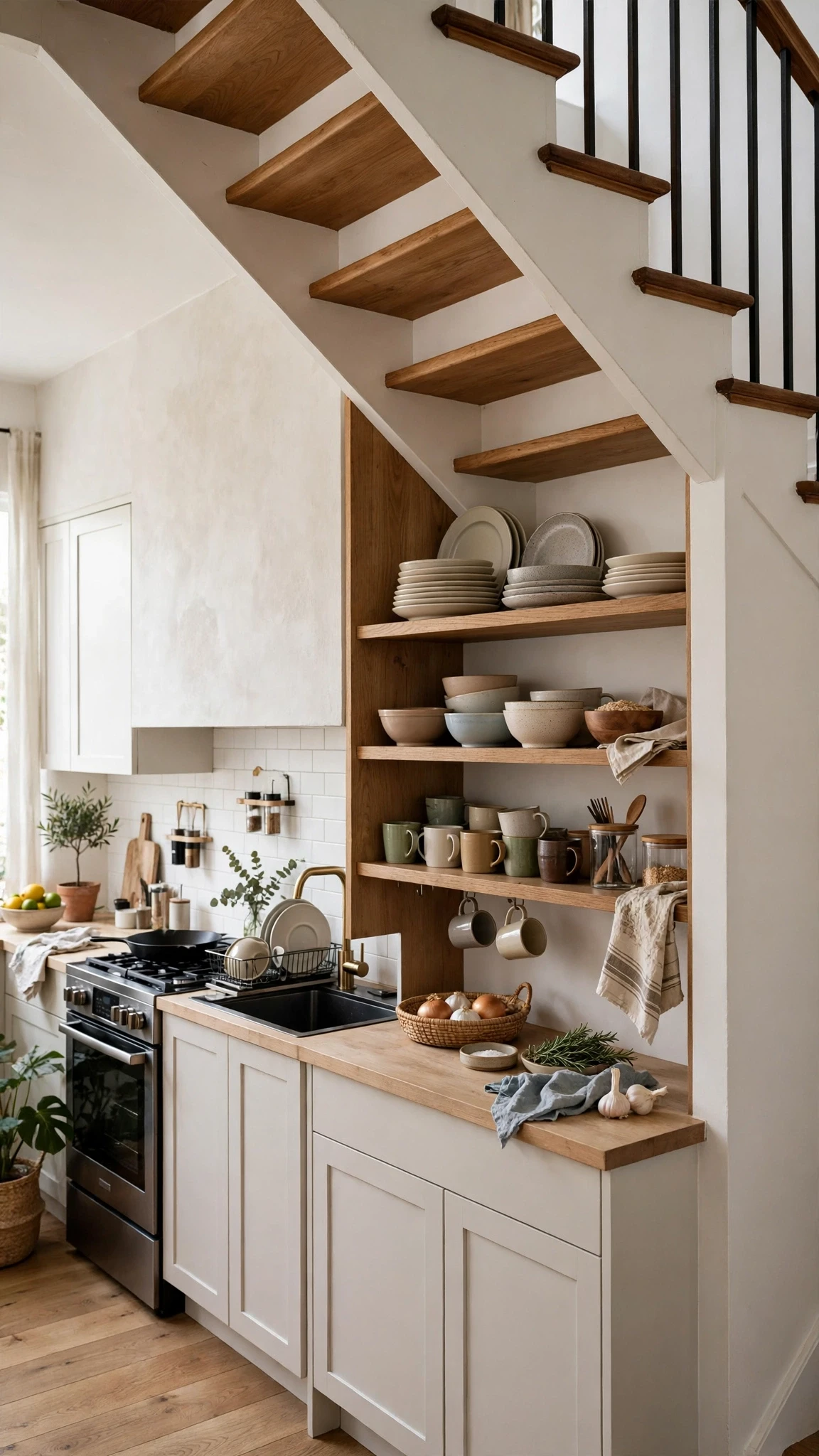
Not everything needs a door. Open shelves under the slope are perfect for the plates, bowls, and mugs you reach for every day, because there is nothing between you and them. They also break up a long run of cabinet fronts, and a few pretty bowls on display make the under-stair area look intentional rather than improvised.
The trick is to keep open shelves for things you use often, so they never gather dust. Everyday dishes, the coffee mugs, and a basket for the dish towels are ideal. Anything you use less than once a week belongs behind a door, where it stays clean until you need it.
6. Hidden Handleless Drawers That Look Like Panelling
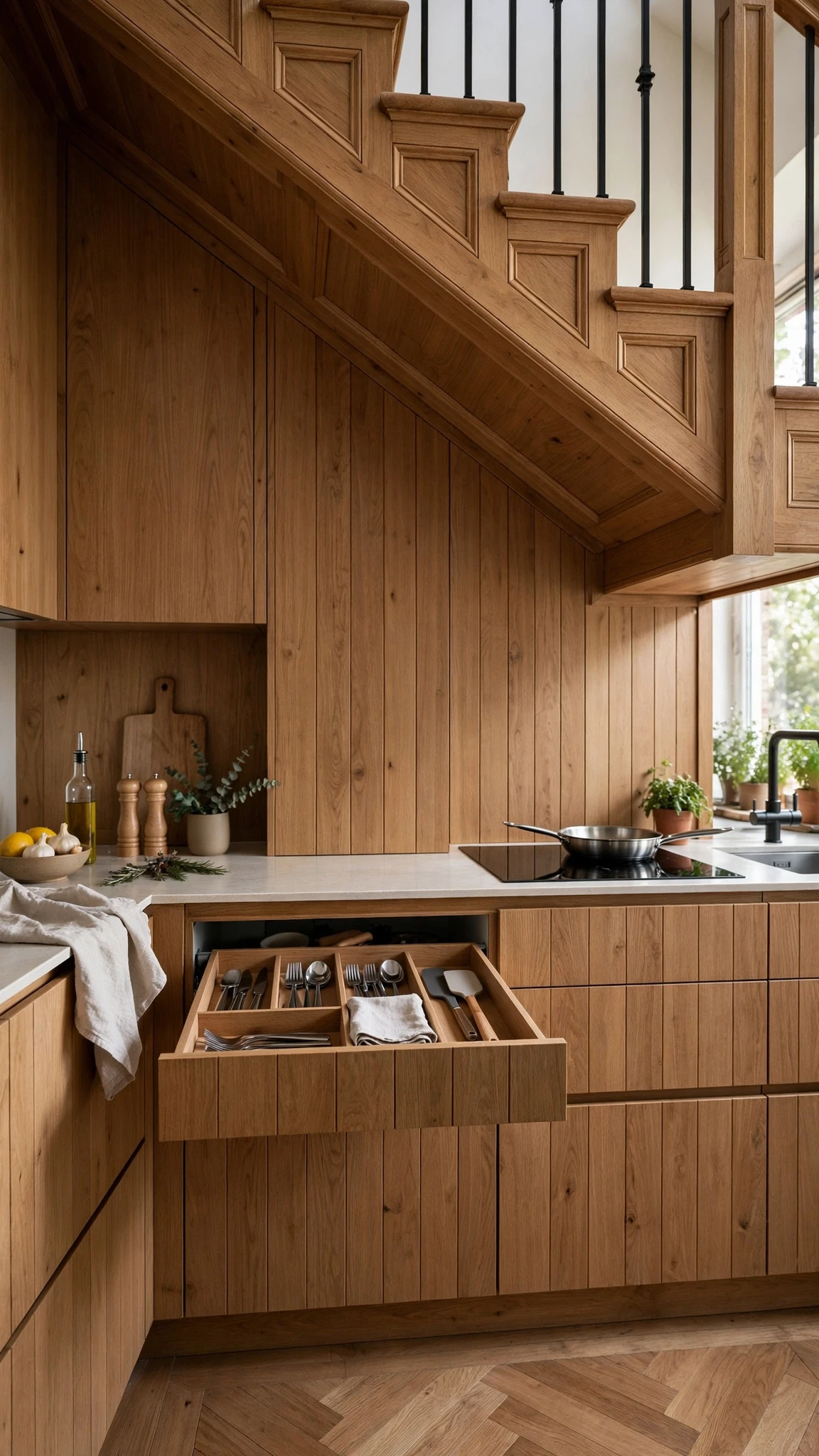
If you want the storage without the kitchen look, handleless drawers that match the wall panelling are a quiet, clever choice. Push to open, and the whole under-stair run reads as a panelled wall until someone opens it. Guests will not guess there are drawers there, and the kitchen keeps its calm, uncluttered face.
This style suits a hallway-facing staircase especially well, where the under-stair wall is visible from the living space. The fronts need to match the surrounding panels closely in colour and finish, or the trick falls apart. It costs a little more in joinery, but it buys a kitchen that looks bigger because nothing shouts storage.
7. Appliance Garage on a Sliding Tray

Stand mixers, blenders, and food processors are the worst countertop clutter because they are heavy, bulky, and used only a few times a week. An appliance garage under the stairs gives them a proper home on a sliding tray. Pull the tray out, lift the mixer straight up, and slide it back when you are done, with no dragging across the counter.
Measure your tallest appliance before you build this one, and add a few centimetres for the lid or the pouring shield. A power point inside the garage is a thoughtful extra, so you can even use a small appliance in place without carrying it to the counter at all.
8. Pull-Out Bin Station for Trash and Recycling
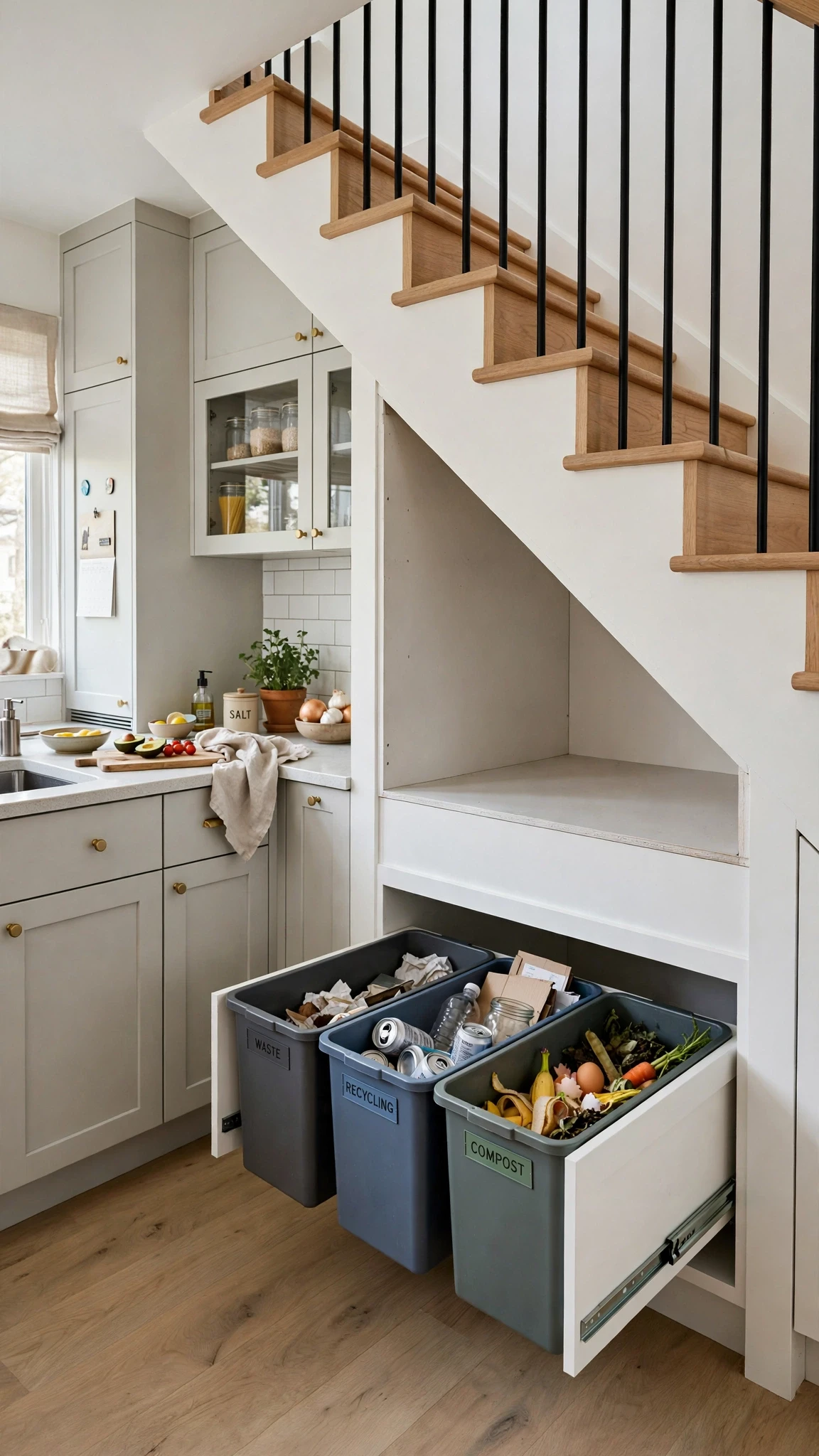
Bins on the kitchen floor are ugly and always in the way, and a pull-out bin station under the stairs solves both problems at once. Two or three bins slide out together on one frame: general waste, recycling, and compost if you use it. You sort as you cook, push it shut, and the kitchen floor stays clear.
Soft-close slides are worth it here, because a bin drawer gets opened dozens of times a day and a slamming bin gets old fast. Line the bottom of the cabinet with something wipeable, and keep a spare roll of bin bags in the drawer above so you are never caught without one mid-cooking.
9. Baking Pantry with Bins and Tray Slots
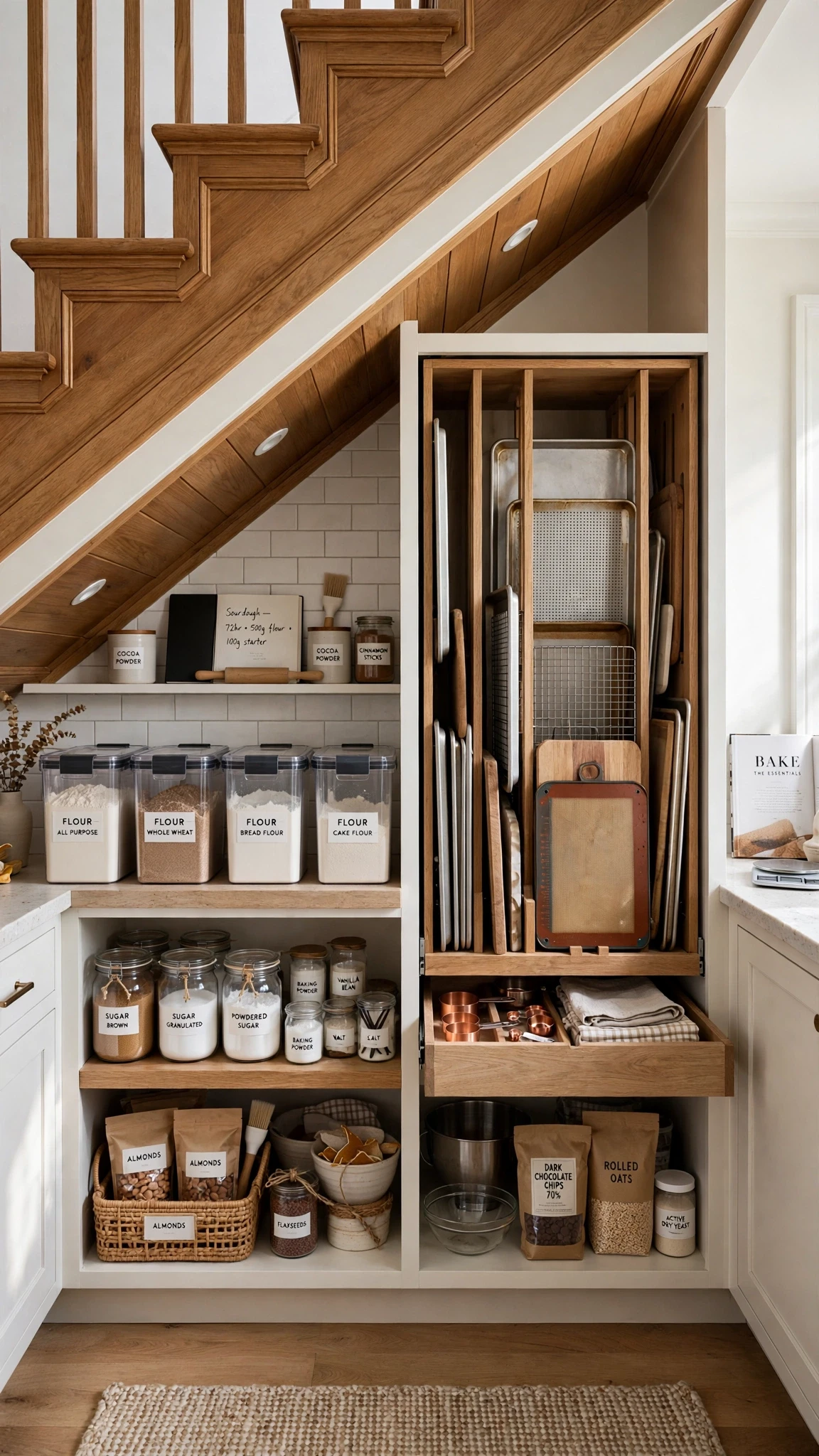
Bakers have a particular kind of clutter: bags of flour that tear, sugar that spills, and trays that lean against everything. A baking pantry under the stairs keeps it all in one place, with sealed bins for flour and sugar, a shelf for the mixing bowls, and vertical slots for the trays. Everything for a bake is in one pull-out, so you are not hunting through three cupboards before you even start.
Put this pantry near the oven if your layout allows it, because carrying a heavy bag of flour across the kitchen is nobody’s idea of fun. A small scoop kept in each bin and a label on the front saves you from opening every bin to find the plain flour.
10. Bottle Rack for the Coolest Corner
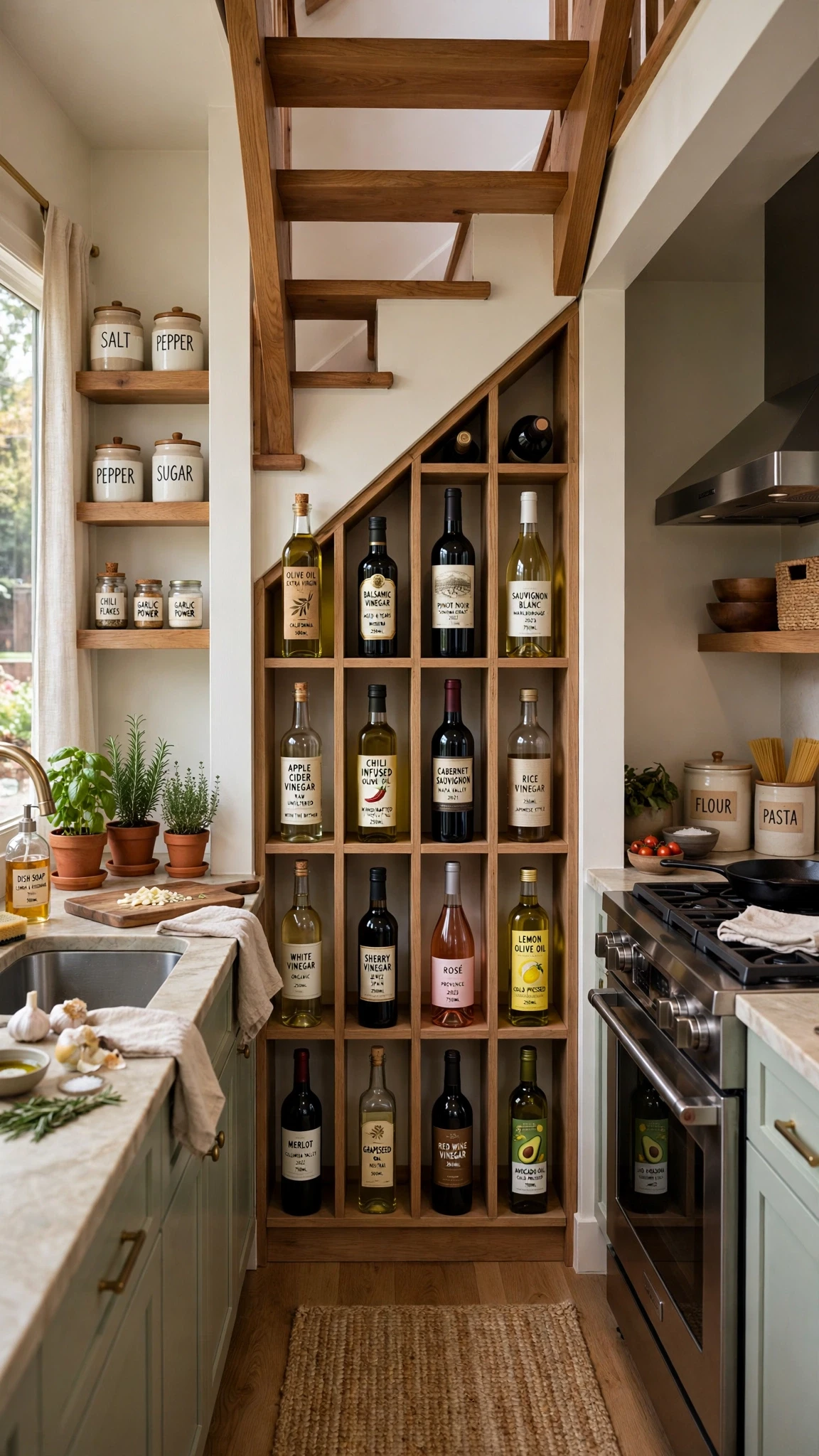
The under-stair space is often the coolest, darkest spot in the kitchen, which makes it a natural home for a bottle rack. Oils, vinegars, and a few bottles of wine sit in individual slots, secure and out of the light. They do not roll, they do not fall over, and you can see at a glance what you have.
This is a small, affordable project compared with a full pantry build, and it fills a narrow slice of slope that is too shallow for much else. Keep the rack away from the oven wall if you can, since heat is the enemy of both oil and wine, and the coolest corner is exactly where they want to be.
11. Vertical Dividers for Trays and Cutting Boards
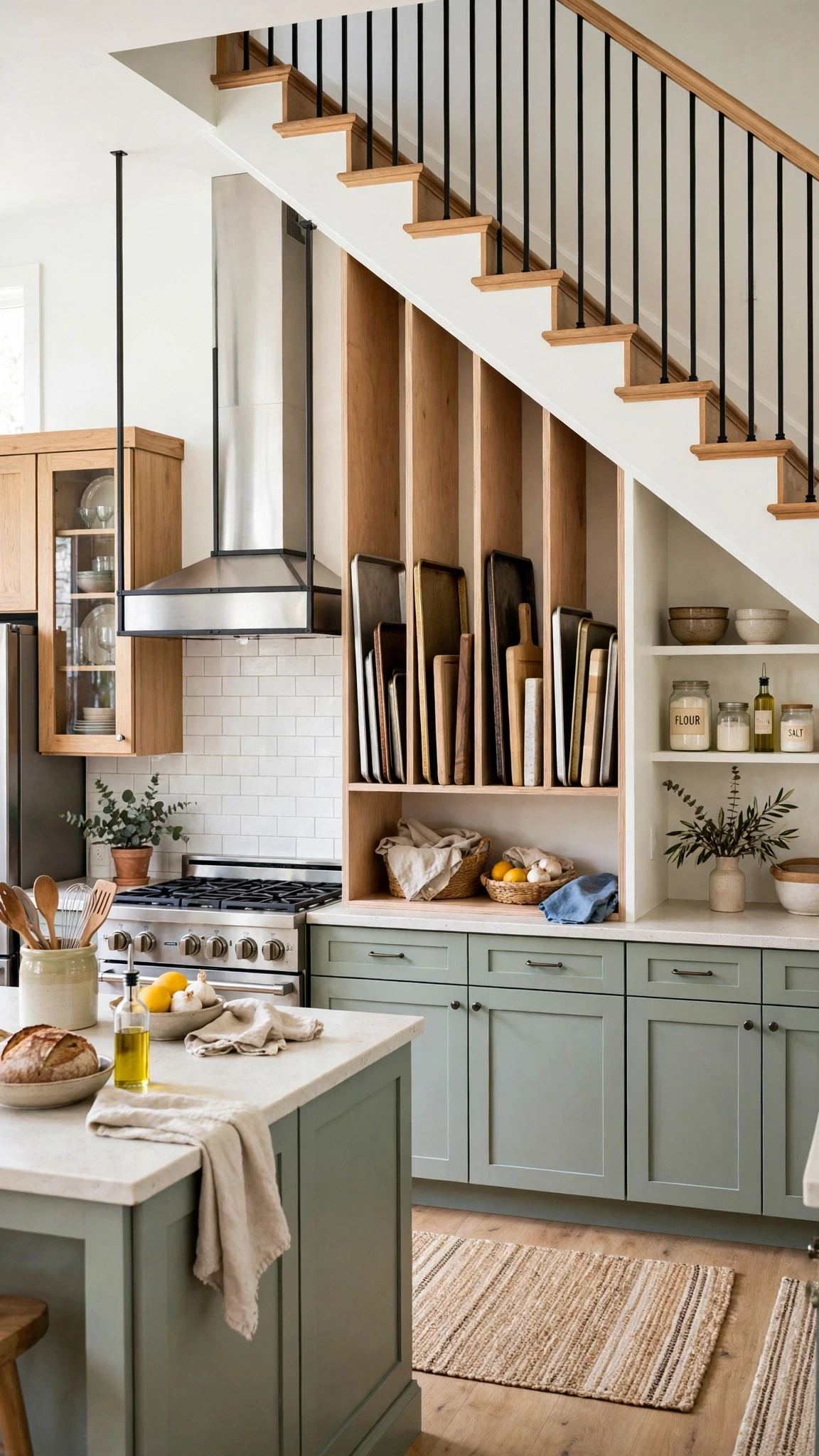
Baking trays, chopping boards, and cooling racks are flat, awkward, and impossible to stack neatly, which is why they usually end up leaning in a heap. Vertical dividers under the stairs store them upright like books on a shelf. You slide one out without disturbing the rest, and you can see every board at a glance.
This works in a surprisingly shallow cabinet, because flat things need depth more than height. Put the dividers near the oven or the prep area, and sort by size so the big roasting tray is not blocking the small chopping board you reach for every day.
12. Coffee and Breakfast Shelf Within Arm’s Reach
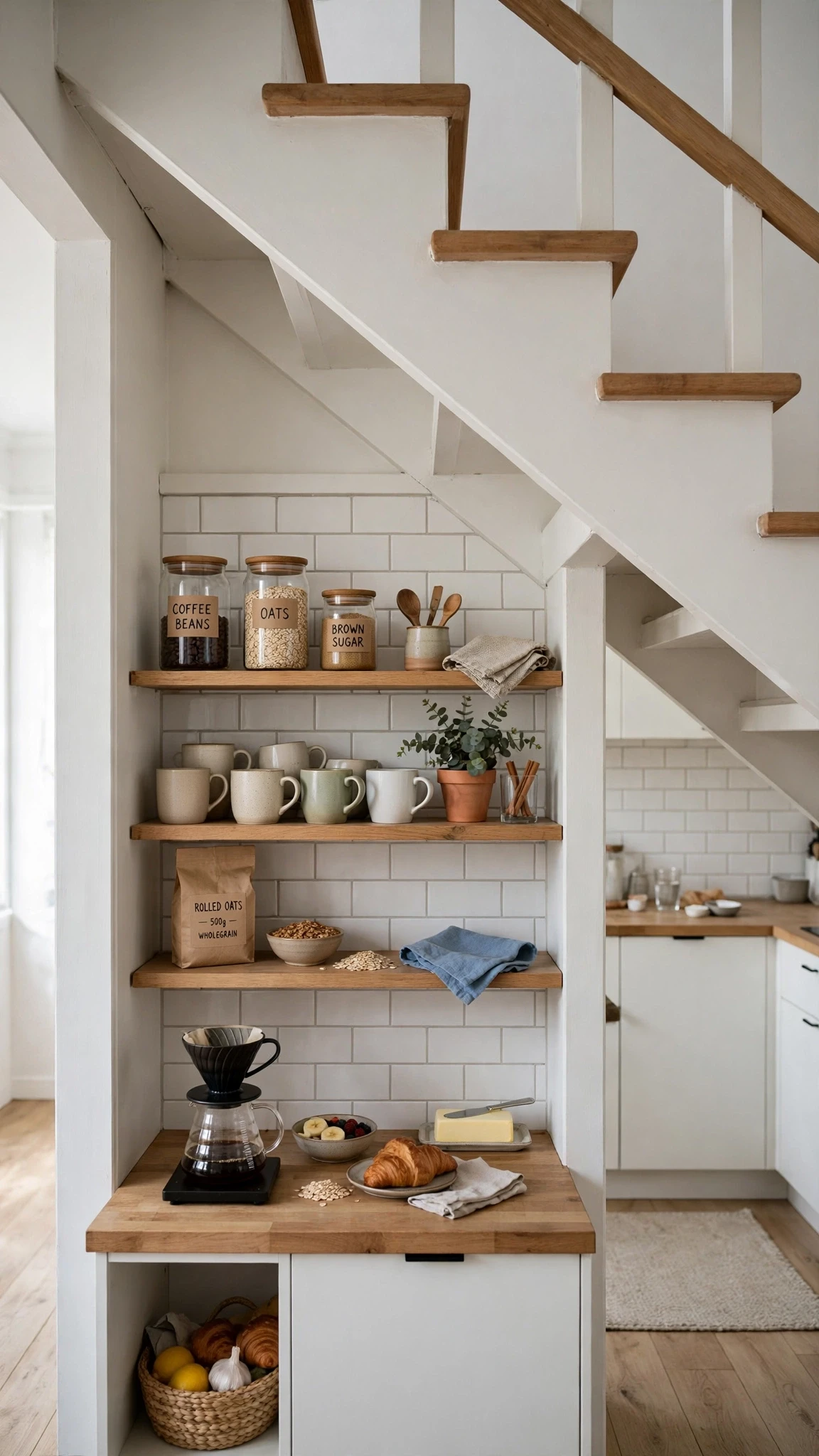
If your mornings start with coffee, a small under-stairs shelf for the coffee, the mugs, and the breakfast things earns its place fast. It sits at hand height, close to the kettle, and it gathers the morning routine into one spot instead of scattering it across three cupboards. You reach, you pour, you are done.
Keep this shelf small and deliberate, because a breakfast shelf that grows into a general dumping ground loses its point. Coffee, tea, mugs, a jar of oats, and the honey is plenty. Anything else can live in the pantry, and your mornings stay simple.
13. Adjustable-Shelf Dry Pantry for Changing Needs
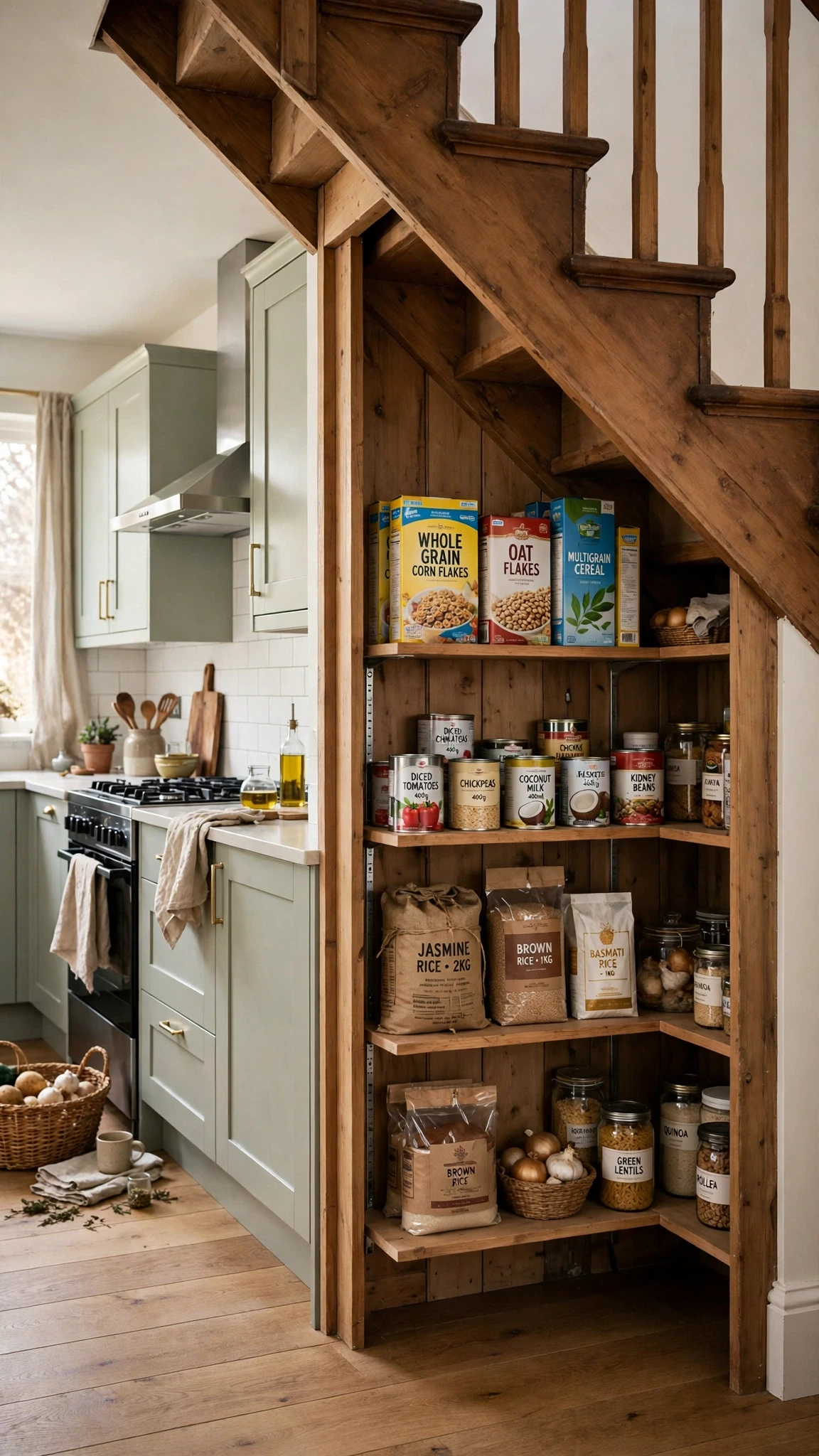
A dry pantry with adjustable shelves is the flexible friend of under-stair storage. This year it holds cereal and tinned tomatoes, next year it holds school lunch supplies and a bulk buy of rice, and the shelves move to fit. You are not locked into a layout that made sense only on the day it was built.
The key is shelves that move without tools, or with just a small clip, so you will actually adjust them instead of living with a bad layout. Leave one tall space in the pantry for the odd large item, a cereal dispenser or a tall oil bottle, and the rest can be standard shelf heights.
14. Pull-Out Baskets for Produce and Packets
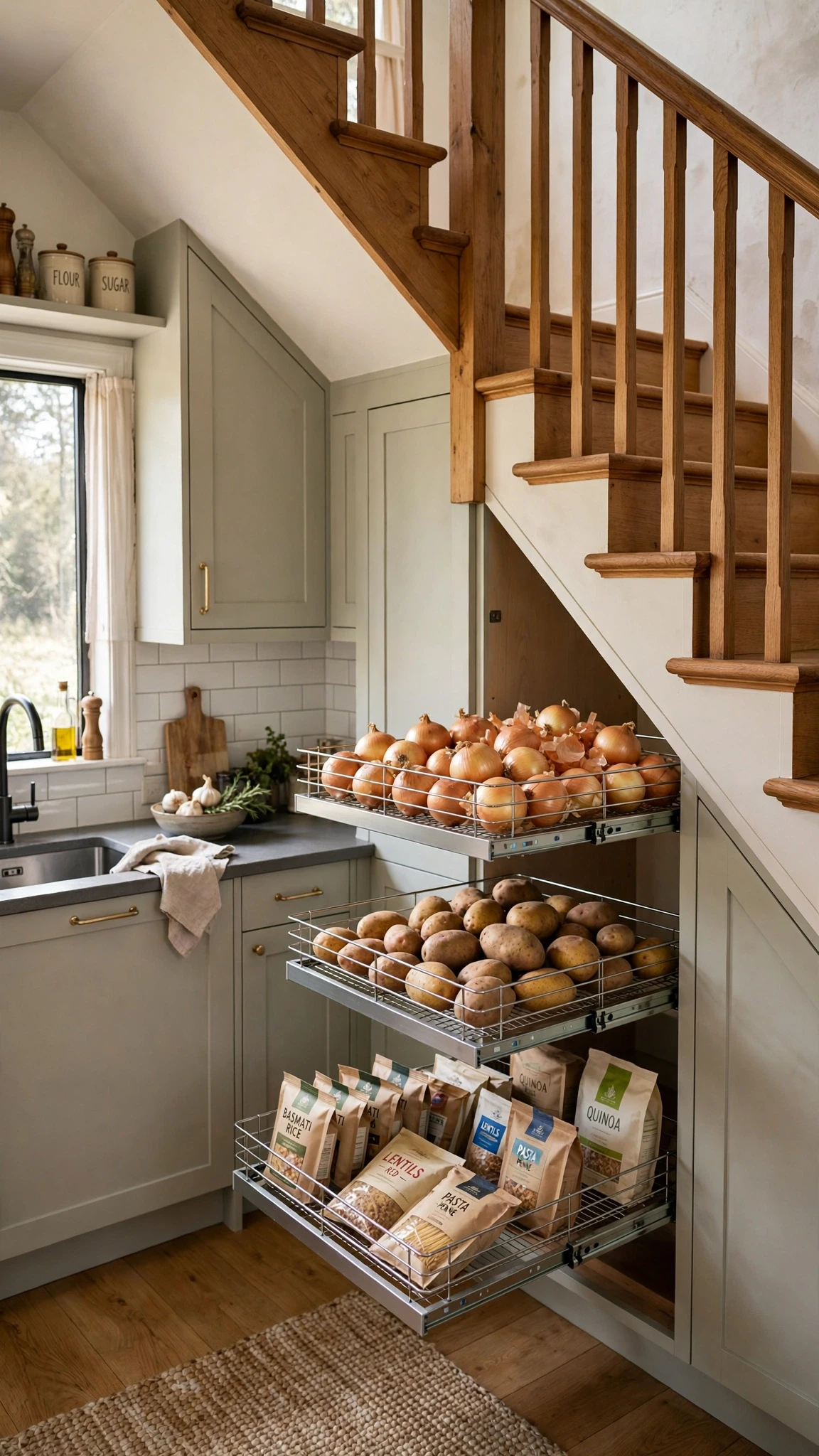
Pull-out baskets are the friendliest kind of under-stair storage, because you can lift the whole basket out, take it to the counter, and put it back. Onions, potatoes, and packets of pasta sit in open baskets where air moves around them, and you can see what is running low without emptying a cupboard.
Wire or woven baskets both work, and the choice is mostly about looks. Wire baskets are easier to wipe clean, while woven ones look softer in a farmhouse kitchen. Either way, keep one basket for the things you buy every week, so restocking becomes a quick glance rather than a full inventory.
15. Glass-Front Cabinet for Pretty Glassware
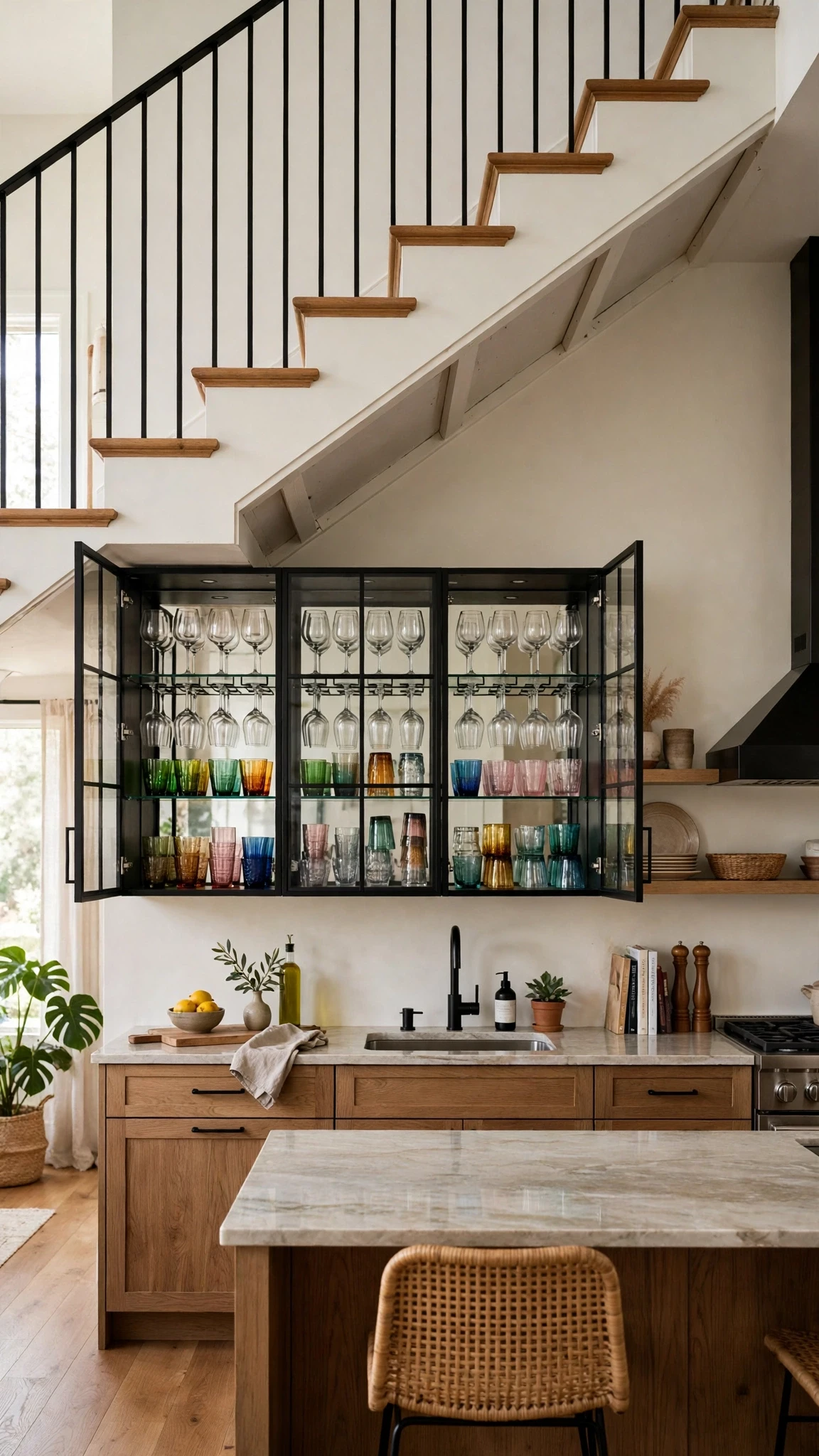
Some things deserve to be seen. A glass-front cabinet under the stairs turns your prettiest glassware, a set of wine glasses or a collection of coloured tumblers, into a display that also happens to be storage. It adds a focal point to a part of the kitchen that usually has none, and it keeps the glasses dust-free behind glass.
This cabinet works best in the tallest, most visible part of the slope, where the glass doors catch the light. Keep the display simple, with space between pieces, because a crammed glass cabinet looks like a shop window rather than a home. The everyday glasses can stay in a closed cupboard nearby.
16. Tall Hidden-Shelf Cabinet for Bulk and Seasonal Items
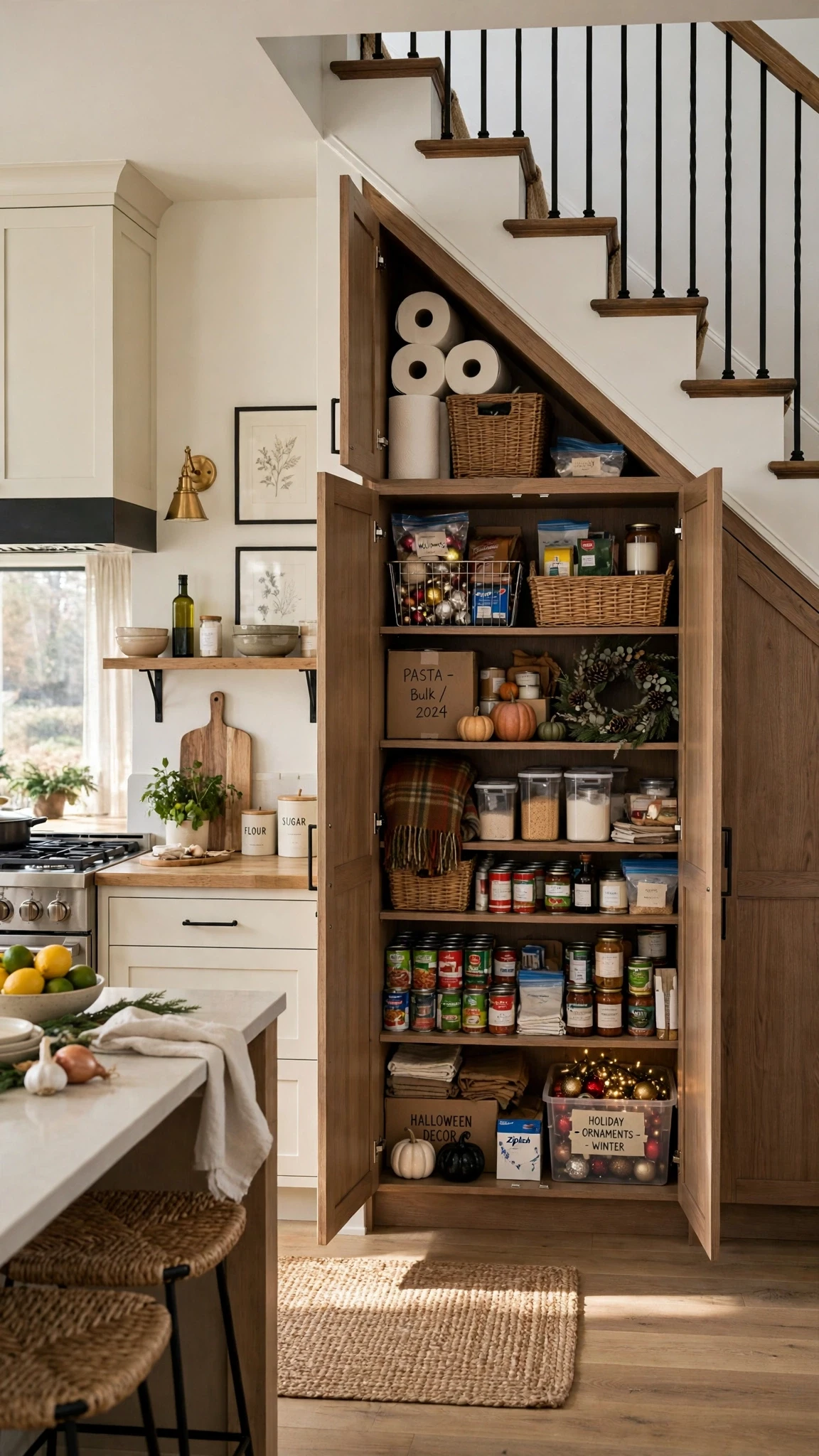
Every kitchen has things it needs but rarely uses: the turkey roaster, the bulk bag of rice, the spare slow cooker. A tall cabinet with hidden shelves under the highest part of the stairs is the right home for them. The doors close, the bulk disappears, and the kitchen looks calm again.
Label the shelves if the cabinet is deep, because a hidden cabinet that you cannot remember the contents of is just a cupboard-shaped mystery. A quick label on each shelf edge, or a note on your phone, means you will actually find the roaster in December instead of buying another one.
17. Lit Pantry with LED Strips You Can Actually See Into
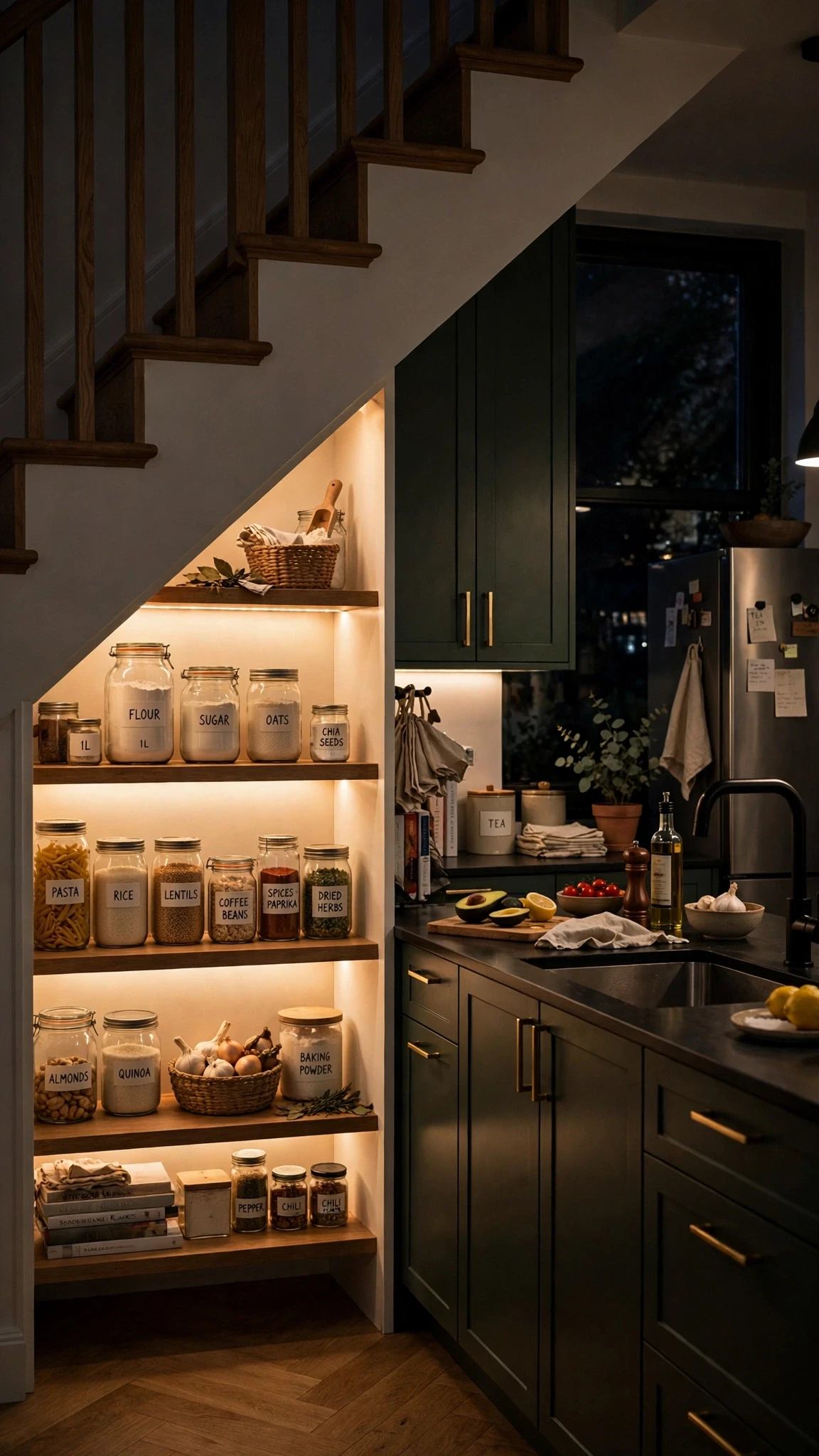
An under-stairs pantry without light is a cave, and a cave is where things go to be forgotten. LED strips along the top of each shelf change that completely. You open the door and everything is visible, the labels readable, the back of the shelf no longer a guessing game. It also makes the pantry feel like a proper part of the kitchen rather than an afterthought.
Battery strips work fine if wiring is a hassle, but a wired strip on a door switch is the version you will never have to think about. Warm white light suits a kitchen better than cold blue, and it makes food packaging look appetising rather than clinical.
18. One Combined Run: Drawers, Shelves and a Rack Together
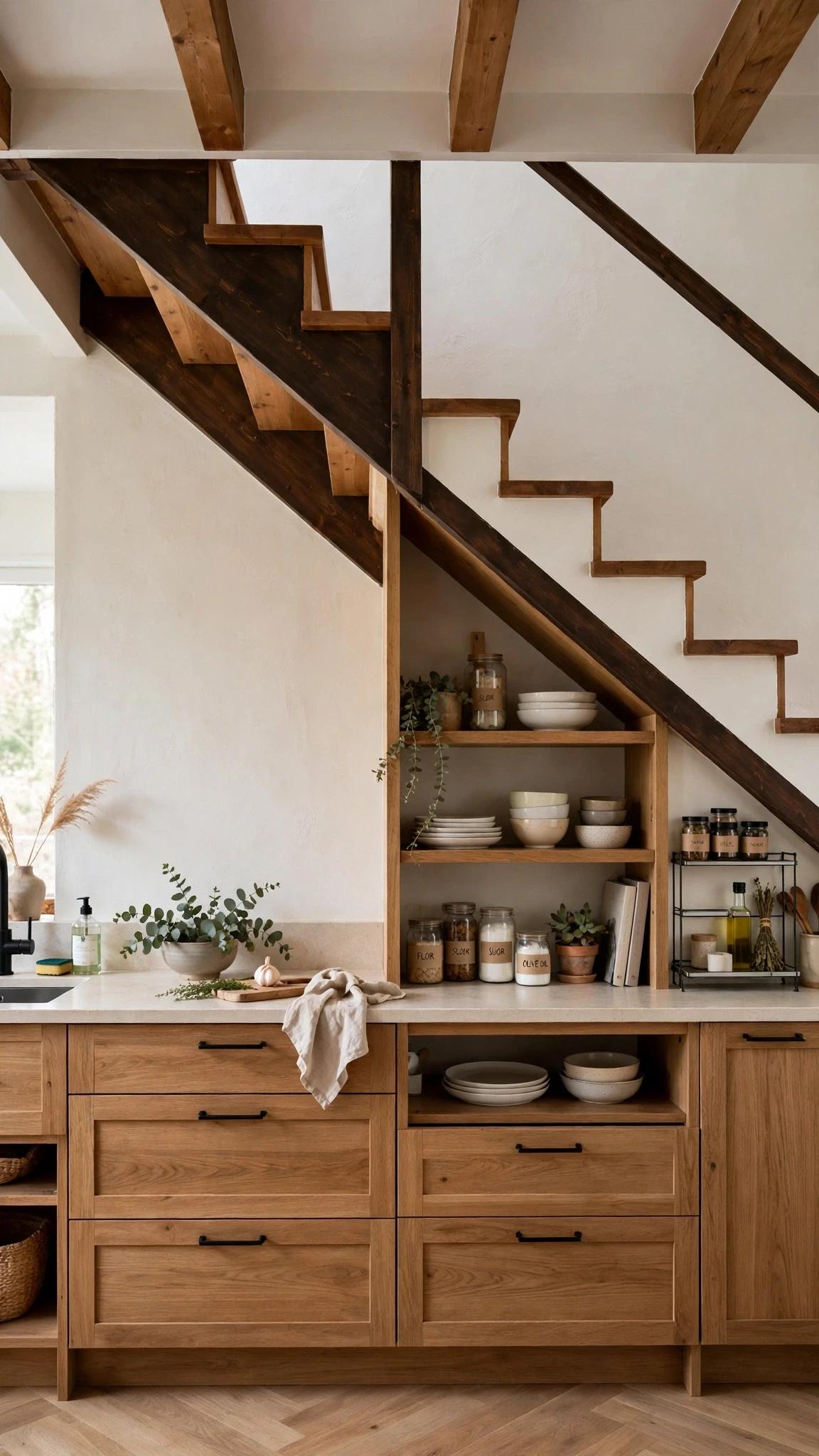
Sometimes one mechanism is not enough, and a combined run is the honest answer. A single under-stair unit can hold deep drawers at the bottom, open shelves in the middle, and a spice rack at the narrow end, all behind matching fronts. It looks like one piece of furniture, but it works like three different cabinets.
This is the best choice when your under-stair space is long rather than tall, because a long slope gives you room to mix storage types without compromise. Plan the run on paper first, zone by zone, so the drawers land where the heavy things are and the shelves land where you can reach them easily.
19. Divided Drawers for Small Utensils and Gadgets
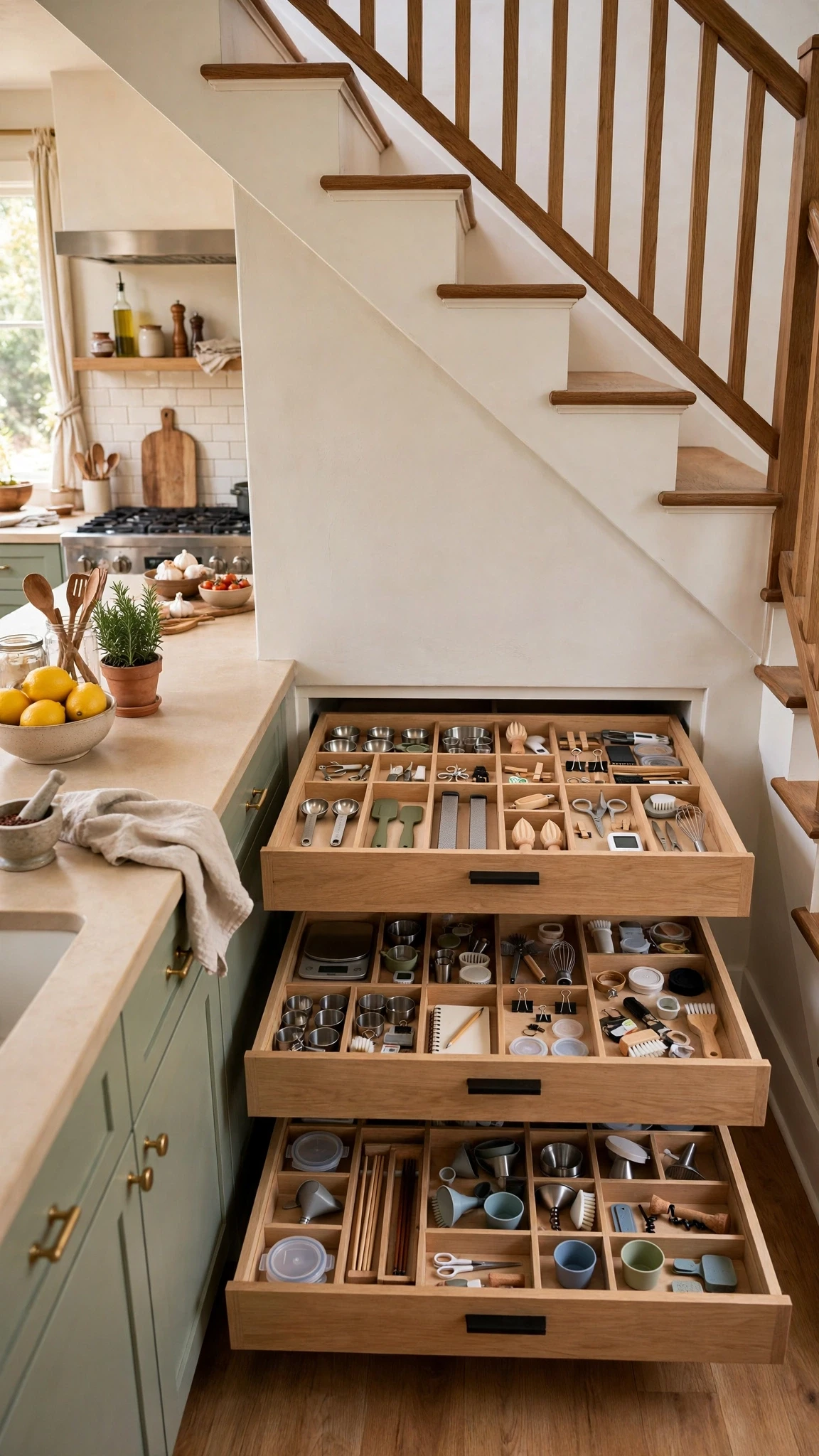
Small things cause the most kitchen chaos, because a drawer full of peelers, whisks, and gadgets with no dividers becomes a tangle within a week. Divided drawers under the stairs give every small thing a slot. The vegetable peeler has a home, the measuring spoons have a home, and you stop buying a third garlic press because you could not find the second.
Adjustable dividers are better than fixed ones here, because your collection changes and a fixed divider that fit last year’s gadgets may not fit this year’s. Keep one shallow divided drawer near the prep area for the tools you use daily, and let the deeper drawers handle the bigger items.
20. Pull-Out Pet Feeding Drawer
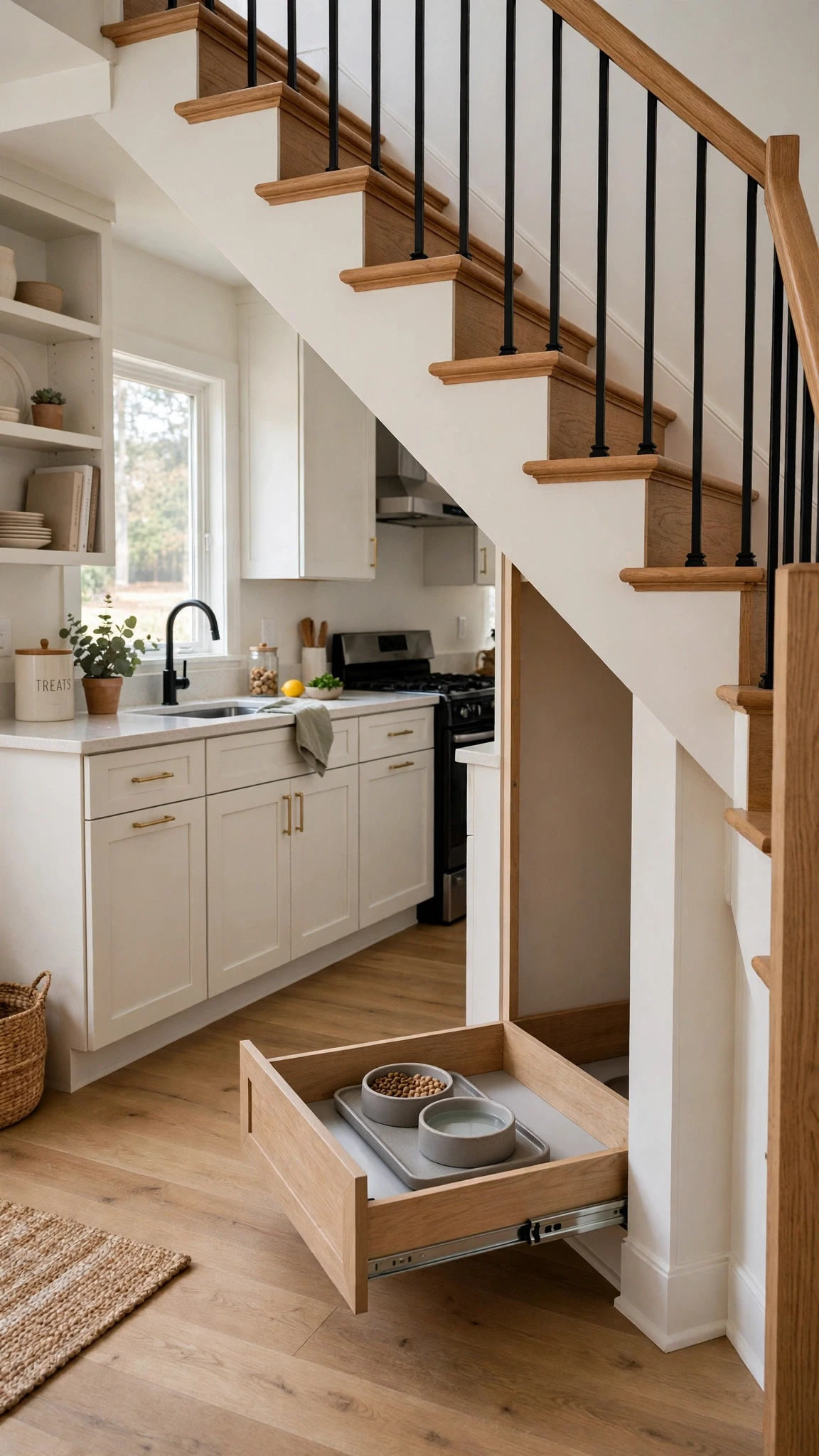
If your pets eat in the kitchen, their bowls are probably sliding across the floor and getting kicked over. A low pull-out drawer under the stairs holds the bowls in a tray that slides out at mealtimes and away afterwards. The floor stays clear, the bowls stay put, and feeding time takes ten seconds instead of a small production.
Choose a tray that lifts out for washing, because pet bowls need cleaning often and a fixed tray is a chore to scrub. A small bin for the pet food can sit in the drawer beside the bowls, so the whole feeding routine lives in one tidy place.
21. Overflow Cabinet for Rarely Used Pieces

Every kitchen eventually overflows, and an overflow cabinet under the stairs is the safety valve. It holds the second set of dishes, the fondue set from a gift, and the serving platter that comes out twice a year. These things do not need prime kitchen real estate, but they do need a home that is not the top of a wardrobe.
The rule for an overflow cabinet is simple: if you have not opened it in a year, something inside it can probably go. Check it once a year, let go of what you no longer use, and it stays a useful safety valve instead of becoming another forgotten cupboard.
Measure the Slope Before You Build Anything
The slope is the boss of this whole project, so measure it before you fall in love with any idea. Measure the height at three points: where the stairs are highest, in the middle, and at the low end. Those three numbers tell you what fits where, and they stop you from ordering a tall cabinet for a spot that is only knee-high.
Also check the door swing and the landing space in front of the stairs, because a beautiful pull-out is useless if it opens into a walkway and blocks the door. Leave room around any pipes or wires that run through the stair wall, and if you are unsure what is behind the plaster, ask someone who knows before you start cutting.
Rental-Friendly Under-Stairs Swaps
Renters can still use the under-stair space without drilling into the staircase. Freestanding baskets slide under the slope and hold pantry goods, a rolling cart tucks into the low end and pulls out when you need it, and a tension rod with hanging baskets can create a shelf where no shelf existed. None of these need permission, and all of them move with you.
The trick with rental swaps is to choose things that fit the slope rather than fighting it. Measure the low end first, then buy the basket or cart that fits under it. A cart that is too tall for the slope will live in the hallway instead of under the stairs, which defeats the whole point.
FAQs
What can I store under the stairs in a kitchen?
Almost anything dry and not too heavy for the cabinet you build, from pantry food and pots to small appliances, cleaning supplies, and recycling. Keep heat-sensitive items like oils away from the oven wall, and avoid storing anything that needs frequent lifting in the lowest, hardest-to-reach part of the slope.
How deep should under stairs drawers be?
Most under stairs drawers work well between 45 and 60 centimetres deep, which suits pots, pans, and pantry goods without becoming a dark tunnel. Full-extension slides matter more than extra depth, because a drawer you can pull fully out lets you reach the back without crouching or emptying the front first.
Can you put a pantry under the stairs?
Yes, a pantry is one of the best uses of under stairs space, especially in a kitchen with no dedicated pantry cupboard. Use pull-out shelves or a tall pull-out unit so nothing gets lost at the back, add adjustable shelves for changing needs, and keep the pantry away from damp walls or uninsulated external walls.
Do under stairs cabinets need ventilation?
Most dry storage does not need special ventilation, but airflow helps for produce baskets and any cabinet near a damp wall. Leave a small gap behind the cabinet, avoid sealing it tight against an external wall, and add a vent or a moisture-resistant backing if the stair wall ever feels damp to the touch.
How much does an under stairs kitchen cabinet cost?
Cost varies widely with size, materials, and whether you build it yourself or hire a joiner, so get at least two local quotes for a like-for-like design. Simple open shelving and baskets are the cheapest route, while a fitted run with soft-close drawers and lighting costs more but lasts longer and works better day to day.
Can I add under stairs storage without a remodel?
Yes, you can start with freestanding baskets, a rolling cart, or a tension-rod shelf that slides under the slope with no building work. These rental-friendly options give you most of the benefit of fitted storage, and you can upgrade to a fitted cabinet later once you know exactly what you want to store there.
What is the best material for under stairs kitchen cabinets?
Plywood with a durable laminate or painted finish is a strong, practical choice for most kitchens, because it resists moisture better than plain MDF and holds screws well. Solid wood looks beautiful and lasts for decades, but it costs more, while good laminate is the budget-friendly option that still wipes clean easily.
Conclusion
The space under your stairs does not need a grand remodel to become useful. It needs one honest look at what clutters your kitchen, three measurements along the slope, and one cabinet that fits the problem you actually have. Start there, and the rest of the list can wait until you know what you are missing.
Once that first cabinet is working, you will notice the difference every day: clearer counters, faster cooking, and a kitchen that feels a little bigger without a single wall moving. That is the real payoff of under stairs storage, and it is well worth the measuring tape.